In books and films, dinosaurs are often shown as sluggish, cold-blooded swamp monsters doomed to die out. Paleontologists have made revolutionary discoveries in recent decades, but many old misconceptions live on in popular culture. Part of our image of these animals still dates from the 19th century, and part was invented by Hollywood screenwriters.
Feathered fossils from China, CT scans of skulls and microscopic studies of bone have changed the picture completely. These are ten popular dinosaur myths that science has debunked.
1. Oil is made from dead dinosaurs
The idea that we drive around on liquefied Tyrannosaurus is a widespread myth, helped along by oil companies such as Sinclair that put a dinosaur in their logo. Oil and natural gas did not come from the carcasses of giant land animals. Almost all of it formed from microscopic organisms: algae, bacteria and plankton that died in ancient seas and lakes, often long before the dinosaurs.
That organic material sank to the oxygen-poor seabed, was buried under sand and mud, and over millions of years turned into hydrocarbons under heat and pressure. Coal has nothing to do with dinosaurs either: most of it formed from vast swamp forests in the Carboniferous period, more than 60 million years before the first dinosaur appeared.
2. Humans and dinosaurs lived at the same time
Cartoons such as The Flintstones loved to show cavemen riding dinosaurs, but in reality there is a gap of more than 60 million years between the two. The last non-bird dinosaurs died out 66 million years ago, at the end of the Cretaceous. The earliest human ancestors appeared in Africa about six to seven million years ago, and our own species, Homo sapiens, is only around 300,000 years old.
So-called human footprints found next to dinosaur tracks along the Paluxy River in Texas in the 1930s turned out to be eroded dinosaur tracks or deliberate fakes. No human ever came face to face with a living Triceratops.
3. All dinosaurs were gigantic
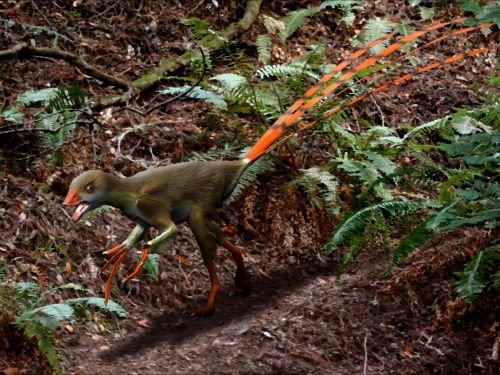
Giant sauropods such as Argentinosaurus, which may have been more than 30 meters long, capture the imagination, so many people think a dinosaur is by definition a giant. That image is partly a bias in the fossil record: massive leg bones fossilize and are found much more easily than the fragile, hollow bones of small species.
In reality, dinosaurs came in every size. Many were the size of a turkey, a dog or a sheep. Compsognathus was hardly bigger than a chicken, and the feathered Microraptor was less than a meter long, most of it tail. Being gigantic was a strategy of certain families, not a feature of all dinosaurs.
4. Pterosaurs and marine reptiles were dinosaurs
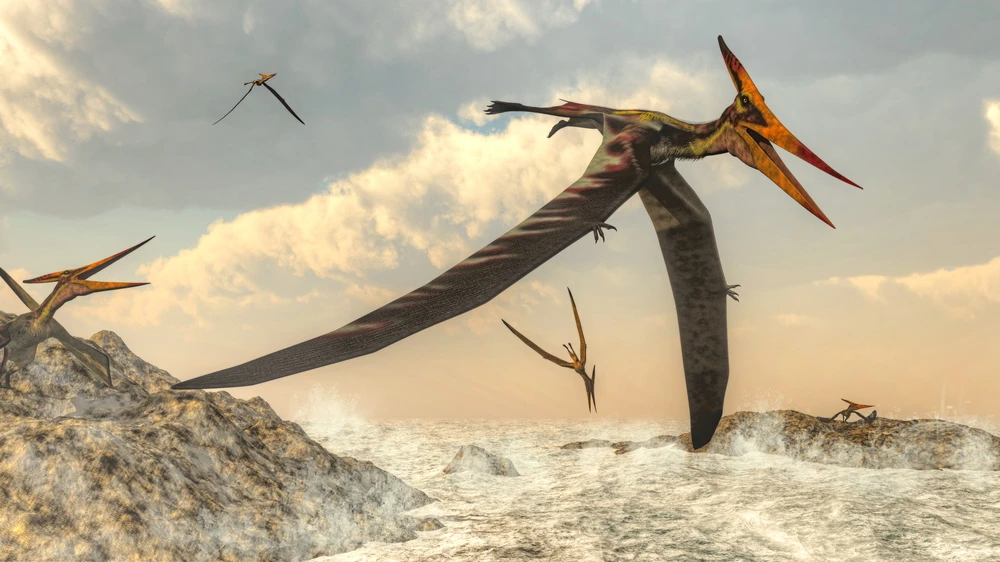
Flying pterosaurs and sea monsters such as Plesiosaurus and Mosasaurus always end up in the same toy box as the dinosaurs, but biologically they do not belong there.
Dinosaurs are defined partly by their upright stance, with the legs directly under the body, like mammals and birds. Pterosaurs were flying reptiles with their own unique anatomy, and marine reptiles descended from land animals that returned to the sea. They lived at the same time, but none of them were dinosaurs.
5. T. rex stood upright and dragged its tail
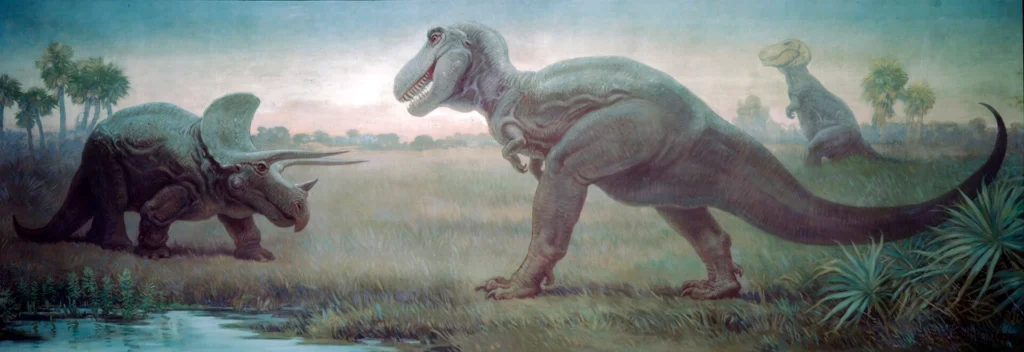
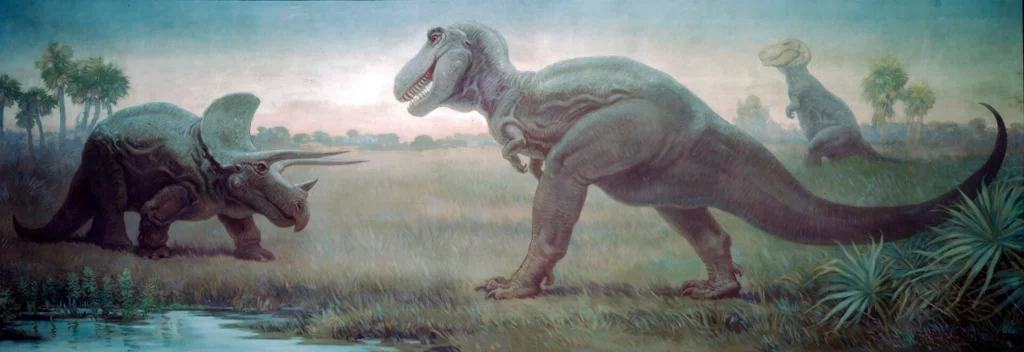
Classic museum displays and early paintings, such as those by Charles R. Knight, showed Tyrannosaurus rex standing upright like a kangaroo, with its heavy tail dragging along the ground. That image lasted for most of a century, until studies in the 1970s and 1980s showed it was anatomically impossible. A T. rex standing like that would have dislocated its own tail and hips.
We now know that the tails of large theropods were held stiff and horizontal by strong tendons. The tail acted as a counterweight to the massive head, balancing the animal over its hips. And among the thousands of fossil dinosaur trackways found worldwide, tail drag marks are extremely rare.
6. Dinosaurs were cold-blooded and slow
Until well into the 20th century, scientists saw dinosaurs as overgrown crocodiles: slow, cold-blooded animals that had to bask in the sun before they could take a few lumbering steps.
That view was overturned in the 1960s and 1970s by paleontologists such as John Ostrom and Robert Bakker, in what became known as the “Dinosaur Renaissance”. Their bones turned out to be full of blood vessels, pointing to fast growth similar to that of mammals and birds. Chemical analyses of teeth and eggshells later suggested that many species kept a high, fairly constant body temperature. Some even lived in polar regions with long, dark winters.
7. Dinosaurs looked like skin stretched over bones
In many films and museum displays, predatory dinosaurs look as if their skin was vacuum-sealed onto their skeletons. Paleoartists call this “shrink-wrapping”: every hole in the skull shows as a deep pit, the ribs stick out and the teeth are always bared like a crocodile’s.
That is very unrealistic. Artists have shown that if you reconstruct a modern hippo, cow or swan from its skeleton in the same way, you get a terrifying skeletal monster, because you leave out all the fat, muscle and soft tissue. And a 2023 study in the journal Science concluded that theropods such as T. rex probably had lizard-like lips covering their teeth when the mouth was closed.
8. T. rex cannot see you if you stand still
In one of the most famous scenes in Jurassic Park, Dr. Alan Grant tells the others to stand perfectly still, because a T. rex supposedly only sees movement. Great for suspense, but in real life that advice would probably have been fatal. Research suggests T. rex had some of the best eyesight of any dinosaur.
Paleontologist Kent Stevens studied its skull and found that its eyes faced forward, with a field of overlapping vision of about 55 degrees, wider than a modern hawk’s. That gave it excellent depth perception. Casts of its braincase also show large areas for smell and vision. Stevens estimated that its eyesight may have been many times sharper than ours.
9. All dinosaurs had scaly skin
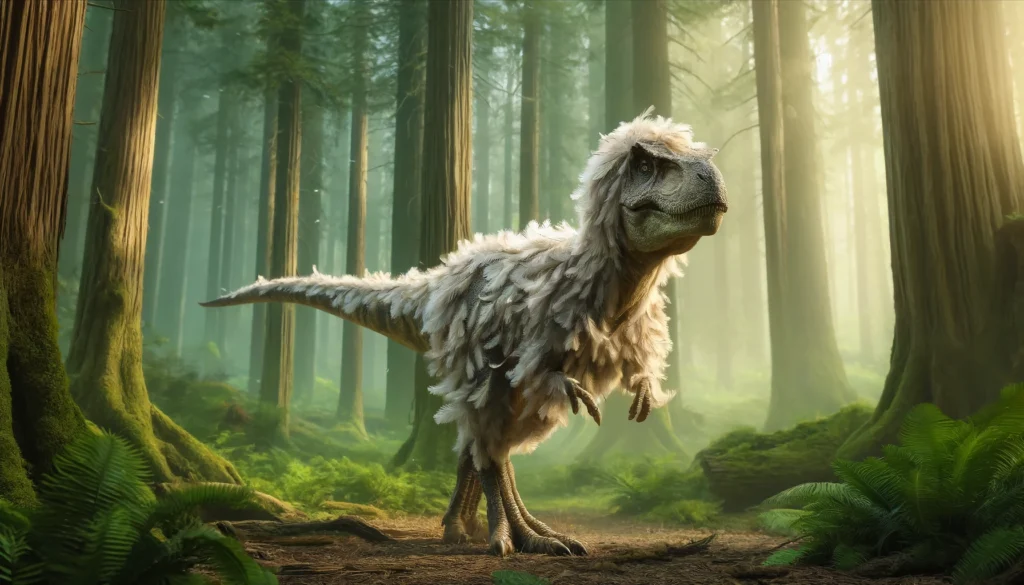
For generations, dinosaurs were painted with leathery green or gray scales like crocodiles. That changed for good in 1996, with the discovery of Sinosauropteryx in Liaoning, China: a fossil with clear traces of a coat of simple, fuzzy feathers. Since then, dozens of feathered species have been found. The nine-meter Yutyrannus was covered in feathers, and Velociraptor had quill knobs on its arm bones, showing it had real wing feathers.
Large plant-eaters such as Triceratops and the sauropods did have scales, so the truth is somewhere in between. But many meat-eaters looked more like giant birds than giant lizards.
10. All dinosaurs are extinct

The biggest dinosaur myth of all is that they all died out 66 million years ago. Look out the window at a sparrow, a duck or a pigeon, and you are looking at a living dinosaur. In modern classification, birds are not just descendants of dinosaurs; they are dinosaurs.
In the Jurassic, a group of small, two-legged theropods developed wings and lighter skeletons. When an asteroid struck what is now the Yucatán Peninsula in Mexico, all the large dinosaurs died out. But a few small, beaked bird species survived, possibly by eating seeds.
All modern birds descend from those survivors. A chicken is more closely related to T. rex than T. rex was to Stegosaurus. And with more than 10,000 living bird species, there are far more species of dinosaurs alive today than species of mammals.