
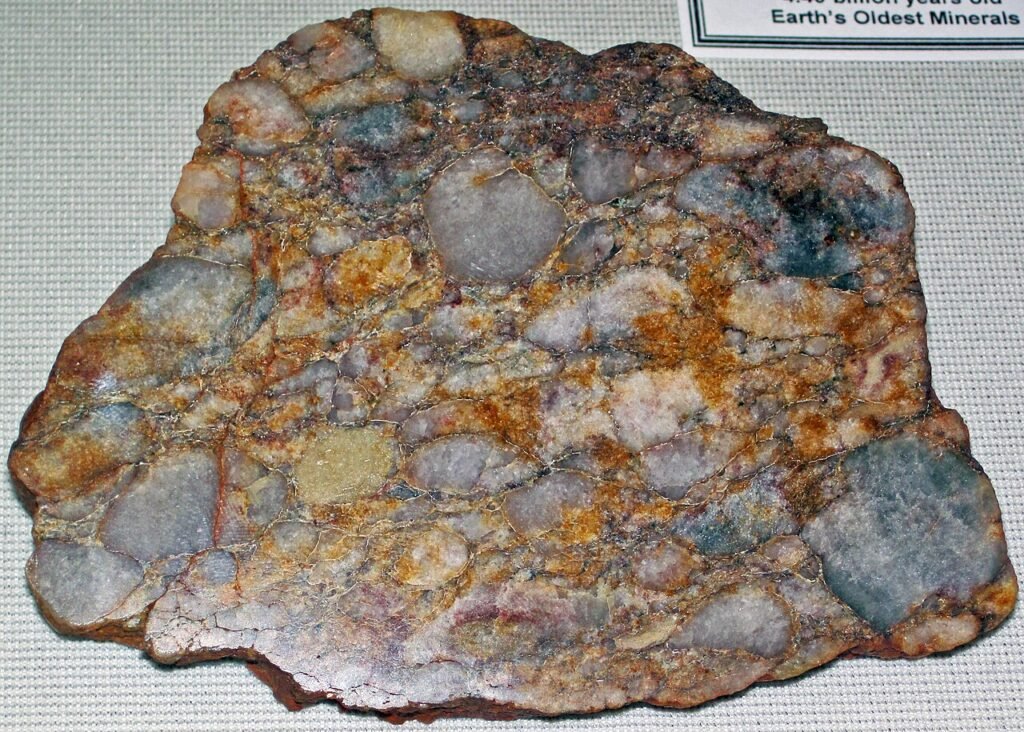
The oldest terrestrial material ever found is a zircon crystal. This microscopic grain, found in the Jack Hills in Australia, is no less than 4.4 billion years old. It proves that the Earth's crust began to form and cool very soon after the planet came into existence.
What is old? A Ming dynasty vase? A prehistoric dolmen? For geologists, that is yesterday's news. The Earth itself is about 4.5 billion years old, and the objects on this list bring us frighteningly close to that starting point.
Some of these objects simply lie on the surface, others are hidden deep underground or have literally fallen from the sky. Holding one of these items is the closest you can get to time travel.
Cast your vote - the ranking shifts live based on the votes.
Jack Hills Zircon (4.4 billion years)
The absolute winner from our own planet. In the barren landscape of Western Australia, scientists found these minuscule crystals. They are so small you can barely see them with the naked eye, but they are indestructible. They have survived volcanic eruptions, meteorite impacts and drifting continents. Researchers at the University of Wisconsin used uranium-lead dating to establish that these crystals formed when the Earth was still a glowing baby.
Murchison Meteorite (7 billion years)
Technically this object is older than the Earth itself (and even older than our sun!), but since it now lies on Earth, it makes the list. This meteorite fell in Australia in 1969. Scientists discovered that it contains 'stardust' formed by dying stars long before our solar system existed. The Field Museum in Chicago recently confirmed that some grains in this rock are no less than 7 billion years old. Oddly enough, it smells remarkably like rotting peanut butter.
Log in to post a comment.
Nuvvuagittuq Greenstone Belt (4.3 billion years)
In Quebec, Canada, you will find rocks that some geologists claim are the oldest complete pieces of the Earth's crust. Where the zircon crystals (number 1) are loose grains, this is an entire rock formation you can stand on. There is some debate about its exact age, but it is certain that here you are walking on the primeval ground of our planet.
Log in to post a comment.
Acasta Gneiss (4.03 billion years)
If you want certainty, head to the Northwest Territories in Canada. The Acasta Gneiss is widely accepted as the oldest intact rock formation in the world exposed at the surface. It is a metamorphic rock, meaning it was formed by enormous pressure and heat. It is bizarre to think this rock was already there when no form of life was possible yet.
Log in to post a comment.
Isua Greenstone Belt (3.7 billion years)
In Greenland lies a rock formation that goes one step further. It is not just old rock; scientists believe they have found the oldest traces of life here. The rocks contain chemical imprints suggesting microbes were already active 3.7 billion years ago. If this is true, life on Earth began much earlier than we thought.
Log in to post a comment.
Stromatolites (3.5 billion years)
These are the oldest fossils you can recognize with the naked eye. You can still find living ones in Shark Bay (Australia), but the fossilized versions are billions of years old. They are not bones but layers of rock built up by cyanobacteria. These single-celled organisms are the heroes of our history: they started pumping oxygen into the atmosphere, which is why we can breathe today.
Log in to post a comment.
Ancient Water from Timmins (2.6 billion years)
In a mine in Ontario, Canada, miners found a water reservoir 2.4 kilometers deep that had been isolated there for billions of years. The water has never seen sunlight and has had no contact with the outside world. The scientists who found it even tasted it! Geologist Barbara Sherwood Lollar described the taste as “extremely salty and bitter”, much saltier than seawater, due to the minerals that have dissolved in it over the ages.
Log in to post a comment.
Makhonjwa Mountains (3.6 billion years)
In South Africa and eSwatini you will find these mountains, also known as the “Genesis of Life”. They contain some of the best-preserved ancient rocks in the world. What makes this place unique is that the rock layers show evidence of a massive meteorite impact that shook the Earth billions of years ago.
Log in to post a comment.
Lomekwi Tools (3.3 million years)
We make a huge leap in time, from geology to “made objects”. Until recently, we thought humanity only started using tools 2.5 million years ago. But in Kenya, stones were found that had clearly been shaped for hitting and cutting, and which according to the Smithsonian Institution are 3.3 million years old. That is shocking, because it means they were made before modern humans (Homo sapiens) even existed.
Log in to post a comment.
Oldest Ice (2.7 million years)
Ice seems fleeting, but in Antarctica it can stay put for a long time. Researchers drill cylinders (ice cores) from the depths to study the climate of the past. In the so-called 'Blue Ice' areas, ice nearly 3 million years old has been found. In the air bubbles trapped in this ice, we can literally breathe the air that existed in the time of the first early humans.
Log in to post a comment.
Missing an item in this list?
Log in or create a free account to add an item yourself.
Log in / create account
Log in to post a comment.