Leonardo da Vinci (1452 to 1519) is best known for the Mona Lisa and The Last Supper. But he spent much of his working life as an engineer, architect and inventor for powerful patrons in Milan, Venice and France.
In thousands of notebook pages, written in his famous mirror writing, he designed machines that were centuries ahead of their time. Because almost none of it was published, most of his ideas stayed hidden for hundreds of years. These are his ten most ingenious inventions, counting down to the most astonishing.
10. Ball bearings
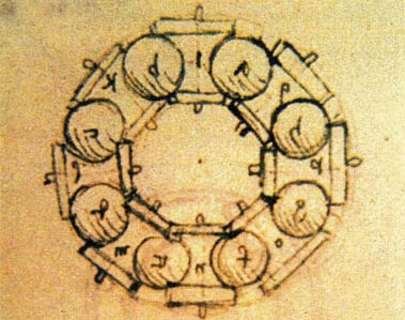
Leonardo understood earlier than most that friction is the great enemy of machines. Around 1497, he sketched a ball bearing in which the balls were held in a ring-shaped cage, so they could roll freely without rubbing against each other and getting stuck.
That simple principle is now at the heart of almost everything that spins, from bicycle wheels and car engines to wind turbines and jet engines.
9. Parachute
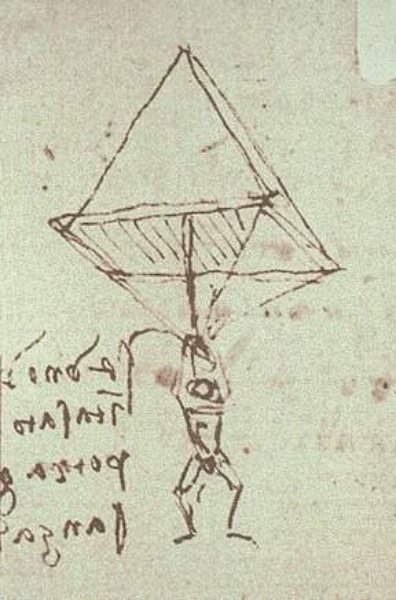
Around 1485, Leonardo sketched a pyramid-shaped parachute made of linen stretched over a wooden frame about seven meters wide. He wrote that with it, a man could throw himself down from any height without injury.
For centuries, people assumed it would never work. Then, in 2000, British skydiver Adrian Nicholas built a replica using only materials available in Leonardo’s time and jumped with it from about 3,000 meters over South Africa. The descent was smooth, and Nicholas said it was even more comfortable than a modern parachute. He did release it and use a regular parachute for the final part, as the heavy wooden frame could have crushed him on landing.
8. Ornithopter
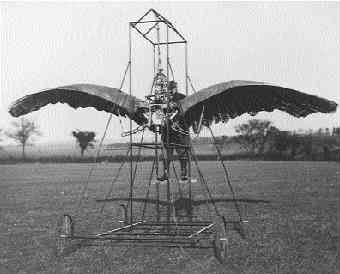
Fascinated by the flight of birds and bats, Leonardo filled entire notebooks with studies of wings. He designed the ornithopter, a flying machine with huge flapping wings, powered by a pilot lying face down and working pedals and levers.
It could never have flown: human muscles are simply too weak. But his careful observations of bird flight were remarkably accurate, and he was one of the first people to study flight scientifically.
7. Multi-barrel gun
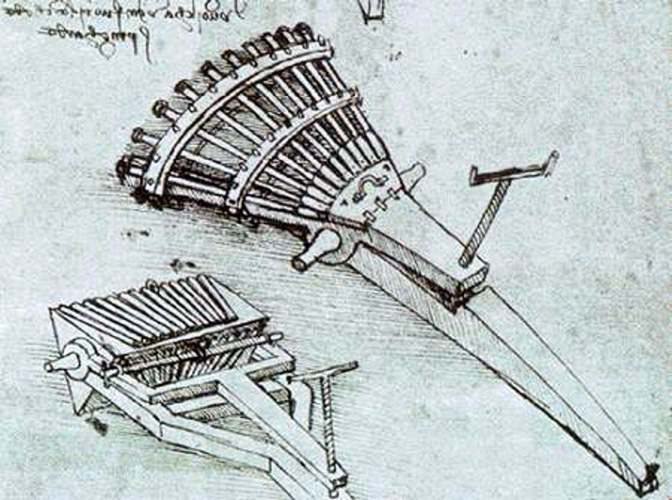
In Leonardo’s time, a cannon needed minutes to cool down and reload after every shot. He designed a gun with 33 barrels in three rows of eleven, mounted on a rotating triangular platform.
While one row fired, the second could cool and the third could be reloaded. By turning the platform, the gun could keep firing almost without pause, an early ancestor of the machine gun.
6. Diving suit
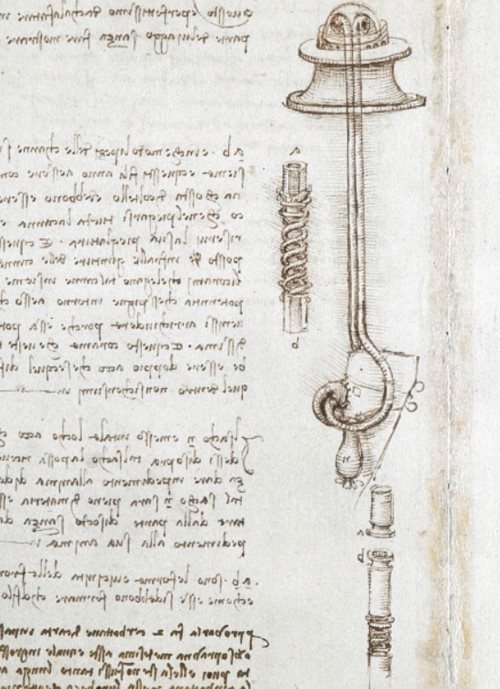
Around 1500, when Venice feared an attack by the Ottoman fleet, Leonardo designed a leather diving suit that would let saboteurs walk underwater and drill holes in enemy ships.
The suit had a mask with glass eyeholes and breathing tubes made of cane, held above the surface by a floating cork bell. It also included a bag to let the diver urinate, so he could stay underwater for longer.
5. Armored tank
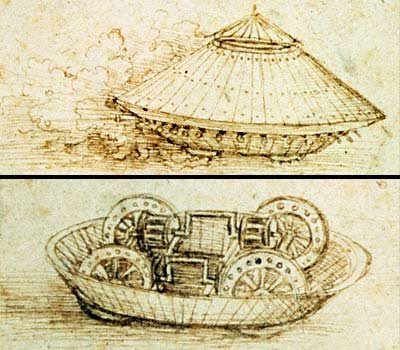
In 1487, while working for the Duke of Milan, Leonardo designed an armored fighting vehicle shaped like a turtle shell, with sloping sides to deflect cannonballs and light cannons pointing in every direction.
Inside, eight men would turn cranks to move the wheels. Oddly, the drawing contains a basic error: the gears would make the front and rear wheels turn in opposite directions, so the vehicle could not move. Many historians suspect Leonardo did this on purpose, perhaps so that the design would be useless if it fell into enemy hands.
4. Self-propelled cart
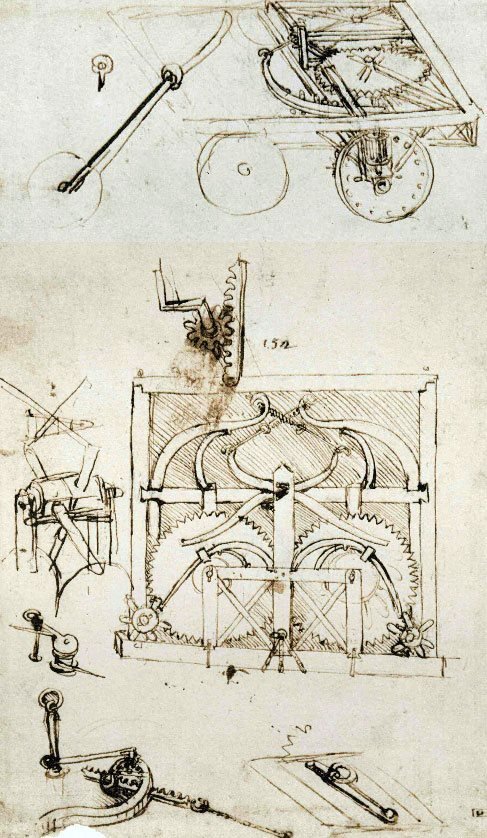
Leonardo’s self-propelled cart, sketched around 1478, is often called the first car, although it was meant for theater shows, not transport. The three-wheeled wooden cart was powered by coiled springs, like a clockwork toy.
Its most impressive feature was a programmable steering system: by placing wooden blocks between the gears, it could follow a route set in advance. In 2004, the Museo Galileo in Florence built a working model based on his drawings, and it worked exactly as planned. Some call it the first robot vehicle.
3. The ideal city
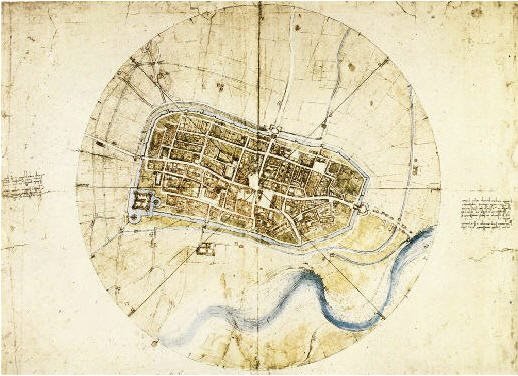
After a plague killed a huge part of Milan’s population in the 1480s, Leonardo realized that crowded medieval streets and open sewers spread disease. He designed a city on two levels.
The upper level, with wide streets and squares, was for pedestrians and fresh air. The lower level had canals for goods, waste and sewage. It was never built, but many of his ideas resurfaced centuries later in modern urban planning.
2. Aerial screw
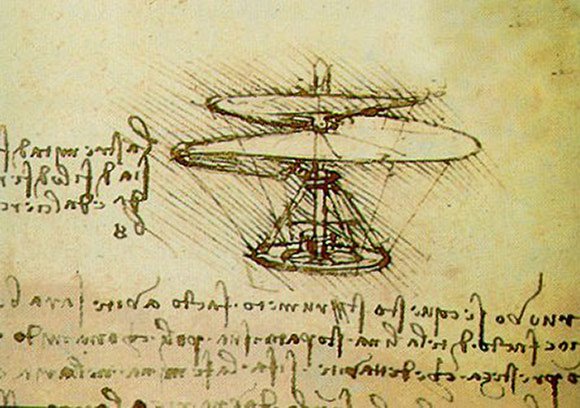
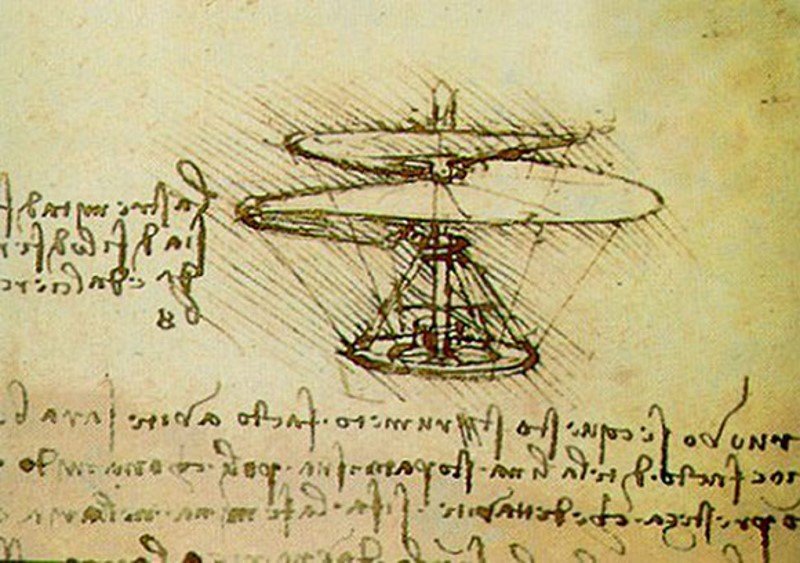
Around 1489, Leonardo drew an aerial screw: a spiral of stiffened linen about five meters across, mounted on a wooden mast. He reasoned that air has density, so a screw spinning fast enough should “drill” its way upward, like a corkscrew into a cork.
Four men were supposed to turn it by walking around a platform. It could never have lifted off, but it is often seen as a distant ancestor of the helicopter.
1. The robot knight
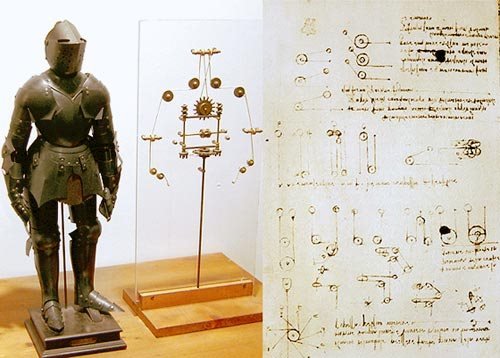
Around 1495, Leonardo designed a mechanical knight in a suit of armor for the court of Milan. Inside, a system of pulleys, cables and gears allowed it to sit up, wave its arms, move its head and open its visor.
His sketches were rediscovered in the 1950s. In 2002, roboticist Mark Rosheim built a working model based on them, and it functioned as Leonardo intended. Rosheim later said Leonardo’s designs inspired some of his own work on robots, including projects for NASA.