Mercury is the smallest planet in the solar system and the closest to the Sun. It is hard to spot from Earth, because it always hugs the Sun’s glare, and only two spacecraft have ever studied it up close.
That does not make it boring. Mercury has some of the most extreme conditions of any planet, and a few genuine mysteries. Here are ten facts about the little planet nearest the Sun.
1. It is named after the speedy messenger of the gods

In Roman mythology, Mercury was the messenger of the gods, famous for his winged sandals and his speed. It is the perfect name for a planet that races around the Sun faster than any other.
Mercury travels at an average of about 47 kilometers per second, much faster than Earth’s 30.
2. A year lasts just 88 days
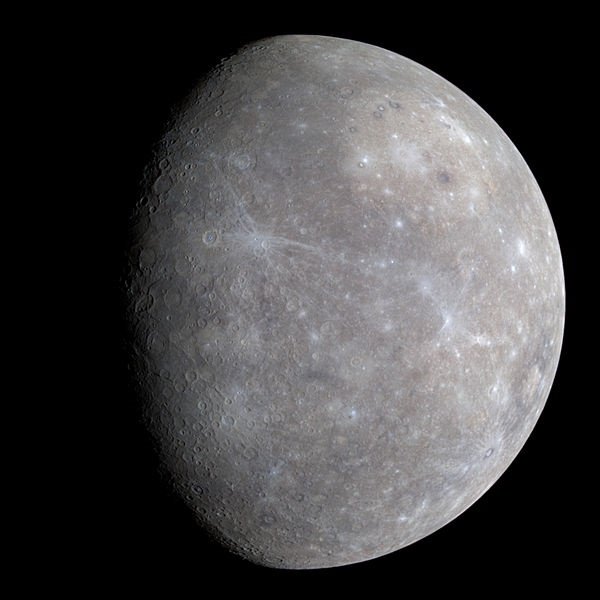
Because it is so close to the Sun, an average of about 58 million kilometers, and moves so fast, Mercury completes an orbit in just 88 Earth days.
That means if you lived on Mercury, you would celebrate a birthday more than four times every Earth year.
3. But a day lasts 176 Earth days
Mercury spins slowly on its axis, exactly three times for every two trips around the Sun. The combination of that slow spin and its fast orbit makes for a very long day.
From sunrise to sunrise, one day on Mercury lasts 176 Earth days, twice as long as its year. Standing on the surface, you would have to wait about three months for the Sun to set.
4. It swings between scorching heat and deep freeze
During the long day, temperatures on the surface climb to about 430 degrees Celsius. At night, they plunge to around minus 180.
That is the biggest temperature swing of any planet in the solar system. Mercury has almost no atmosphere to hold on to the heat, so it escapes into space as soon as the Sun goes down.
5. There is ice near the Sun
It sounds impossible, but the planet closest to the Sun has water ice. Because Mercury barely tilts on its axis, the floors of some craters near its poles never see sunlight at all.
NASA’s MESSENGER spacecraft confirmed that these permanently shadowed craters contain water ice, along with dark organic material, frozen at temperatures well below minus 170 degrees.
6. Its surface is covered in scars
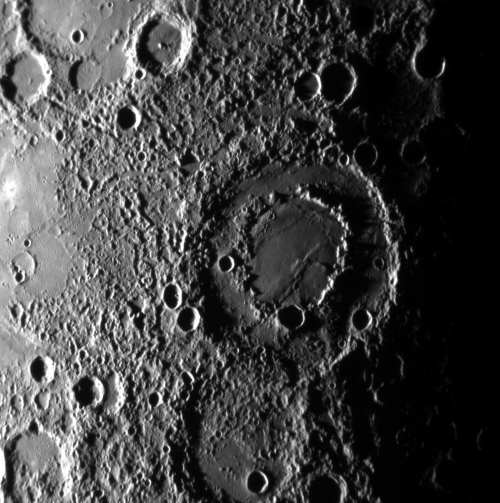
With no thick atmosphere to burn up incoming rocks, Mercury has been pounded by asteroids and comets for billions of years. At first glance, its cratered surface looks a lot like our Moon.
The biggest scar is the Caloris Basin, about 1,550 kilometers across. The impact that created it was so violent that it seems to have jumbled the terrain on the exact opposite side of the planet.
7. Its gravity is the same as on Mars
Mercury is much smaller than Mars, yet if you stood on either planet you would weigh exactly the same: about 38 percent of your weight on Earth.
The reason is what is inside. Mercury is much denser than Mars, so it packs a lot more mass into a smaller ball, and the two effects cancel each other out.
8. It is mostly made of metal
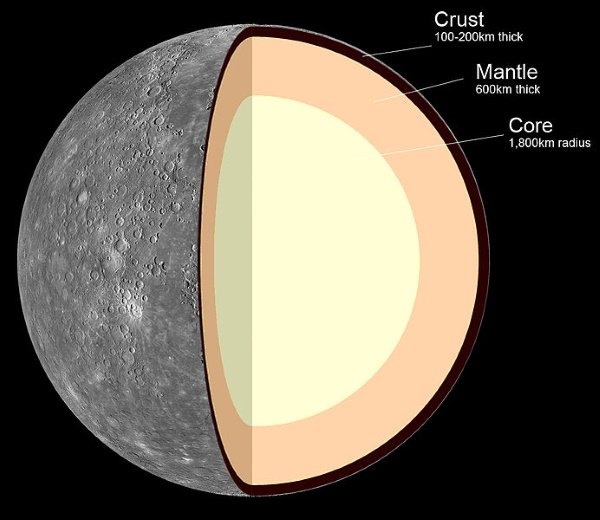
Mercury has an enormous iron core that takes up about 85 percent of its radius. In comparison, Earth’s core reaches only about halfway to the surface.
Why Mercury is so metal-heavy is still a mystery. One theory is that a giant collision early in its history stripped away much of its rocky outer layers, leaving the iron heart behind.
9. The planet is shrinking
As Mercury’s huge iron core slowly cools, it contracts, and the whole planet shrinks with it. Its surface has wrinkled like the skin of a drying apple, forming long cliffs that can be hundreds of kilometers long and up to several kilometers high.
Scientists estimate that Mercury’s radius has shrunk by up to about 7 kilometers over its history, and research suggests it is still contracting today.
10. A new mission is just arriving
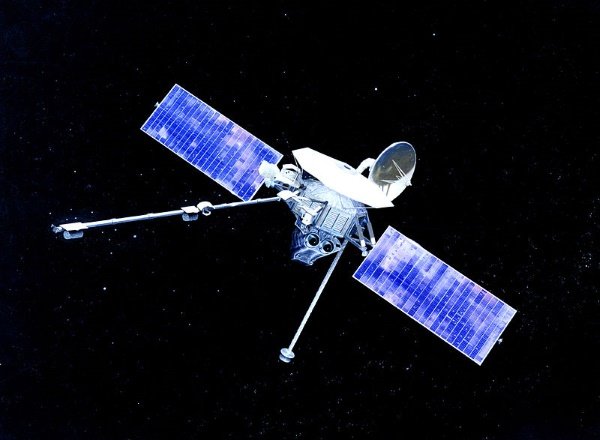
Reaching Mercury is surprisingly hard. A spacecraft heading toward the Sun speeds up constantly, so it needs to brake enormously to enter orbit. Only NASA’s Mariner 10 in the 1970s and MESSENGER, which orbited from 2011 to 2015, have studied it up close.
The European-Japanese mission BepiColombo, launched in 2018, has used one flyby of Earth, two of Venus and six of Mercury itself to slow down. After a journey of eight years, it was scheduled to enter orbit around Mercury on November 21, 2026, with full science operations planned from spring 2027.