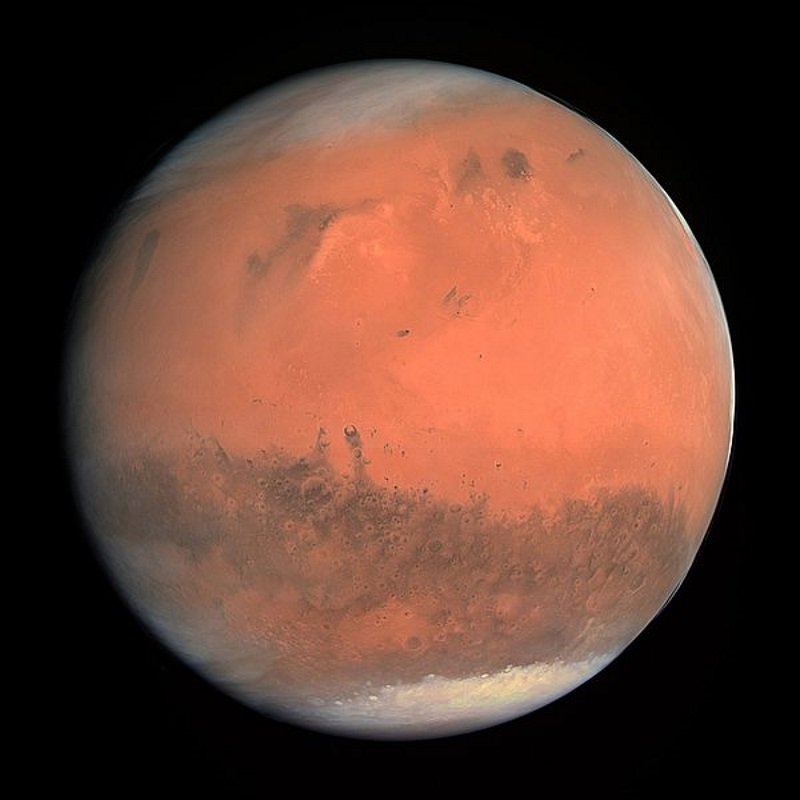
No planet has captured our imagination quite like Mars. It is close enough to study in detail, similar enough to Earth to make us wonder, and strange enough to keep surprising scientists after more than half a century of missions.
Seen from Earth it glows a deep red, but up close the surface looks more like butterscotch or rust. At 6,779 kilometers across, Mars is about half the width of our planet. What it lacks in size, it makes up for with some of the most spectacular features in the solar system.
1. It is named after the god of war
That blood-red glow in the night sky made ancient skywatchers think of battle. The Greeks named the planet after Ares, their god of war, and the Romans swapped in their own war god, Mars. The name stuck.
Other cultures saw the same color. Chinese astronomers called it the “fire star”, and Egyptian astronomers knew it as “the red one”.
2. People have watched it for thousands of years

Mars is bright enough to see without a telescope, so it has been tracked since antiquity. Ancient Egyptian astronomers recorded it as a wandering star, and they had noticed its odd habit of seeming to move backward across the sky for a while, an effect now known as retrograde motion.
Galileo was the first to point a telescope at Mars, in 1610. Later astronomers spotted its polar ice caps and worked out the length of its day. Since the 1960s, a long line of spacecraft, landers and rovers has followed, from Viking to Curiosity and Perseverance.
3. It has two potato-shaped moons
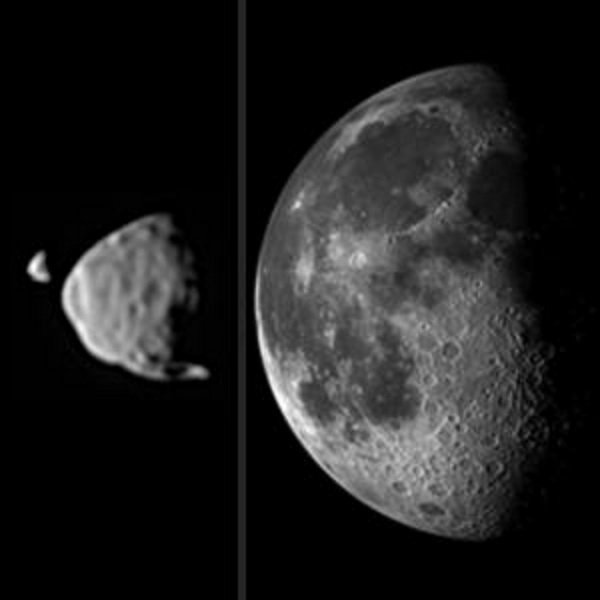
Mars has two moons, Phobos and Deimos, named after the Greek words for fear and terror. They look nothing like our round Moon. Both are small and lumpy, more like oversized potatoes, and many scientists think they may be captured asteroids or debris from an ancient impact.
Phobos is doomed. It orbits so close to Mars that it is slowly spiraling inward, and in roughly 30 to 50 million years it will either crash into the planet or be torn apart into a ring.
4. A familiar day, but a very long year
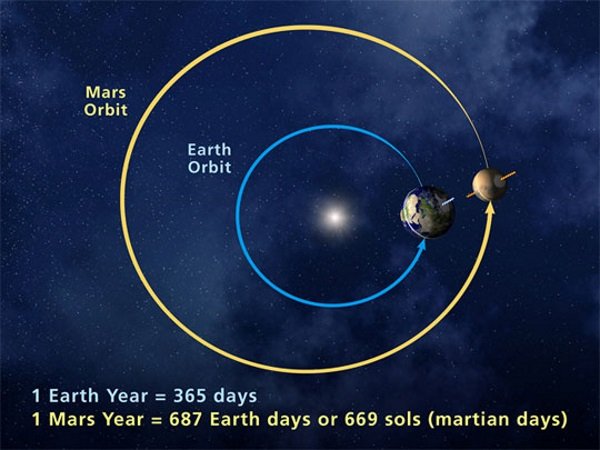
A day on Mars, called a sol, lasts 24 hours and 37 minutes, almost the same as ours. Mars is also tilted on its axis much like Earth, so it has seasons.
The year is another story. Mars takes 687 Earth days to circle the Sun, so each season lasts about twice as long. And the weather is extreme: winter nights near the poles can drop below minus 120 degrees Celsius, while a summer afternoon at the equator can reach a pleasant 20 degrees.
5. Getting there takes about seven months
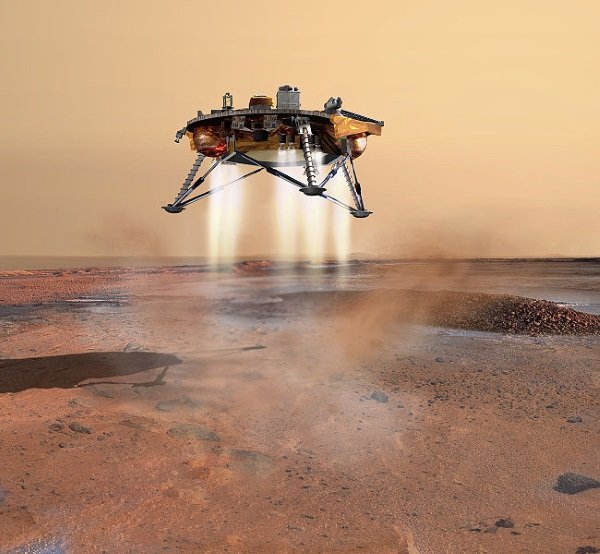
Mars may be our neighbor, but it is not a quick trip. A typical mission takes around seven months to arrive, longer than most astronauts spend on the International Space Station.
Launches are timed for when Earth and Mars line up favorably, which happens roughly every 26 months. In 2003, the two planets came within about 56 million kilometers of each other, the closest approach in nearly 60,000 years.
6. It has the biggest dust storms in the solar system
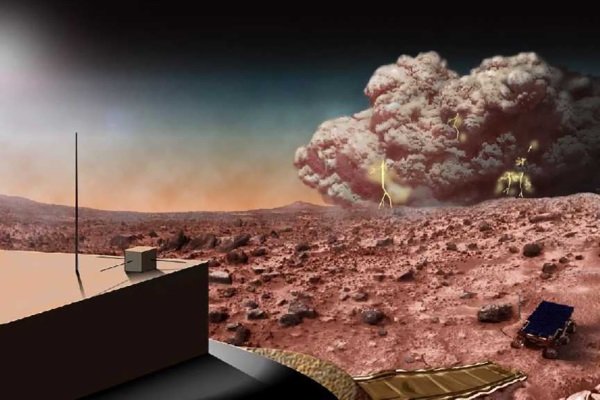
Every few years, local dust storms on Mars grow and merge until they wrap the entire planet in a haze that can last for months, blocking out much of the sunlight.
These storms have real consequences. A planet-wide storm in 2018 covered the solar panels of NASA’s Opportunity rover, which had been exploring Mars for almost 15 years. It never woke up again.
7. Pieces of Mars have landed on Earth
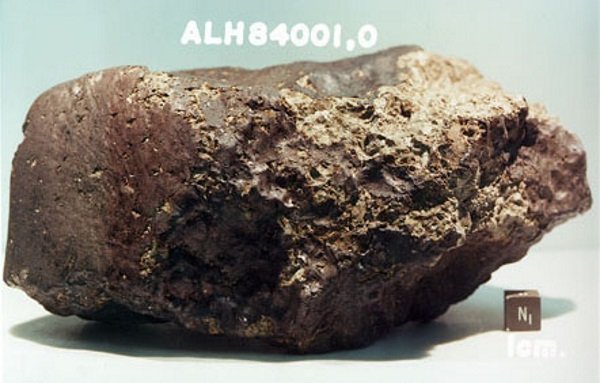
It sounds like science fiction, but we already have bits of Mars here. When large asteroids hit Mars, they can blast rocks into space with enough force to escape the planet’s gravity. Some of those rocks drift through space for millions of years before falling to Earth as meteorites.
Several hundred Martian meteorites have been identified so far. Scientists know where they came from because tiny bubbles of gas trapped inside match the Martian atmosphere measured by spacecraft.
8. It is home to the tallest volcano in the solar system
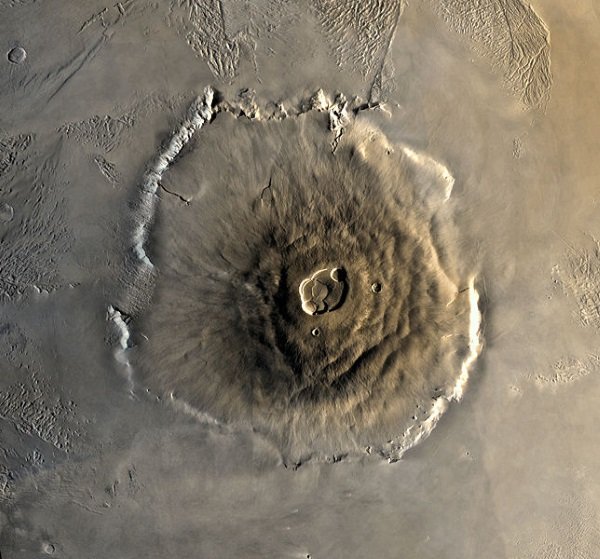
Olympus Mons rises about 22 kilometers above its surroundings, roughly two and a half times the height of Mount Everest. Its base is about the size of Poland.
It could grow so large because Mars has no moving tectonic plates. On Earth, a hotspot creates a chain of volcanoes as the crust slides over it, like Hawaii. On Mars, the lava kept piling up in the same place for millions of years.
9. Mars once had rivers, lakes and maybe an ocean
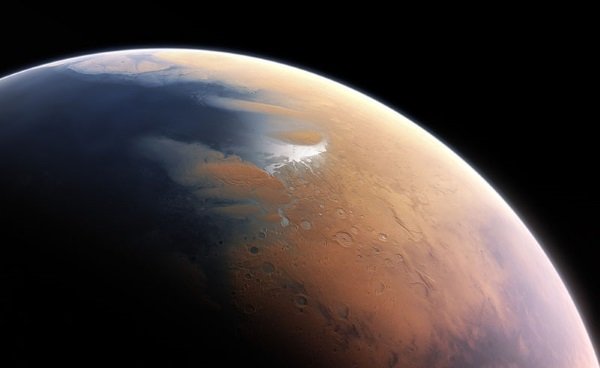
Today Mars is a cold, dry desert, but it was not always like this. Spacecraft have photographed dried-up river valleys, deltas and ancient lakebeds, and rovers have found rocks that could only have formed in water.
Many scientists think a large ocean may once have covered much of the northern hemisphere, billions of years ago. As Mars lost most of its atmosphere to space, the water froze, sank underground or escaped.
10. There is still water on Mars
The water did not all disappear. Huge amounts are locked up as ice in the polar caps and just beneath the surface across large parts of the planet. If the polar ice alone melted, it could cover Mars in a layer of water many meters deep.
There may even be liquid water. Based on seismic data from NASA’s InSight lander, researchers suggested in 2024 that a large reservoir of water could be hidden in cracks in rock some 10 to 20 kilometers underground. That is far too deep to reach for now, but it keeps the question of life on Mars wide open.