
Atoms are unimaginably small, yet they are the building blocks of literally everything around us, from the screen you are reading this on to the air in your lungs. Their properties often defy our everyday sense of scale, emptiness and time.
These are ten remarkable facts about the particles that make up you and the entire universe.
1. A human hair is about 500,000 atoms wide

A single hair looks paper-thin to the naked eye, but on the atomic scale it is gigantic. An average human hair is about 50 micrometers thick. Divide that by the width of a typical carbon atom, about 0.1 nanometers, and you find that around 500,000 atoms would fit side by side across a single hair. For a thicker hair, it can be a million.
2. You contain more atoms than there are stars in the universe
An adult weighing 70 kilograms is made up of an estimated 7 × 1027 atoms, that is, a 7 followed by 27 zeros. Most of them are hydrogen, oxygen, carbon and nitrogen.
Astronomers estimate that the observable universe contains somewhere between 1022 and 1024 stars. That means your body contains thousands to millions of times more atoms than there are stars in the entire observable universe.
3. An atom is almost entirely empty space
A wooden table or a stone wall feels completely solid, but all matter is in fact almost entirely empty. The nucleus, which holds nearly all of an atom’s mass in its protons and neutrons, is tens of thousands of times smaller than the atom itself.
If the nucleus were the size of a marble in the center of a football stadium, the outer electrons would be zipping around somewhere in the upper stands. Everything in between is empty. The reason you do not fall through your chair is not that solid particles touch, but that the electrons in your body and the chair repel each other with powerful electromagnetic forces.
4. Every breath contains molecules from Julius Caesar’s last breath
It sounds far-fetched, but it is a classic calculation. One breath contains about 1022 molecules of air. Over the centuries since Caesar was murdered in 44 BC, the gas he exhaled has mixed through the entire atmosphere. Because there are so incredibly many molecules in a single breath, the math suggests that, on average, about one of the molecules you just inhaled was also in Caesar’s dying breath.
The same goes for the atoms in your body. The carbon, hydrogen, nitrogen and oxygen you are made of are billions of years old and are never lost; they simply keep changing owners. Some of the atoms in you were almost certainly once part of other people, animals and plants long ago.
5. Most of your atoms are replaced over time
Your body is not a permanent structure, but more like a busy hotel for atoms. In the 1950s, scientist Paul Aebersold used radioactive tracers to show how quickly atoms in the body are exchanged. He estimated that about 98 percent of the atoms in your body are replaced every year, through breathing, sweating, shedding cells and digestion, and replaced by new ones from food, drink and air.
That figure is a rough estimate, and not every part of the body renews equally fast. Cells in the stomach lining and red blood cells are replaced within days to months, while parts of your bones, teeth and the lenses of your eyes hold on to their atoms much longer.
6. You lose weight mainly by breathing out carbon
Many people assume that fat lost during weight loss is turned into heat or leaves the body through sweat or the toilet. But mass cannot simply disappear, so where does it go?
In 2014, researchers from the University of New South Wales calculated the answer in the British Medical Journal. When fat is broken down, about 84 percent leaves the body as carbon dioxide through the lungs. The remaining 16 percent becomes water, which leaves through urine, sweat and breath. In other words, when you lose weight, you literally breathe most of it out.
7. Some of your atoms may come from other galaxies
All elements heavier than hydrogen and helium were forged inside stars and spread through space by stellar explosions. In 2017, astrophysicists at Northwestern University used supercomputer simulations to show that this material may have traveled even farther than thought.
Powerful galactic winds, driven by exploding stars, can blow gas out of small galaxies and across millions of light-years to larger ones like our Milky Way. According to the simulations, up to half of the matter in our galaxy may have come from other galaxies. That means some of the atoms in your body may have originated far beyond the Milky Way.
8. Graphene is exactly one atom thick
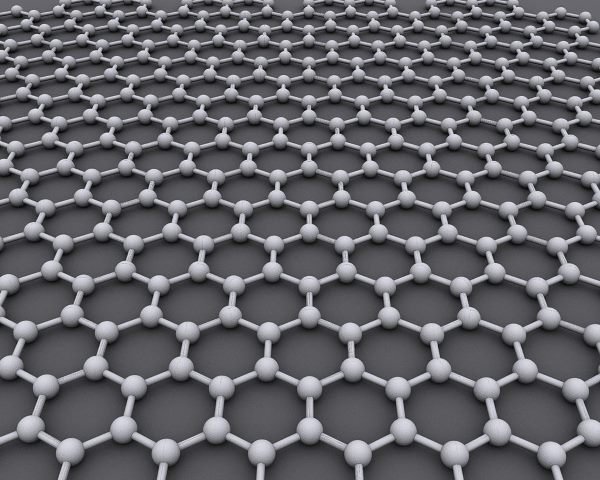
In 2004, physicists Andre Geim and Konstantin Novoselov at the University of Manchester made a breakthrough with a surprisingly simple tool: ordinary sticky tape. By repeatedly peeling layers off a piece of graphite, they isolated graphene, a honeycomb lattice of carbon atoms just one atom thick.
Despite being so thin, graphene is, by some measures, about 200 times stronger than steel of the same thickness. It conducts heat and electricity extremely well and absorbs only about 2.3 percent of the light that hits it. The discovery earned Geim and Novoselov the Nobel Prize in Physics in 2010.
9. The universe contains about 1080 atoms
Cosmologists estimate that the observable universe contains somewhere between 1078 and 1082 atoms, a number with around eighty zeros. It sounds unimaginably large, but it also shows how empty the cosmos really is. Spread across the vast volume of the observable universe, it works out to an average of roughly one atom for every four cubic meters of space.
10. All of humanity would fit in a sugar cube

Because atoms are almost entirely empty space, nearly all of a person’s mass is in the tiny nuclei of their atoms. If you could squeeze all the empty space out of the atoms of every person on Earth, more than eight billion people, very little would be left.
The nuclei of all of humanity together would take up just a few cubic centimeters, roughly the size of a sugar cube. That cube would have the density of a neutron star and would still weigh around 500 million tonnes.