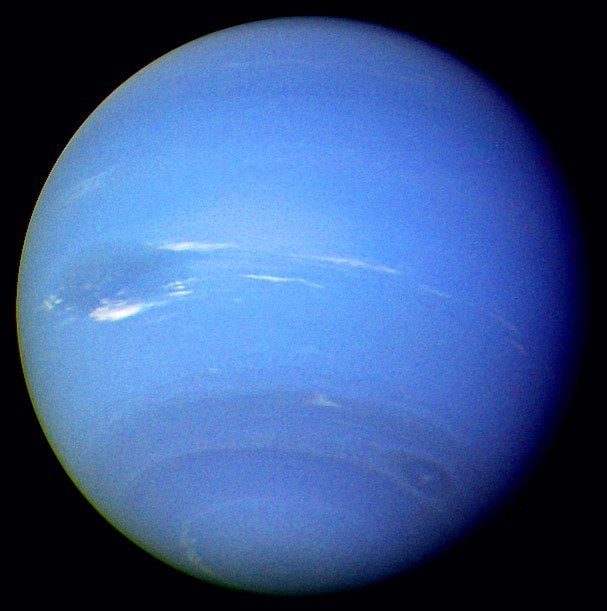
Neptune, named after the Roman god of the sea, is the most distant planet in our solar system and one of the least explored. This deep blue world was the first planet found through mathematics rather than observation, and it is home to some of the most violent weather we know of.
Only one spacecraft has ever been there, which means many of its secrets are still waiting. Here is what we do know.
1. It is the most distant planet from the Sun
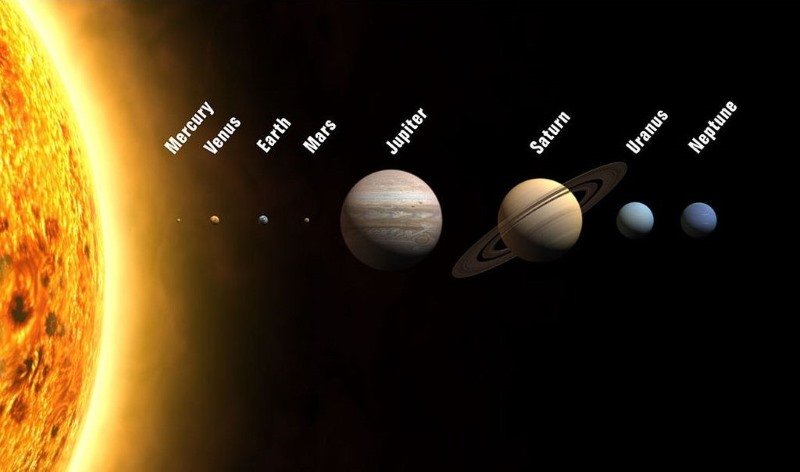
For decades, Pluto was taught as the ninth and outermost planet. In 2006, the International Astronomical Union introduced a new definition of a planet that Pluto did not meet, and it was reclassified as a dwarf planet.
Since then, the solar system officially has eight planets, and Neptune is the last of them. It orbits about 4.5 billion kilometers from the Sun, thirty times farther than Earth.
2. It is the smallest giant, but not the lightest
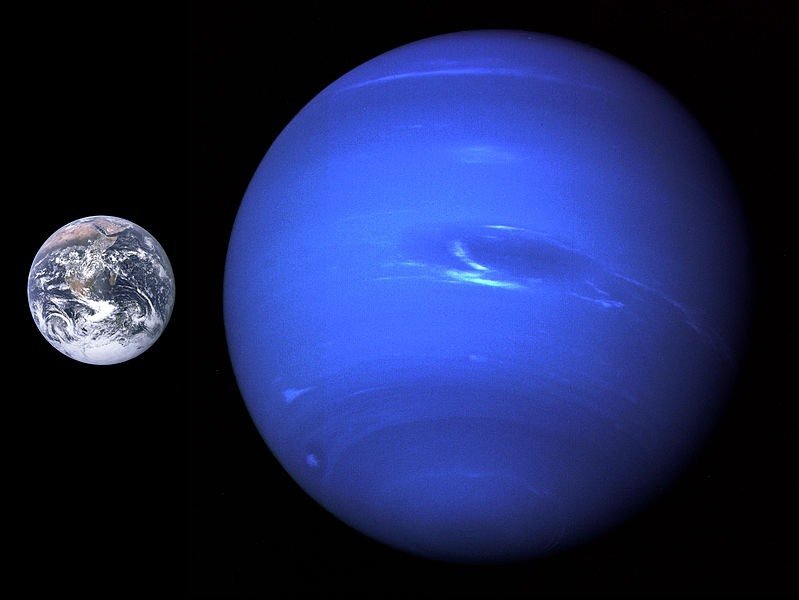
Of the four giant planets, Neptune has the smallest diameter, about 49,500 kilometers. Even so, it is heavier than its near twin Uranus, because it is denser.
Neptune and Uranus are often called ice giants rather than gas giants. Beneath their atmospheres lies a thick, hot, slushy layer of water, ammonia and methane. Still, Neptune is no lightweight: almost 60 Earths would fit inside it.
3. Its gravity feels almost like home
You could never walk on Neptune, as it has no solid surface. But if you could hover at the level of its cloud tops, you would notice something surprising: you would feel only about 14 percent heavier than on Earth.
That is because Neptune’s enormous mass is spread over a huge volume. In fact, every giant planet except Jupiter has a “surface” gravity surprisingly close to Earth’s.
4. Its discovery sparked an international row

Galileo actually saw Neptune in 1612 and 1613, but he mistook it for a star. More than two centuries later, astronomers noticed that Uranus was not moving quite as expected, as if something unseen was tugging on it.
The Frenchman Urbain Le Verrier and the Englishman John Couch Adams independently calculated where the mystery planet should be. In 1846, Johann Galle in Berlin pointed his telescope at Le Verrier’s predicted spot and found Neptune within an hour. France and Britain then argued for years over who deserved the credit.
5. It has the fastest winds in the solar system
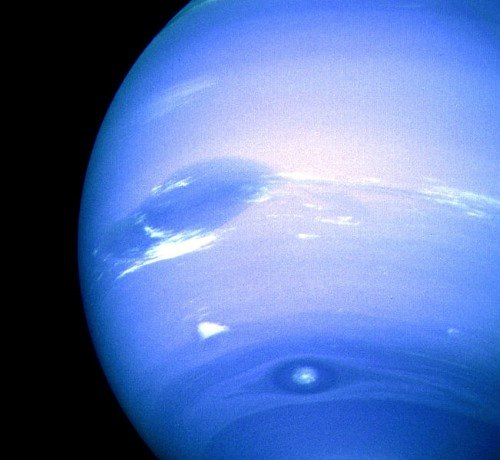
Neptune is a stormy place. Voyager 2 measured winds of up to about 2,100 kilometers per hour, faster than the speed of sound on Earth and far stronger than any hurricane.
How a planet that receives so little sunlight can produce such violent weather is still a puzzle. One idea is that its extreme cold reduces friction in the atmosphere, letting winds build up with little to slow them down.
6. It is a frozen world
Sunlight at Neptune is about 900 times weaker than on Earth. At the top of its clouds, temperatures drop to around minus 200 degrees Celsius.
Its striking blue color comes from methane in the atmosphere, which absorbs red light. Interestingly, Neptune gives off more than twice as much heat as it receives from the Sun, a sign that something is still warming it from inside.
7. Neptune has rings
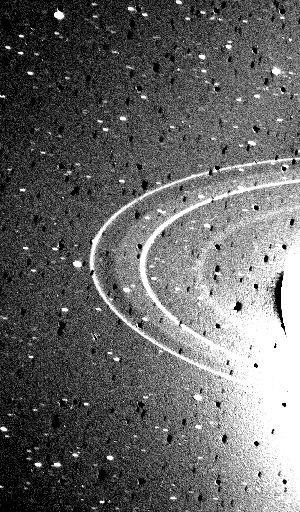
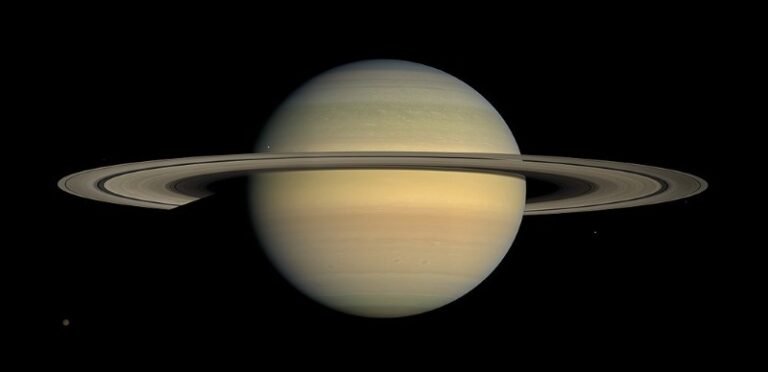
Saturn is not the only planet with rings. Neptune has five main rings, named after astronomers involved in its discovery: Galle, Le Verrier, Lassell, Arago and Adams. They are dark and faint, made largely of dust.
The outermost ring, Adams, has a strange feature. Instead of being even all the way around, it contains several bright clumps called arcs, which astronomers are still trying to explain.
8. Its largest moon orbits backward
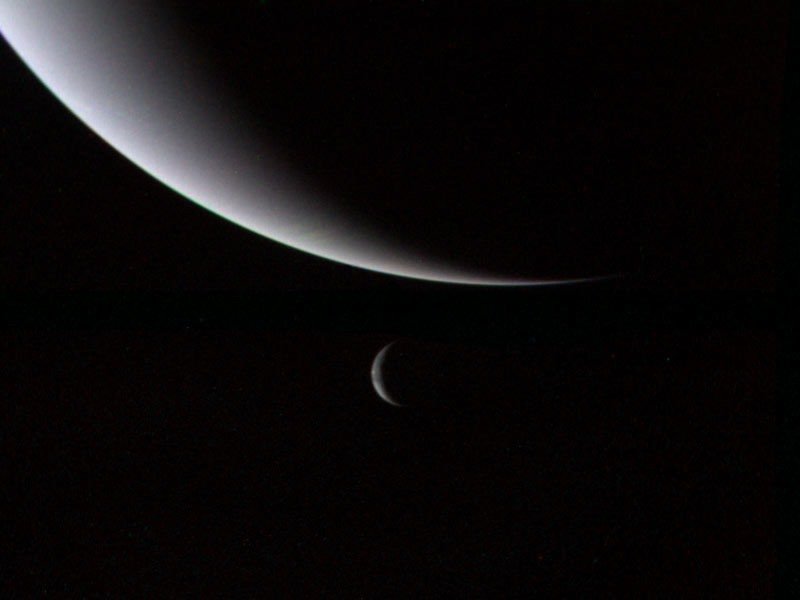
Neptune has 16 known moons. By far the largest is Triton, and it is a true oddball: it is the only large moon in the solar system that orbits in the opposite direction to its planet’s rotation.
That strongly suggests Triton did not form around Neptune but was captured from the Kuiper Belt, the icy region where Pluto lives. Triton is also one of the coldest places ever measured, and Voyager 2 spotted geysers shooting dark plumes from its frozen surface.
9. Only one spacecraft has visited
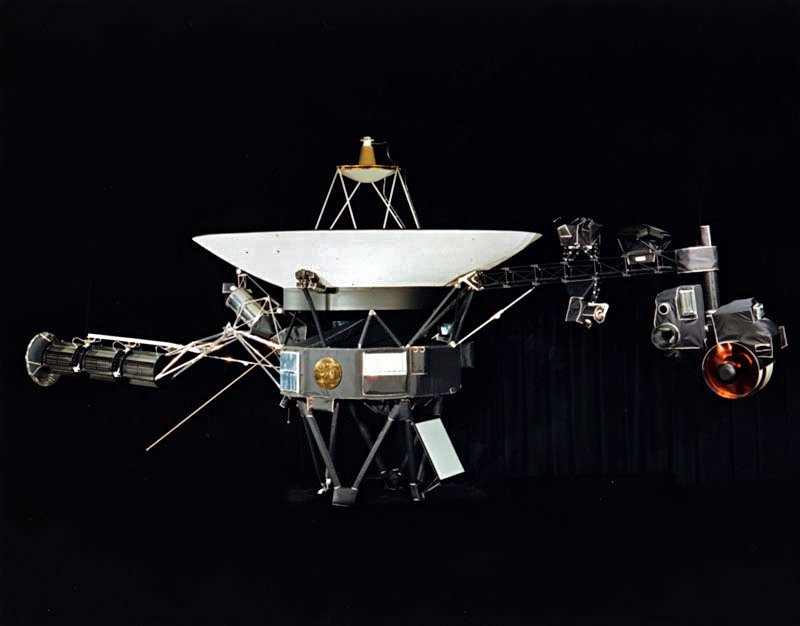
Everything we have seen of Neptune up close comes from a single flyby: Voyager 2 in August 1989. It revealed the planet’s rings, several new moons, Triton’s geysers and a giant storm called the Great Dark Spot.
When the Hubble Space Telescope looked a few years later, that storm had vanished. Since then, others have appeared and disappeared, showing just how changeable Neptune’s weather is.
10. A return trip is still a dream
Scientists would love to go back. Ice giants turn out to be among the most common types of planet around other stars, so understanding Neptune could help us understand worlds across the galaxy.
No mission is officially on the way yet, and because of the vast distance, any spacecraft would need more than a decade just to get there. For now, telescopes like the James Webb Space Telescope are our best window on this distant blue world.