Everyone has seen one: an image that looks like one thing but turns out to be something else. Optical illusions come in many forms, from a mirage in the desert to two lines that look different in length but are exactly the same. What they have in common is that we perceive something differently from how it really is.
It is tempting to blame the image, but the confusion actually happens in our own heads. Your brain constantly makes quick assumptions about perspective, light and shape so you can make sense of the world. Most of the time, those shortcuts work brilliantly. These ten famous illusions show what happens when they don’t.
10. The impossible triangle
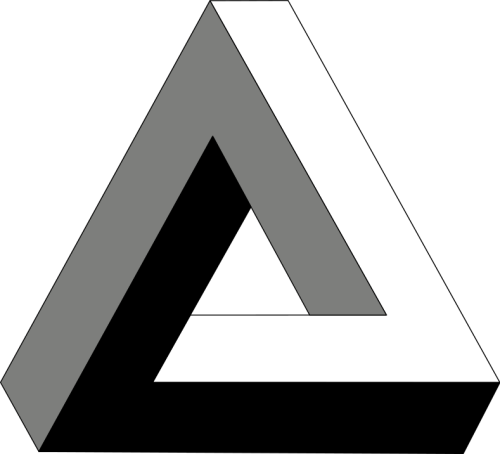
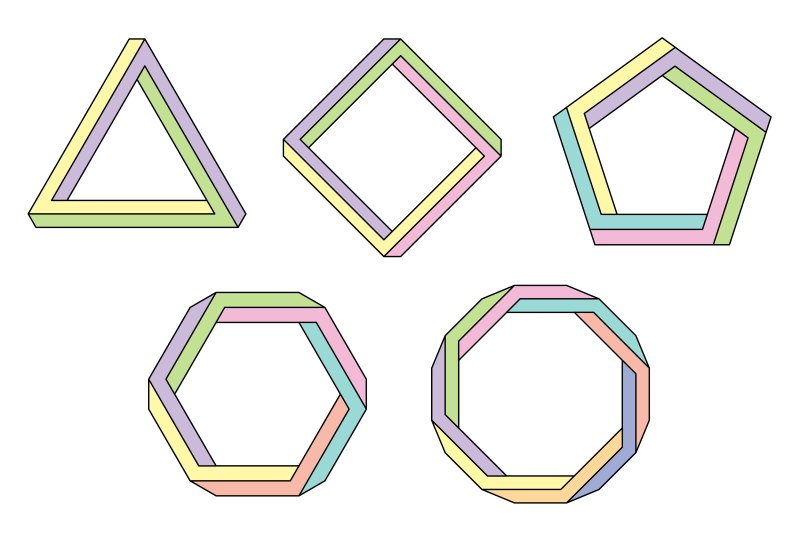
At first glance, this looks like a solid three-dimensional triangle. Look again and you will see that it cannot exist: each corner makes sense on its own, but together they form an impossible object. The trick is that your brain assumes all the beams touch each other, when in a real 3D model they would not.
The figure is known as the Penrose triangle, after psychiatrist Lionel Penrose and his son, the mathematician Roger Penrose, who published it in 1958. The Swedish artist Oscar Reutersvärd had already drawn a version in 1934. Dutch artist M.C. Escher later used the idea in famous works such as Waterfall.
9. Rotating snakes
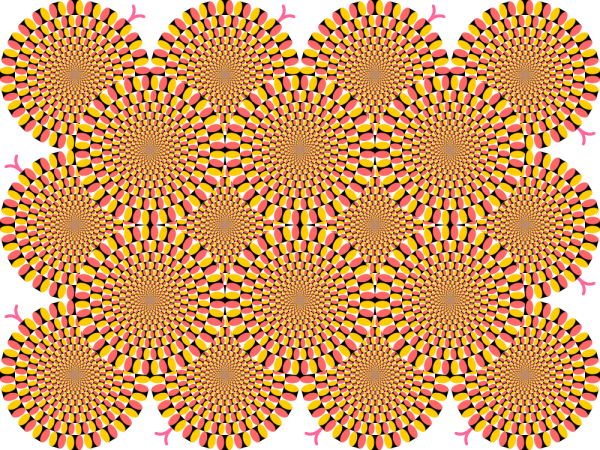
Focus on one point in this image and pay attention to the edges of your vision. Most people see the circles in the periphery slowly turning. But look directly at a “moving” circle and it stops dead.
This version was created in 2003 by the Japanese psychologist Akiyoshi Kitaoka. It is a type of peripheral drift illusion, and scientists still do not fully agree on how it works. What is known is that the sequence of shades matters: dark, very light, slightly less light and black. One theory is that the brain processes high-contrast edges faster than low-contrast ones, and interprets the difference in timing as movement.
8. The duck-rabbit
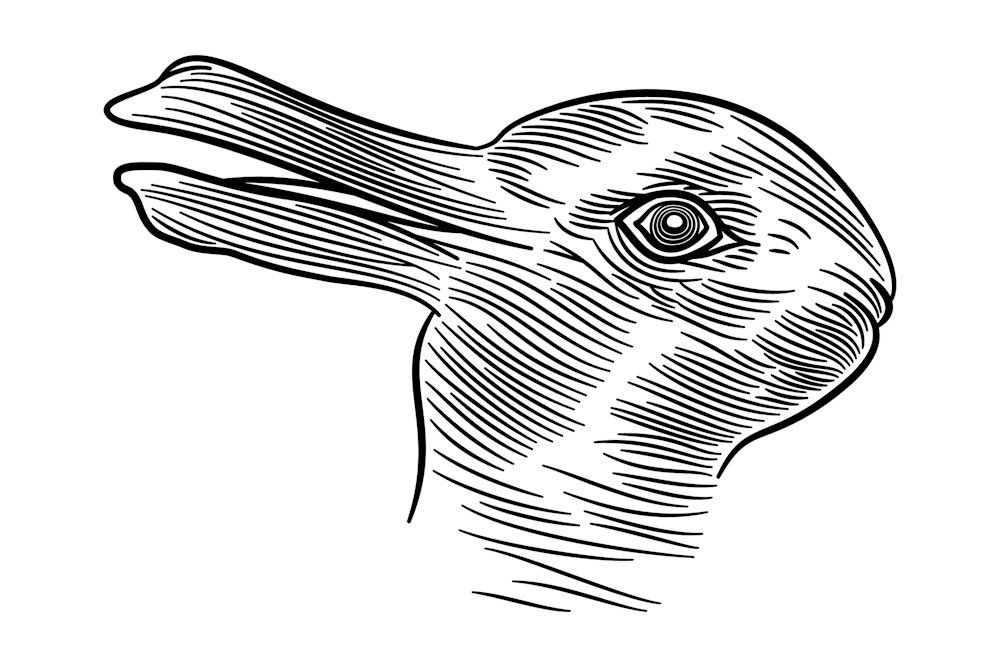
Is this a duck or a rabbit? Whichever you saw first, look again and you will probably see the other. What you cannot do is see both at the same time. Psychologists call this a bistable or ambiguous image: the brain flips between two interpretations but never holds both at once.
The drawing first appeared in the German humor magazine Fliegende Blätter on 23 October 1892, with the caption “Which animals are most like each other?” In 1899, the American psychologist Joseph Jastrow used it to show that we see not only with our eyes but also with our minds.
7. Einstein or Marilyn?
This famous image shows Albert Einstein. Or does it? Step back a few meters, or squint, and many people suddenly see Marilyn Monroe instead.
It is a so-called hybrid image, made by Aude Oliva and her colleagues at the Massachusetts Institute of Technology. They removed the fine details from a photo of Monroe, kept only the fine details of a photo of Einstein, and merged the two. Up close, your brain picks up the sharp lines of Einstein’s face. From a distance, those details disappear and the broad shapes of Monroe’s face take over.
6. The leaning tower illusion
Place two identical photos of the Leaning Tower of Pisa side by side, and something strange happens: the tower on the right seems to lean much more than the one on the left. Yet the images are exactly the same.
The explanation lies in perspective. When two real towers rise side by side, their outlines converge as they recede, because of perspective. In this image they run parallel instead, so your brain concludes that the towers must be diverging, and the right one appears to lean more. The illusion was discovered by Frederick Kingdom and his colleagues at McGill University in Montreal and won the Best Illusion of the Year Contest in 2007.
5. The café wall

The horizontal lines in this pattern seem to slope, like a wall of tilted bricks. In reality, they are perfectly straight and parallel. The effect is caused by the offset rows of black and white tiles, combined with the thin gray lines between them, which confuse the brain’s edge detectors.
A version of the effect was described in the 1890s as the “kindergarten illusion”, after a pattern used in children’s crafts. It got its current name in the 1970s, when psychologist Richard Gregory studied it after a colleague noticed the effect on the tiled wall of a café in Bristol.
4. Shepard’s tables
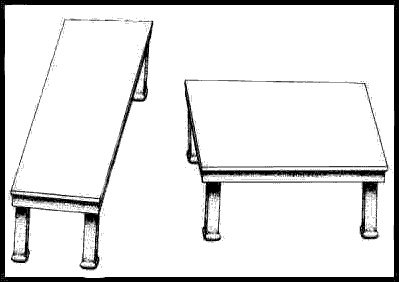
These two tabletops look completely different: one long and narrow, the other short and wide. Grab a ruler, though, and you will find they are exactly the same shape, just rotated by 90 degrees.
The illusion was created by Stanford psychologist Roger Shepard. It works for two reasons. Vertical lines tend to look longer than horizontal ones, and the table legs make your brain read the drawing in 3D. Your brain then “corrects” for perspective and concludes that the tabletop receding into the distance must be much longer than it appears.
3. The Thatcher effect
Look at an upside-down photo of a face in which the eyes and mouth have been flipped, and it looks almost normal. Turn the image the right way up, and the face suddenly becomes grotesque.
The effect was discovered in 1980 by psychologist Peter Thompson, who used a photo of then British Prime Minister Margaret Thatcher. It shows that our brains are highly specialized in recognizing upright faces as a whole. Upside down, we mainly process the separate features, so we miss that something is badly wrong.
2. The Hermann grid

Ghostly gray spots seem to appear at the intersections of the white lines. Look directly at one intersection and the spot vanishes, only to reappear at others in the corner of your eye.
The German physiologist Ludimar Hermann described the effect in 1870. For a long time, it was explained by a process in the retina called lateral inhibition, but research has since cast serious doubt on that theory. The exact explanation remains a subject of debate.
1. Adelson’s checker shadow
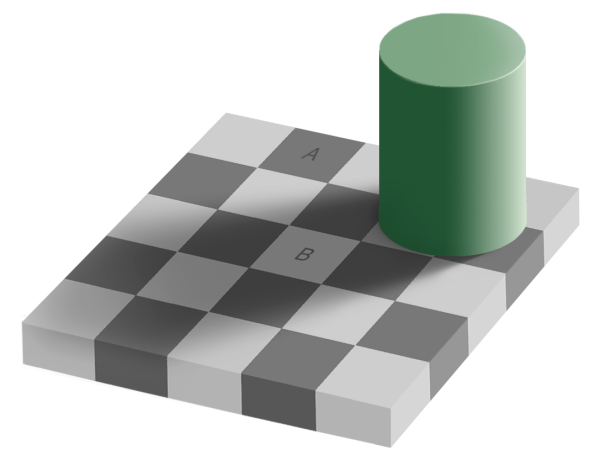
Look at squares A and B. Which one is darker? If you answered A, you are in good company, and you are wrong. The two squares are exactly the same shade of gray.
The illusion was created in 1995 by Edward H. Adelson of MIT. Your brain constantly corrects colors for light and shadow: you know that grass in the shade of a tree is not actually darker grass. Here, it concludes that square B is a light square in shadow, and therefore “really” lighter than A. It is a perfect example of a brain that is a little too clever for its own good.
Without these mental shortcuts, we would need far longer to make sense of what we see. So while our brains occasionally lead us astray, they are usually right. Just remember that what you see is not always exactly what is there.