We love to complain about the weather: too wet, too cold, too windy. But compared to what nature can really do, an ordinary rainy day is nothing. The atmosphere has some tricks up its sleeve that are far stranger, from tornadoes made of fire to fish falling from the sky.
These are ten of the most bizarre weather phenomena on Earth.
10. Microbursts
A microburst is sometimes described as an upside-down tornado. Instead of air being sucked upward, a column of cold air suddenly slams down from a thunderstorm.
When it hits the ground, it spreads out in all directions like water from a burst balloon, with gusts that can exceed 240 kilometers per hour. Microbursts are extremely dangerous for aircraft trying to land and can flatten whole stretches of forest. One tell-tale sign: after a microburst, the fallen trees all point outward from one spot, while after a tornado they lie in all directions.
9. Fire rainbows
Despite the name, this phenomenon has nothing to do with fire, and technically it is not a rainbow either. Its official name is a circumhorizontal arc.
It only forms when the sun is very high in the sky, more than 58 degrees above the horizon, and sunlight passes through flat, six-sided ice crystals in high, thin clouds. That means it is mostly seen in summer, at lower latitudes. The result is a huge band of vivid colors that makes the clouds look as if they are on fire.
8. Fire tornadoes
This is pure nightmare material. During a large wildfire, under the right wind conditions, the flames themselves can start to spin. The result is a swirling column of fire that can tower dozens of meters high, sucking in air and making the fire burn even hotter.
The deadliest example happened in Tokyo in 1923. After the Great Kantō earthquake, tens of thousands of people sought refuge in an open area where an army clothing depot once stood. That afternoon, a huge fire whirl swept across the site, killing an estimated 38,000 people.
7. Thundersnow
Snow usually muffles sound and makes the world feel quiet and peaceful. But very occasionally, when the winter atmosphere is extremely unstable, a snowstorm comes with thunder and lightning.
It is rare, because snowstorms usually lack the energy to produce lightning. When it does happen, the white landscape is briefly lit up by a flash, followed by a strangely muffled rumble of thunder.
6. Mammatus clouds
After a powerful thunderstorm, the sky can sometimes look like it is covered in hanging pouches. The name mammatus comes from the Latin word for breast or udder.
These rounded bulges form when cold, moist air sinks from the underside of a storm cloud. They look threatening, but they often appear when the worst of the storm has already passed. At sunset, they make for a beautiful and surreal sight.
5. Volcanic lightning
What could be scarier than a volcanic eruption? A volcanic eruption with lightning inside it. The phenomenon is also known as a “dirty thunderstorm”.
During an eruption, ash, rock fragments and ice particles are blasted into the air with enormous force. As they collide, they build up static electricity, and the volcano creates its own thunderstorm inside its plume. It is one of the most spectacular and apocalyptic-looking sights in nature.
4. Ball lightning
This is the UFO of weather phenomena. Scientists still do not know exactly what it is, because it is rare and almost impossible to study in the wild.
Witnesses describe a glowing ball, from the size of a grapefruit to a football, floating through the air during a thunderstorm. Sometimes it seems to pass through walls or windows before vanishing, occasionally with a bang. Theories range from burning silicon vapor released when lightning hits the ground to clouds of ionized gas, but none has been proven.
3. Derechos
Most people know tornadoes, but fewer have heard of the derecho: a widespread, long-lived windstorm that races across the land in a more or less straight line.
A derecho is like a wall of wind that can blow at hurricane strength for hours, with gusts that can exceed 160 kilometers per hour. Where a tornado causes damage along a narrow path, a derecho can leave destruction across hundreds of kilometers. In the United States, it is sometimes called an “inland hurricane”.
2. Blood rain
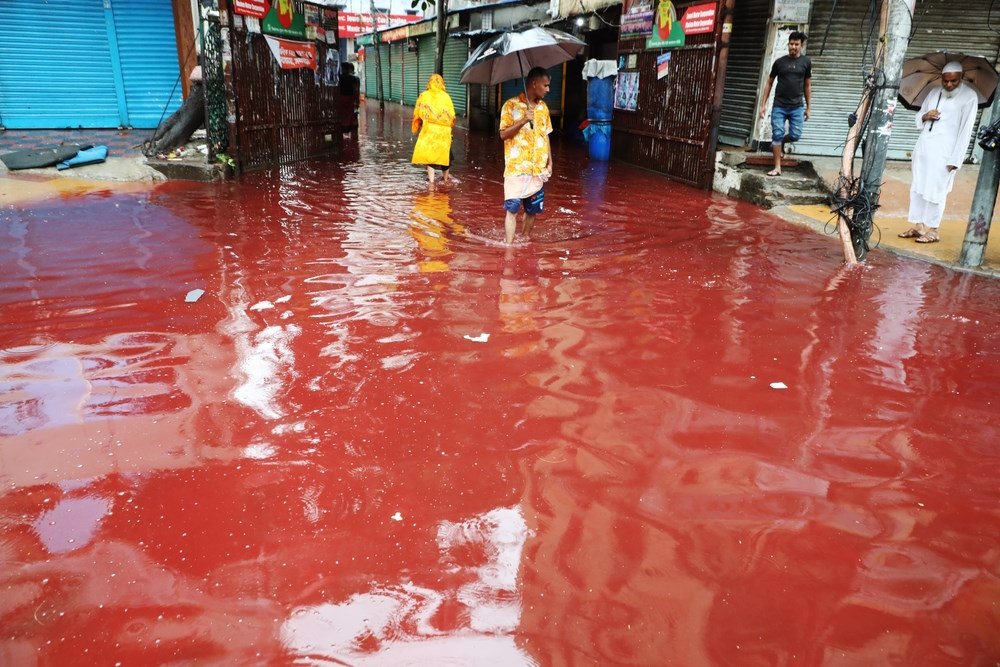
In the past, people believed red rain was a sign that the gods were angry. Today we know better, although it is still a messy affair.
Blood rain usually happens when storms in the Sahara whip huge amounts of reddish dust into the atmosphere. The wind carries it for thousands of kilometers, and when it rains, the water brings the dust down with it, leaving cars and garden furniture covered in reddish-brown sludge. In 2001, red rain that fell in the Indian state of Kerala was traced to the spores of a type of algae.
1. Raining fish

It sounds like an urban legend, but in the town of Yoro in Honduras, people say it happens almost every year: the Lluvia de Peces, or “rain of fish”.
Usually between May and July, after a heavy storm, residents find small fish flopping in the streets and fields. Locals see it as a miracle and celebrate it with an annual festival. The usual scientific explanation for fish rain is a waterspout that sucks up fish and drops them over land. In Yoro’s case, which is far from the sea, another theory is that heavy rain flushes fish out of underground rivers. Either way, it is free food from the sky.