People have long wondered whether we are alone in the universe. Since the rise of radio astronomy and modern SETI projects, the search for extraterrestrial intelligence, scientists and amateurs have been listening for strange signals from space. Sometimes they find radio pulses, sometimes strange patterns in light and sometimes unexpected X-rays.
An important detail: a “mysterious signal” almost never means “aliens”. It usually means that a measurement does not neatly fit into a known category, or that there is too little data to say anything with certainty. These are ten signals and phenomena that raised eyebrows.
1. The Wow! signal
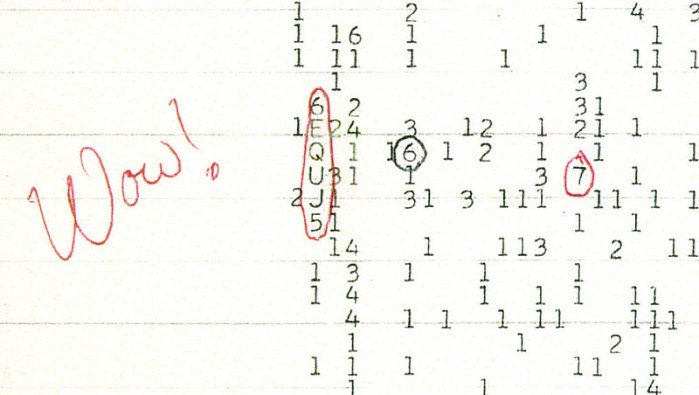
“Wow!” wrote astronomer Jerry Ehman on 15 August 1977 next to a printout from the Big Ear radio telescope in Ohio. It showed a strong, narrowband radio signal that lasted 72 seconds, exactly as long as it would take for a fixed point in the sky to pass through the telescope’s view. It seemed to come from the direction of the constellation Sagittarius and had the characteristics that scientists expected from an artificial signal.
And then: nothing. Despite many attempts, it was never detected again. In recent years, researchers have proposed a natural explanation: a sudden brightening of a cold hydrogen cloud, triggered by a powerful flare from a nearby star. But the Wow! signal remains the most famous example of a candidate that is strange enough to stick in the mind, but lacks the evidence to lead anywhere.
2. Tabby’s star
In 2015, data from the Kepler space telescope revealed strange dips in the brightness of the star KIC 8462852, nicknamed Tabby’s star after astronomer Tabetha Boyajian. Some dips were extremely deep, dimming the star by up to 22 percent, and irregular. That is exactly the kind of data that led the internet to shout “alien megastructure!”
Further research at different wavelengths pointed to something more mundane: dust. Because the star dimmed more in blue light than in red light, the cause is most likely fine dust particles rather than a solid object. The exact source of the dust is still not entirely clear, but the evidence points firmly away from alien constructions.
3. The Lorimer burst, the first fast radio burst
The Lorimer burst, discovered in 2007 by astronomer Duncan Lorimer and his student in archival data from the Parkes radio telescope in Australia, was the first “fast radio burst” (FRB) to gain wide attention: an extremely short, bright radio pulse lasting only milliseconds, from far beyond our galaxy. In that brief moment, the source released as much energy as the Sun does in days or more.
Since then, thousands of FRBs have been detected. We now know that most come from far beyond the Milky Way, and that at least some are produced by magnetars, extremely magnetic neutron stars. But their exact causes are still being studied.
4. A repeating fast radio burst
FRB 121102 was a breakthrough because it repeats. While many FRBs seem to flash only once, this source has produced many bursts. That ruled out explanations involving a one-time cataclysmic event, such as two stars colliding.
FRB 121102 was traced to a small, distant galaxy around three billion light-years away. Researchers think it is probably an extreme object, such as a young magnetar, in a turbulent environment. In 2020, a fast radio burst was detected for the first time from a magnetar in our own galaxy, strengthening the link.
5. The “space roar”
ARCADE 2 was a balloon experiment that flew in 2006 to measure the faint radio glow of the sky with great precision. The analysis revealed a surprising result: a diffuse radio background that was around six times stronger than expected from all known sources of radio waves. In popular reports, it was quickly nicknamed the “space roar”.
Has it been explained today? Not conclusively. There are various models, but measuring such a diffuse background is extremely difficult, because you have to subtract everything else: the instrument, the atmosphere, our own galaxy and all known radio sources. It remains an intriguing puzzle in radio astronomy.
6. Radio source SHGb02+14a
SHGb02+14a is a candidate signal that was picked up three times, in 2003, by the SETI@home project, which used home computers around the world to analyze data from the Arecibo telescope. It was detected around 1,420 MHz, the frequency of hydrogen, which SETI researchers consider a likely channel for interstellar communication. What made it striking was its rapid drift in frequency.
But that is exactly the catch: with weak, short detections like this, interference, noise or coincidence are just as plausible. The signal was never convincingly confirmed as artificial, and it remained a strange candidate rather than a breakthrough.
7. A signal from the direction of HD 164595
In 2015, a team at the Russian RATAN-600 radio telescope recorded a short, strong radio signal from the direction of the star HD 164595, which is similar to our Sun. When the news came out in 2016, the media did what the media do: “Could this be aliens?”
Then came the sober part. The signal was seen only once, by only one telescope, and after further investigation the Russian researchers themselves concluded that it was most likely interference from a source on Earth. No repetition, no solid candidate, but an important lesson: a single detection is almost never enough.
8. Patterns in the light of stars
Astronomer Ermanno Borra suggested that an alien civilization could in theory send extremely fast light pulses that would show up as a periodic pattern in the spectra of stars. In 2016, Borra and Eric Trottier published an analysis of millions of spectra from the Sloan Digital Sky Survey, and found a periodic modulation in 234 stars that they could not immediately explain.
They discussed several possible explanations, including alien signals as a hypothesis, but stressed that this was not proof. Other astronomers suggested that the pattern was more likely caused by the way the data were processed. Without independent confirmation, it remains an intriguing but disputed pattern.
9. X-rays from the Perseus cluster
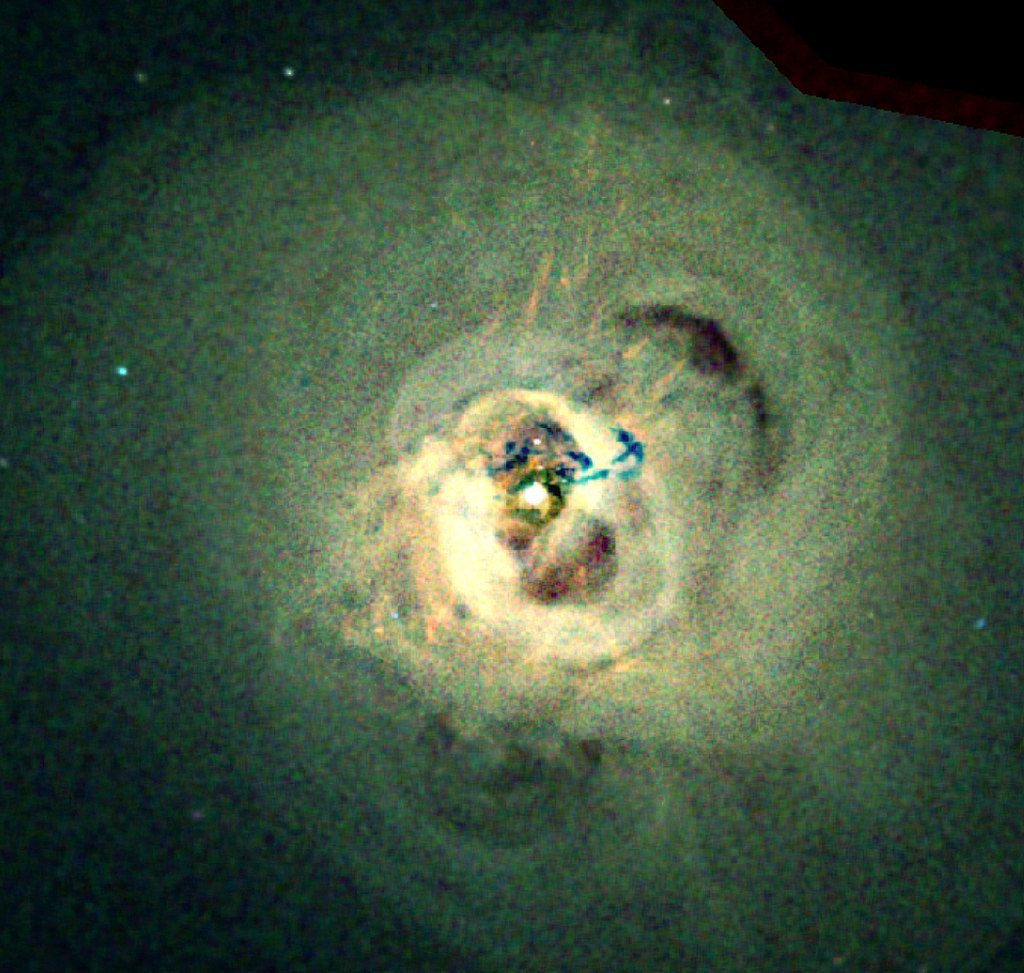
The Perseus cluster is a huge cluster of galaxies around 240 million light-years away. In 2014, astronomers reported a faint, unexplained X-ray signal from this and other galaxy clusters, at an energy that did not match any known element. Some suggested it could be a sign of dark matter decaying.
Later observations, including with the Japanese Hitomi satellite, failed to confirm the signal clearly, and many astronomers now think it is more likely an instrumental effect or an unknown atomic process. The Perseus cluster is also famous for something else: NASA turned pressure waves from its central black hole into sound, a deep “hum” that went viral in 2022.
10. The recordings of the Judica-Cordiglia brothers
In the early 1960s, the Italian radio amateurs Achille and Giovanni Battista Judica-Cordiglia claimed to have picked up strange radio signals from space, including, they said, the voices of Soviet cosmonauts in distress on secret missions that the Soviet Union had kept quiet.
The problem: there is no independent hard evidence, and their stories fit into the broader “lost cosmonauts” myths, which historians consider poorly supported. Their recordings remain food for speculation, not for firm conclusions.