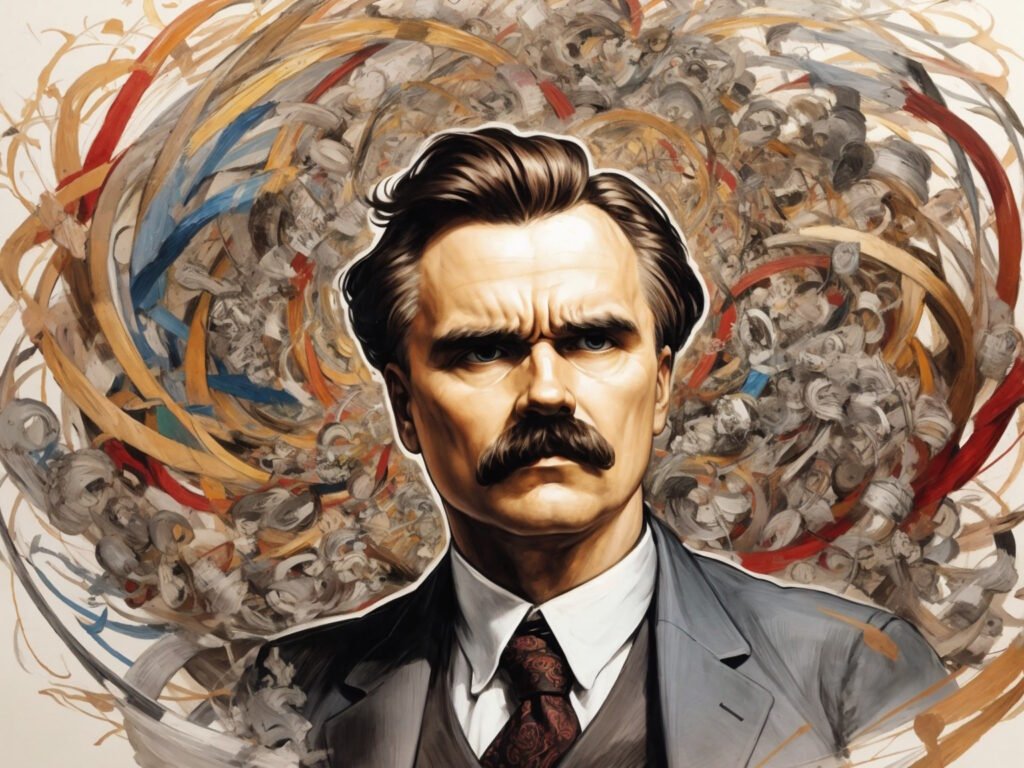
Friedrich Nietzsche wrote his most important books in less than fifteen years, often suffering from terrible headaches and failing eyesight, in cheap boarding houses in Switzerland and Italy. In January 1889, he collapsed in Turin. He was 44, and he never wrote another sentence.
What he left behind is still the most quoted and the most misunderstood work of modern philosophy. These are ten of his key ideas, and what he actually meant by them.
1. God is dead, and that is not a victory
The phrase “God is dead” comes from The Gay Science, published in 1882. It is not the triumphant cry of an atheist. In its most famous version, a madman runs through the marketplace with a lantern, shouting that we have killed God, and then realizes the bystanders do not even understand what they have done.
Nietzsche meant that the Christian worldview had lost its self-evident authority in a culture increasingly driven by science. His concern was not whether God exists, but the void left behind, where for centuries all meaning had hung. He called that void nihilism, and he saw it as the greatest danger of the coming century.
2. The Übermensch: the person who overcomes themselves
In Thus Spoke Zarathustra, Nietzsche introduced the Übermensch, often translated as “Overman” or “Superman”, as a goal humanity should set itself now that God had fallen away. Humans, he wrote, are not an end point but “a rope, tied between beast and Übermensch”. The Übermensch does not live by other people’s rules, but creates his own values.
The concept was later horribly abused. His sister Elisabeth Förster-Nietzsche, who controlled his legacy after his collapse, linked his name to German nationalism and antisemitism, movements Nietzsche himself wrote about with disgust. She even welcomed Hitler to the Nietzsche Archive. The Übermensch is about self-overcoming, not about a superior race.
3. The will to power: the drive to grow
Nietzsche suspected that behind all our actions lies not the pursuit of happiness, but a drive to grow, overcome resistance and give shape to things. This will to power is not mainly about political domination. An artist who starts over twenty times to get a work right is expressing it just as much.
Be careful with the book that bears this title. The Will to Power was never published by Nietzsche himself, but compiled after his death by his sister from his scattered notes, in an order she chose. Philosophers therefore treat it with great caution. The idea itself does appear in works he did publish, such as Beyond Good and Evil.
4. Morality has a history
In On the Genealogy of Morality, published in 1887, Nietzsche asked a question few had asked before him: where do our moral ideas actually come from? His answer was that they did not fall from the sky, but developed over time, and that their history can be traced.
This led to his famous distinction between “master morality” and “slave morality”. The ruling classes once called “good” what they themselves were: strong, proud and confident. In response, he argued, the oppressed turned those values upside down out of resentment, declaring humility and meekness to be virtues and strength to be sinful. Nietzsche did not call for a return to master morality; he wanted to show that our certainties have a history.
5. Amor fati: learn to love your fate

As a New Year’s resolution for 1882, Nietzsche wrote that he wanted to learn to see what is necessary in things as beautiful. That is amor fati, “love of fate”: not wishing your life had gone differently, not even in the places where it hurt.
It is not resignation, and it is not positive thinking. You do not have to like your fate, but you stop wanting to trade it in. The fact that Nietzsche wrote this while suffering for years from migraines, stomach problems and failing eyesight makes it hard to dismiss as a slogan for a coffee mug.
6. Eternal recurrence: would you live this life again?
Nietzsche presented eternal recurrence as a question from a demon who visits you at night. Imagine you had to live this exact life again, down to the smallest detail, an infinite number of times. Would you curse the demon, or would you say you had never heard anything more divine?
As a thought experiment, it works like a measuring stick. Every choice gains infinite weight, because you do not make it once but forever. Anyone who shrinks from the thought immediately knows which part of their life is not right. Nietzsche himself called it “the heaviest weight”.
7. The Apollonian and the Dionysian
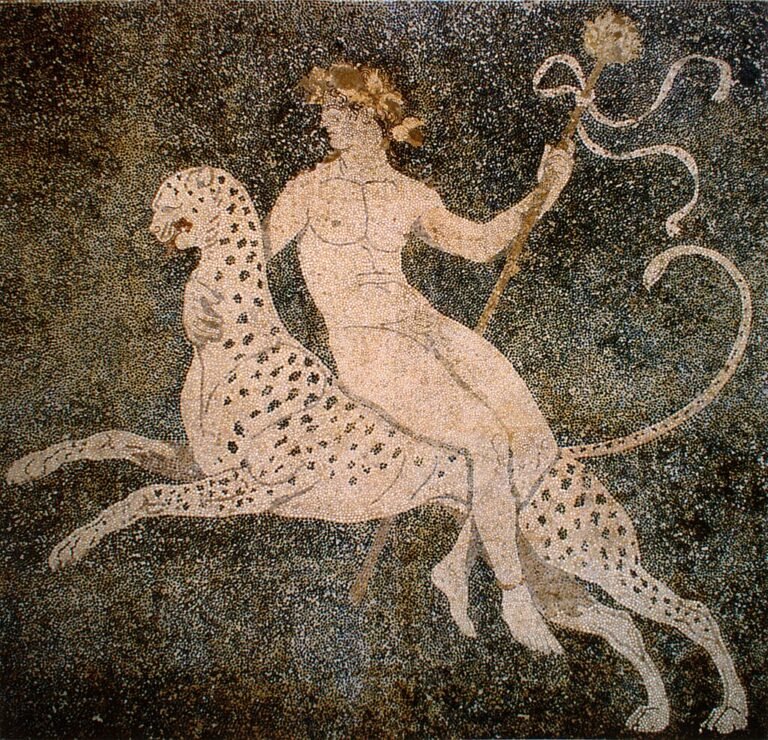
In his first book, The Birth of Tragedy from 1872, Nietzsche described two fundamental forces in art and in human nature. The Apollonian, named after the god Apollo, stands for order, form and clear boundaries. The Dionysian, after Dionysus, stands for intoxication, music and the dissolving of the self.
According to Nietzsche, Greek tragedy was born exactly where these two forces met, and went into decline when Socrates and Euripides tried to subject everything to reason. Nietzsche later looked back critically on the book, but the distinction has stuck. Art that is only neat leaves you cold; art that is only chaos does too.
8. Truth is “a mobile army of metaphors”
In an essay from 1873, published only after his death, Nietzsche wrote that truths are metaphors we have forgotten are metaphors, like coins that have lost their image and are now treated only as metal.
From this grew his perspectivism: there is no view from nowhere, every way of seeing is from a particular position, and the more perspectives you can take on something, the fuller your understanding. That is different from the modern claim that everything is just an opinion. Nietzsche wanted to expose the blind spots of every point of view, not to abolish the difference between better and worse thinking.
9. What does not kill me makes me stronger
This famous line comes from Twilight of the Idols, published in 1889, and in the original it is in the first person: “What does not kill me makes me stronger.” It was a personal note from a man who at that time hardly had a day without pain, not a general law about adversity.
As a motivational poster, the line is rather misleading. Suffering does not make everyone stronger; it breaks people just as often. What interested Nietzsche was the ability to do something with your suffering, instead of being defined by it.
10. Become who you are
The call to “become who you are” was not Nietzsche’s own invention; he borrowed it from the ancient Greek poet Pindar and gave his autobiography, Ecce Homo, the subtitle “How One Becomes What One Is”.
It does not mean that there is a “real you” hidden somewhere that you just need to dig up. It is a task, not a discovery. You become yourself by choosing, practicing and unlearning things, even when the people around you expect something else. For Nietzsche, a person is a project, not a given.
Nietzsche did not want followers. In Zarathustra, he has his main character say that “one repays a teacher badly if one always remains nothing but a pupil.” Anyone who reads his books as a manual for life is doing exactly what he despised.