We see games all around us. With today's photorealistic graphics and vast worlds, it is sometimes almost as if you are walking around in another reality. It is therefore difficult to imagine that computer games have only been around for a few decades. If you ask people what the first game was, many will say “Pong”. This simple game, in which you hit a virtual ball back and forth, was indeed the first game to become known worldwide. However, it was far from the first game ever made. What deserves the title “first game” depends on your definition. Usually this means a game that is digitally generated by a computer and displayed on a screen. In this list we look at the early electronic pioneers who were essential to the development of the modern gaming industry. We travel back in time…
Which one of these deserves the top spot? Cast your votes below and let us know your personal ranking in the comments!
Cast your vote - the ranking shifts live based on the votes.
Cathode Ray Tube Amusement Device (1947)
The oldest interactive electronic game dates from 1947. It was created by Thomas T. Goldsmith Jr. and Estle Ray Mann. The game simulated firing missiles at a target and was inspired by radar technology from World War II. The rocket was a simple dot on a screen that the player had to control. Since the screen could not show anything other than that dot, the targets were drawn on transparent sheets and taped to the screen. If the dot hit a “target” at the right time, the dot was blurred to simulate an explosion. There is a world of difference between this first dot on a television screen and today's blockbusters. Yet this simple device ignited the spark that ultimately created the modern gaming world.
Nim (1951)
On May 5, 1951, the “Nimrod” computer was presented at the Festival of Britain. This machine weighed more than a ton and was the first digital computer built purely for playing a game. However, the goal was serious: to show the audience how digital logic worked. The game was “Nim”, an ancient strategy game where you have to take objects from stacks. The Nimrod used a panel with lights as a screen. Although it was a technical tour de force, the machine was unfortunately demolished after the festival.
Log in to post a comment.
OXO / Noughts and Crosses (1951)
“OXO” was the first game to use a true digital display. Alexander S. Douglas developed it for the EDSAC computer at the University of Cambridge. Players played tic-tac-toe against the machine. What was special about this game was the controller: players used the dial of an old telephone to transmit their moves. The crosses and circles were shown on a television tube in a resolution of only 35 by 16 “pixels”.
Log in to post a comment.
Strachey's Drafts Program (1951)
In 1951, computer scientist Christopher Strachey wrote a simulation of the board game checkers. He did this for the Pilot ACE, an early computer that had very little memory at the time. The program was impressive because it could play a full game of checkers against a human opponent at “reasonable speed.” Strachey later made an improved version for the Manchester Mark 1, a computer that offered more memory space for more complex calculations.
Log in to post a comment.
Tennis for Two (1958)
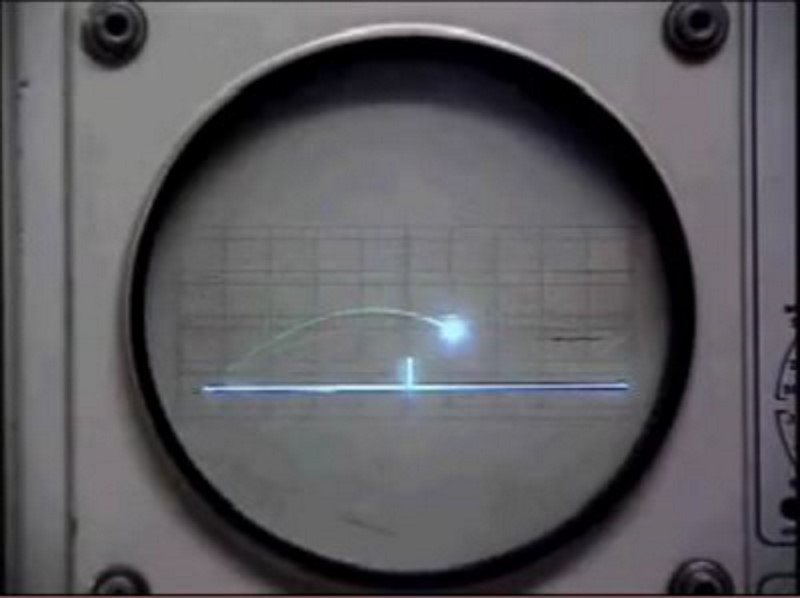
“Tennis for Two” is a special case, because it was not controlled by a digital, but by an analogue computer. The images were displayed on the screen of an oscilloscope. Developer William Higinbotham built the game especially for an open day at the laboratory where he worked. The game is similar to “Pong”, but viewed from the side. The ball is influenced by gravity and can even fly into the net. The game remained unknown for a long time because it was stopped immediately after the visitors' days.
Log in to post a comment.
Mouse in the Maze & Tic-Tac-Toe (1959)
Between 1957 and 1961, MIT developed a collection of interactive programs on the TX-0 computer. In “Mouse in the Maze,” users could draw a maze on the screen with a light pen and place pieces of cheese (dots) in it. A virtual mouse then had to find the fastest way to the cheese. At the same time, a version of “Tic-Tac-Toe” was also created, in which you could simply play a game of tic-tac-toe against the computer.
Log in to post a comment.
Space war! (1962)
“Space War!” was developed by students at MIT and served as the major inspiration for later space games. It is considered the very first “shooter”. Two players each control a spaceship and must shoot at each other while staying out of the way of a star's strong gravity. The game was originally intended to demonstrate the power of the PDP-1 computer. It worked so well that the manufacturer supplied the game as standard to test the hardware. Later, other programmers even added options such as mining and a “first person” perspective.
Log in to post a comment.
Galaxy Game (1971)
Just two months before “Computer Space” was released, there was already a similar game called “Galaxy Game”. This was the very first computer game in a slot machine format. It was built by Bill Pitts and Hugh Tuck and stood on the campus of Stanford University. Only one copy existed at the time. However, the machine was later improved, making it possible to play with four to eight separate consoles simultaneously on one system.
Log in to post a comment.
Computer Space (1971)
“Computer Space” was released a year before “Pong”. This was the very first arcade machine to be sold commercially and therefore the first computer game available to the general public. The player controls a spaceship and must dodge attacks from two flying saucers while shooting back. The game was developed by Nolan Bushnell and Ted Dabney, the later founders of Atari. Although 1,500 copies were sold, many people found the game too complicated. This insight encouraged Bushnell to later design a much simpler game: “Pong”.
Log in to post a comment.
Magnavox Odyssey (1972)
The Magnavox Odyssey was the very first game console to be sold commercially. It was released in May 1972, just before the famous arcade game “Pong” was released. You could connect the console to any television. A total of 27 games were released, spread over 12 different cartridges. Because the console could not display colors, buyers received transparent sheets with it. You paste this over your television screen to add background images and color. You also often had to keep track of the score manually with chips. The design came from Ralph Baer, who had already built a working prototype in 1968 under the name “Brown Box”.
Log in to post a comment.
Missing an item in this list?
Log in or create a free account to add an item yourself.
Log in / create account
Log in to post a comment.