Everybody loves a good prank. But sometimes a joke, a forgery or a clever lie gets out of hand and fools millions of people, including scientists, journalists and famous writers.
It is easy to laugh at the people who fell for these. But be honest: would you have known better at the time? These are ten of the most famous hoaxes in history.
10. The alien autopsy (1995)
In 1995, British producer Ray Santilli released grainy black-and-white footage that appeared to show doctors dissecting an alien, supposedly recovered from the 1947 crash in Roswell, New Mexico. It was broadcast around the world, including on Fox, and watched by millions.
In 2006, Santilli admitted the film was staged, although he claimed it was a “restoration” of real footage he had seen. The alien was a dummy filled with sheep brains, chicken entrails and knuckle joints from a butcher’s shop.
9. The Cardiff Giant (1869)
In 1869, workers digging a well on a farm near Cardiff, New York, uncovered what looked like a petrified man about three meters tall. Crowds paid to see the “giant”, and some took it as proof of the giants mentioned in the Bible.
It was the work of George Hull, a tobacconist and atheist who had argued with a preacher about giants. He had the figure carved from gypsum and buried it a year earlier. Showman P.T. Barnum even made his own copy, which drew bigger crowds than the original fake.
8. The Loch Ness Monster photo (1934)
It is the most famous image of Nessie: a long, graceful neck rising from the dark water of the Scottish loch. Known as the “surgeon’s photograph”, because it was submitted by a respected London doctor, it was taken as evidence of the monster for decades.
In 1994, sixty years later, the truth came out. The “monster” was a toy submarine fitted with a head and neck made of plastic wood. It had been set up by Marmaduke Wetherell, a big-game hunter who had been ridiculed after mistaking hippo footprints for monster tracks.
7. Piltdown Man (1912)
In 1912, amateur archaeologist Charles Dawson announced a sensational find in a gravel pit in Piltdown, England: the fossil remains of an early human with a large, human-like skull and an ape-like jaw. Here, it seemed, was the “missing link”.
For four decades it was in the textbooks. In 1953, scientists proved it was a fake: a medieval human skull combined with the jaw of an orangutan, with teeth filed down and the bones stained to look ancient. Who did it is still debated, but Dawson is the prime suspect.
6. The Cottingley Fairies (1917)
Two young cousins in Cottingley, England, Elsie Wright and Frances Griffiths, claimed they played with fairies by the stream behind their house. As proof, they took photographs showing themselves surrounded by tiny dancing figures.
To modern eyes the fairies look like paper cut-outs, and they were. But Sherlock Holmes author Arthur Conan Doyle was convinced and promoted the photos in a magazine and a book. Only in 1983, as elderly women, did the cousins admit they had copied the fairies from a children’s book and held them up with hatpins.
5. The Protocols of the Elders of Zion (1903)
Not every hoax is harmless. The Protocols of the Elders of Zion, first published in Russia in 1903, claimed to be the secret minutes of a Jewish plan for world domination.
In 1921, The Times of London showed that large parts were plagiarized from an earlier French satire that had nothing to do with Jews. Despite that, the forgery spread around the world and was used as propaganda by the Nazis. It is still circulated today, which makes it the most harmful hoax on this list.
4. Operation Mincemeat (1943)
One of the most successful hoaxes ever was carried out by British intelligence. In 1943, they dressed the body of a dead man as a fictional Royal Marines officer, “Major William Martin”, and let it wash up on the coast of Spain with fake secret documents.
The papers suggested the Allies would invade Greece and Sardinia, not Sicily. The Germans fell for it and moved troops away from Sicily, which helped the real invasion succeed. The story has been told in several books and films.
3. The Hitler Diaries (1983)
In 1983, the German magazine Stern announced the scoop of the century: 60 volumes of Adolf Hitler’s private diaries, found in the wreckage of a plane crash. The magazine paid 9.3 million German marks for them, and a famous British historian vouched for their authenticity.
Within two weeks, forensic tests showed that the paper, ink and binding were made after the war. The diaries were forged by Konrad Kujau, a dealer in Nazi memorabilia, who had even used the wrong initials on the cover. He and the journalist who bought them went to prison.
2. The War of the Worlds (1938)
On October 30, 1938, Orson Welles broadcast a radio adaptation of H.G. Wells’s The War of the Worlds as a series of realistic news bulletins about a Martian invasion of New Jersey.
The next day, newspapers reported mass panic across America. Here is the twist: historians now think the panic itself was largely exaggerated. Most people were not listening, and few of those who were believed it. The real hoax may have been the newspaper stories about the hoax.
1. Crop circles (1970s to 1990s)
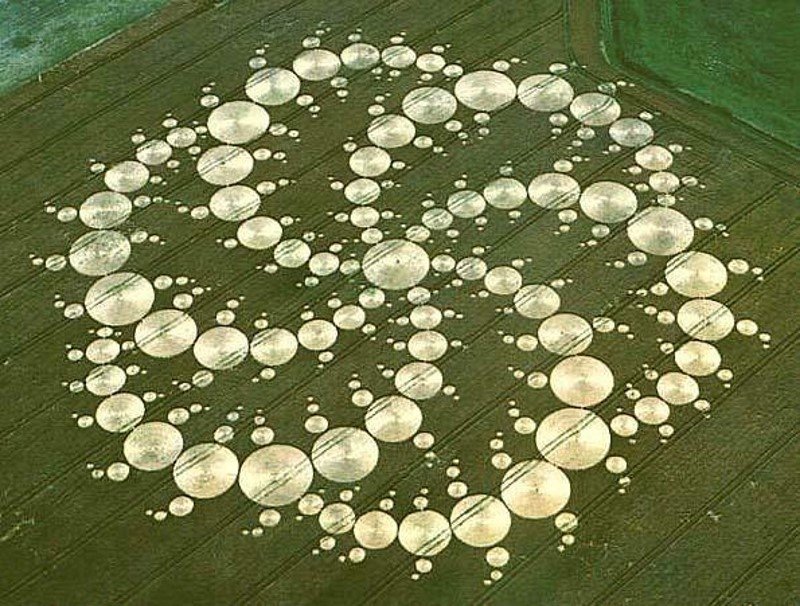
From the late 1970s, mysterious circles began to appear in wheat fields across southern England. Believers saw them as messages from aliens or signs of mysterious energy, and a whole industry of books and tours grew around them.
In 1991, two men from Southampton, Doug Bower and Dave Chorley, revealed that they had been making them since 1976, using planks, rope and a baseball cap fitted with a wire sight. Copycats took over, and crop circles have since become an art form of their own.