In 73 BC, an enslaved Thracian gladiator broke out of a training school in southern Italy with a handful of kitchen knives and sparked the largest slave uprising in Roman history. For two years, Spartacus routed Roman armies and shook the Republic to its core.
Here are 14 historical facts about Spartacus and the war he led against Rome.
1. He came from Thrace and once served alongside the Roman army
Spartacus was born around 103 BC in Thrace, a tribal region covering parts of modern Bulgaria, northeastern Greece, and European Turkey. According to the Greek historian Plutarch, he was not just a strong fighter, but “more Greek than Thracian” in his intelligence and character.
Ancient sources report that Spartacus originally served as an auxiliary soldier in the Roman army before deserting, getting captured, and being sold into slavery.
2. He was trained as a heavyweight gladiator in Capua
Because of his combat experience and physique, a gladiator trainer named Lentulus Batiatus bought Spartacus and brought him to his training school (ludus) in Capua, south of Rome.
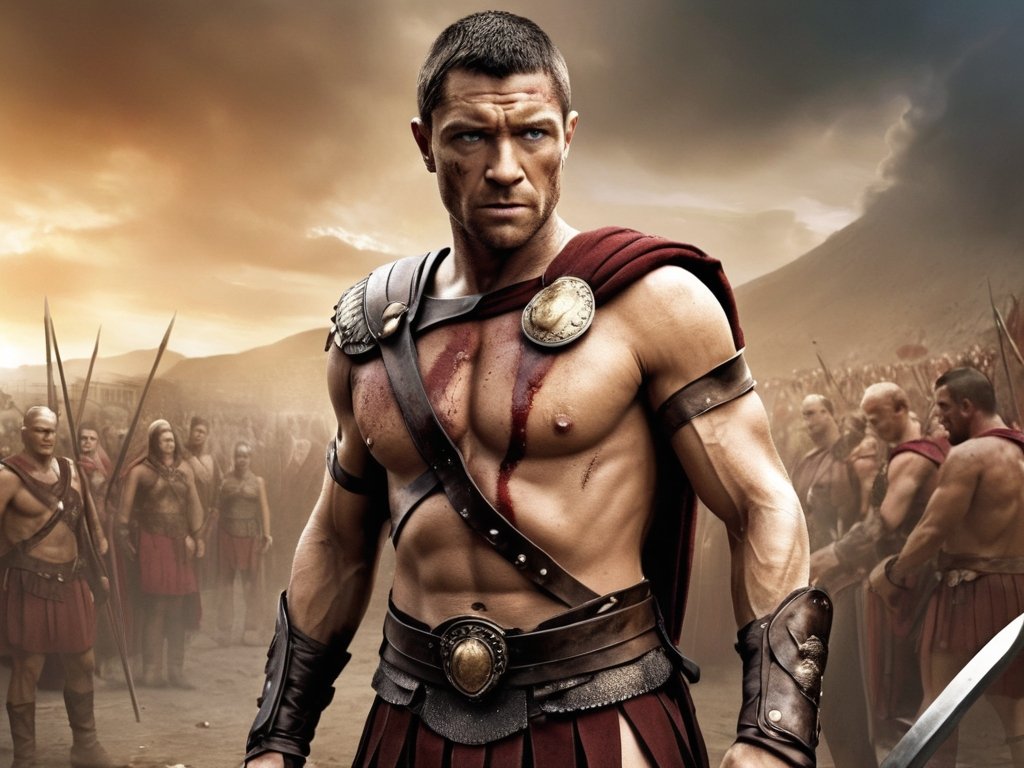
At the school, Spartacus fought as a murmillo, a heavyweight gladiator armed with a short broadsword (gladius), a large rectangular shield, and a crested bronze helmet.
3. The breakout began with kitchen cleavers and roasting spits
In 73 BC, roughly 200 gladiators at Batiatus’s school plotted to overpower their guards and escape. When someone betrayed the plan, Spartacus and about 70 to 78 fellow fighters refused to wait for execution.
Storming the school’s kitchen, they grabbed meat cleavers, knives, and iron roasting spits, fought their way past the guards into the streets of Capua, and hijacked several wagons loaded with real gladiator weapons.
4. The rebels made their first camp inside the crater of Mount Vesuvius
Pursued by local militia from Capua, the escaped gladiators marched south and set up camp on the slopes of Mount Vesuvius near Naples. More than a century before its famous 79 AD eruption destroyed Pompeii, the volcano was quiet and overgrown with wild vines and thick woods.
Spartacus was chosen as one of the rebel leaders alongside two Gallic gladiators, Crixus and Oenomaus, and runaway farm slaves and herdsmen quickly began flocking to their mountain stronghold.
5. They ambushed a Roman army by rappelling down a cliff on wild vines
Rome initially treated the breakout as a minor policing matter and sent praetor Gaius Claudius Glaber with 3,000 militiamen to deal with it. Glaber blocked the only steep path leading down from Vesuvius and waited for the rebels to starve.
Instead, Spartacus’s men wove long, sturdy ropes out of wild grapevines growing on the crater rim, rappelled down a sheer unguarded cliff face behind the Roman lines, and ambushed Glaber’s camp in the middle of the night.
6. His rebel army swelled to at least 70,000 people
Word of Glaber’s humiliating defeat spread across the huge slave-worked estates (latifundia) of southern Italy. Tens of thousands of enslaved field hands, shepherds, and poor rural laborers abandoned their masters to join Spartacus.
According to ancient historians Appian and Plutarch, the rebel force grew into an army of between 70,000 and 120,000 men, women, and children.
7. Historians call the conflict the Third Servile War
The uprising was the third and most dangerous of three major slave revolts fought against the Roman Republic (following two earlier uprisings in Sicily). Known in history as the Third Servile War or the Gladiator War (73-71 BC), it was the only one that directly threatened the Italian heartland and Rome itself.
8. Spartacus insisted on dividing all plunder equally
Unlike Roman generals who kept the lion’s share of war loot for themselves, Spartacus enforced strict rules of fairness in his camp. The historian Appian notes that Spartacus banned merchants from bringing gold and silver into the rebel camp and divided all captured food, livestock, and weapons in equal shares among his followers.
9. He defeated two full Roman consular armies in open battle
By 72 BC, the alarmed Roman Senate dispatched both of its elected consuls, Lucius Gellius Publicola and Gnaeus Cornelius Lentulus Clodianus, at the head of four full Roman legions.
Although Crixus and a breakaway group of 30,000 Gauls were defeated near Mount Garganus, Spartacus outmaneuvered the two consuls in the Apennine Mountains, defeating both armies one after the other and marching all the way north to the Po Valley.
10. Cilician pirates took his gold and stranded him at the Strait of Messina
Instead of crossing the Alps, Spartacus’s army turned back south toward the toe of Italy. Hoping to ferry his followers across the narrow Strait of Messina to Sicily, where he could spark a new uprising on an easily defended island, Spartacus struck a deal with Cilician pirates.
After accepting Spartacus’s gifts and payment, the pirates broke their promise and sailed away, leaving the rebel army trapped on the mainland.
11. Rome’s richest man trapped him behind a 55-kilometer wall
In desperation, the Senate handed supreme command of eight legions to Marcus Licinius Crassus, the wealthiest man in Rome. To bottle up Spartacus on the narrow Bruttium peninsula (modern Calabria), Crassus ordered his soldiers to dig a 55-kilometer (34-mile) ditch backed by a high timber-and-earth wall stretching from sea to sea.
On a snowy winter night, Spartacus waited for a storm, filled a section of the trench with earth, timber, and branches, and fought his way across Crassus’s lines with a third of his army.
12. He killed his own horse before his final battle at the Silarus River
In the spring of 71 BC, with Pompey’s legions approaching from Spain and Lucullus landing in Brundisium, Spartacus made his final stand against Crassus near the headwaters of the Silarus River. Before the battle began, handlers brought Spartacus his horse.
Drawing his sword, Spartacus slew the horse in front of his men, declaring: “If I win today, I will have plenty of fine horses from the enemy; and if I lose, I shall not need one.”
13. His body was never found on the battlefield
During the battle, Spartacus tried to cut his way directly through the Roman ranks to reach Crassus in person, killing two centurions in hand-to-hand combat. Surrounded on all sides after his companions fled, he stood his ground until he was cut down.
So many men fell around him that Roman soldiers were never able to find or identify Spartacus’s body after the fighting ended.
14. Crassus crucified 6,000 survivors along the Appian Way
Determined to make sure enslaved people never dared rebel again, Crassus ordered a brutal public spectacle. Six thousand captured rebels were crucified one after another along the 200-kilometer stretch of the Via Appia between Capua and Rome.
Although Spartacus never actually fought inside the Colosseum (which was built 150 years after his death), his name endured across the centuries as the ultimate symbol of defiance against slavery. Which part of Spartacus’s story stands out to you the most? Let us know in the comments below.