The Republic of Chile occupies an extraordinary geographic ribbon stretching over four thousand three hundred kilometers along the southwestern spine of South America, compressed between the towering granite crests of the Andes Mountains and the Pacific Ocean. Spanning extreme climatic zones ranging from the bone-dry moonscapes of the northern Atacama Desert to the temperate lake districts and glacial fjords of Patagonia, the nation’s urban topography reflects localized adaptation to geographic barriers. According to municipal demographic registers maintained by the National Statistics Institute of Chile (INE), roughly eighty-eight percent of Chileans live in urban areas, with the central Mediterranean valley accommodating the vast majority of the population.
Chilean cities are characterized by dramatic mountain backdrops, active maritime fishing docks, and modern seismic engineering designed to withstand significant geological activity. Beyond metropolitan Santiago, regional capitals govern copper mining logistics, university research, commercial maritime shipping, and agricultural exports. Examining the ten most populous cities reveals how geography and industry shape civic identity across this South American territory.
10. Talca (approx. 236,300 residents)
Situated in the heart of the fertile central valley roughly two hundred and fifty kilometers south of Santiago, Talca serves as the agricultural, administrative, and cultural capital of the Maule Region. Founded in 1742 by Governor José Antonio Manso de Velasco, the city holds historic significance in the fight for republican emancipation: it was here in 1818 that Supreme Director Bernardo O’Higgins signed the definitive Act of Chilean Independence. Today, the historic house where the declaration was signed functions as the O’Higginian and Fine Arts Museum of Talca.
Talca functions as the economic hub for Chile’s premier wine-producing valley, surrounded by historic vineyards specializing in Carmenere, Cabernet Sauvignon, and traditional Pais grape varieties. The city also operates the Ramal Talca-Constitución, the last surviving historic passenger narrow-gauge branch railway in Chile, which meanders along the banks of the Maule River to coastal fishing villages.
9. Puerto Montt and Puerto Varas (approx. 238,200 residents)
Positioned on the shores of the Reloncaví Sound where the Chilean central valley terminates into the Pacific Ocean, this conurbation serves as the undisputed gateway to Northern Patagonia and the Chiloé archipelago. Founded in 1853 by German immigrants who cleared dense native Valdivian rainforest, the towns retain charming German timber architecture, traditional bakeries serving German kuchen, and wooden shingle houses. The snow-capped volcanic cone of Osorno Volcano towers majestically over nearby Lake Llanquihue, creating a striking postcard landscape.
Economically, Puerto Montt is the capital of the global salmon farming industry, anchoring multinational aquaculture laboratories, fish processing facilities, and maritime transport fleets. The Angelmó coastal cove features famous artisan woodcraft markets and open-air seafood kitchens serving traditional curanto stews.
8. Rancagua (approx. 290,000 residents)
Located eighty kilometers south of Santiago in the fertile Cachapoal Valley, Rancagua is the administrative capital of the O’Higgins Region. The city occupies an honored chapter in national history as the site of the heroic Battle of Rancagua in 1814, where patriotic troops fought Spanish royalist forces in the central plaza, an event commemorated annually with civic parades around Plaza de los Héroes.
Rancagua is the operational hub for El Teniente, the largest underground copper mine in the world, whose extensive network of tunnels penetrates the interior of the nearby Andes. The surrounding countryside is also celebrated as the heartland of Chilean rodeo and huaso cowboy culture, hosting the National Rodeo Championship in its grand municipal arena every autumn.
7. Iquique (approx. 293,100 residents)
Wedged between the golden dunes of the Atacama Desert and the crashing Pacific surf in northern Chile, Iquique is a sun-drenched coastal city with a rich mining past. In the late nineteenth century, the city flourished as the global shipping capital of the natural saltpeter (nitrate) boom, leaving behind opulent Belle Epoque mansions, the wooden municipal theater, and the neoclassical Astoreca Palace along historic Baquedano Street. Nearby in the desert lie the eerie ghost towns of Humberstone and Santa Laura, UNESCO World Heritage sites preserving historic nitrate processing works.
Today, Iquique thrives as a major commercial duty-free port through the ZOFRI (Free Trade Zone), drawing merchants from across South America. The city’s golden Cavancha beach is renowned internationally for world-class surfing waves, while paragliders launch daily from towering coastal dunes to soar over the city skyline.
6. Temuco (approx. 312,500 residents)
Resting in the rolling heartland of the Araucanía Region along the Cautín River, Temuco was established in 1881 as a military frontier fort during the pacification of the region. The city possesses deep indigenous heritage, serving as the cultural and commercial capital of the native Mapuche people. The bustling Aníbal Pinto Municipal Market features Mapuche weavers, traditional silver jewelry artisans, and medicinal herb stalls selling native remedies.
Temuco holds an extraordinary place in world literature as the hometown where two Nobel laureates in Literature spent formative years: Gabriela Mistral served as a school director here, while young Pablo Neruda grew up wandering its misty railyards and native forests. Surrounding national parks like Conguillío showcase ancient monkey puzzle (araucaria) forests and the active Llaima Volcano.
5. Antofagasta (approx. 348,500 residents)
Stretching along a narrow coastal shelf in the northern Atacama Region beneath towering brown coastal escarpments, Antofagasta is the mining capital of Chile and the world’s primary copper hub. Nicknamed the Pearl of the North, the city commands the logistics for colossal open-pit copper mines like Escondida, shipping millions of tons of refined red metal annually through its deep-water port terminals. In the city center, the historic Plaza Colón features a distinctive clock tower donated by British residents in 1910 to commemorate the Chilean centenary.
Just south of the city limits stands the iconic Hand of the Desert (Mano del Desierto), an eleven-meter-tall iron-and-cement sculpture rising eerily from the barren sands, created by sculptor Mario Irarrázabal. The city also hosts major universities and technological centers supporting astronomical observatories across the desert plateaus.
4. La Serena (approx. 399,500 residents)
Founded in 1544 by Juan Bohón on the Pacific coast, La Serena is the second-oldest city in Chile after Santiago. In the mid-twentieth century, President Gabriel González Videla initiated the Plan Serena, an urban architectural initiative that mandated a unified Spanish colonial revival style, giving the city its distinctive stone archways, terracotta tiled roofs, and pastel walls. Together with its neighboring industrial port city of Coquimbo, La Serena forms the primary metropolitan center of the Norte Chico region.
The city features the monumental El Faro lighthouse watching over expansive sandy beaches that welcome hundreds of thousands of summer vacationers. Thanks to extraordinarily clear desert skies, La Serena acts as the operational base for major international astronomical observatories in the nearby Elqui Valley, which is also celebrated for producing aromatic pisco brandy.
3. Concepción (approx. 719,900 residents)
Situated on the banks of the mighty Bío Bío River near its Pacific estuary, Concepción reigns as the cultural, academic, and industrial capital of southern Chile. Founded in 1550 by Pedro de Valdivia, the city served as a military command center during the centuries-long Arauco War and was the actual location where Bernardo O’Higgins signed the declaration of independence in 1818. The University of Concepción anchors a prestigious campus adorned with the monumental mural Presence of Latin America, painted by Mexican artist Jorge González Camarena.
Often hailed as the rock music capital of Chile, Concepción has produced prominent national bands and maintains a flourishing live music and university arts scene. The surrounding metropolitan area encompasses heavy naval shipyards at Talcahuano, steel manufacturing plants, and extensive forestry processing terminals.
2. Valparaíso (approx. 935,600 residents)
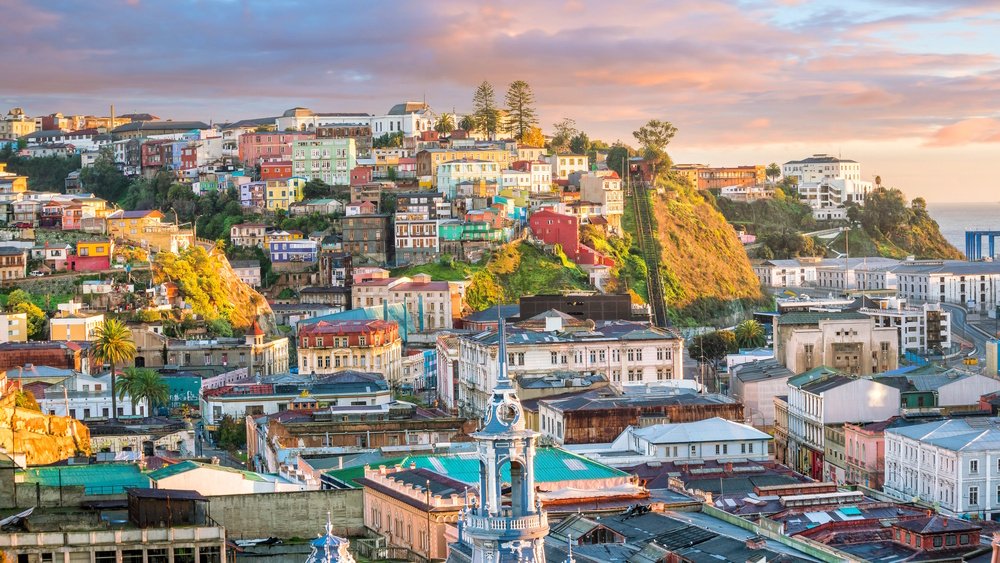
Dramatically spilling across forty-two steep coastal hills overlooking a natural Pacific amphitheater bay, Valparaíso is the historic legislative capital and cultural jewel of Chile. Known affectionately as the Jewel of the Pacific, the city’s historic hill quarters, including Cerro Alegre and Cerro Concepción, form a UNESCO World Heritage site filled with colorful nineteenth-century timber houses, winding staircases, and colorful outdoor street murals. Dozens of historic funicular elevators (ascensores) continue to carry pedestrians effortlessly up and down steep ravines.
The city’s romantic, bohemian atmosphere captivated poet Pablo Neruda, who built his whimsical hillside residence La Sebastiana here to watch New Year fireworks over the bay. Contiguous with the modern seaside resort city of Viña del Mar, known for its pristine beaches and famous floral clock, Greater Valparaíso combines naval academies and government congress halls with active commercial container wharves.
1. Santiago (approx. 6,139,100 residents)
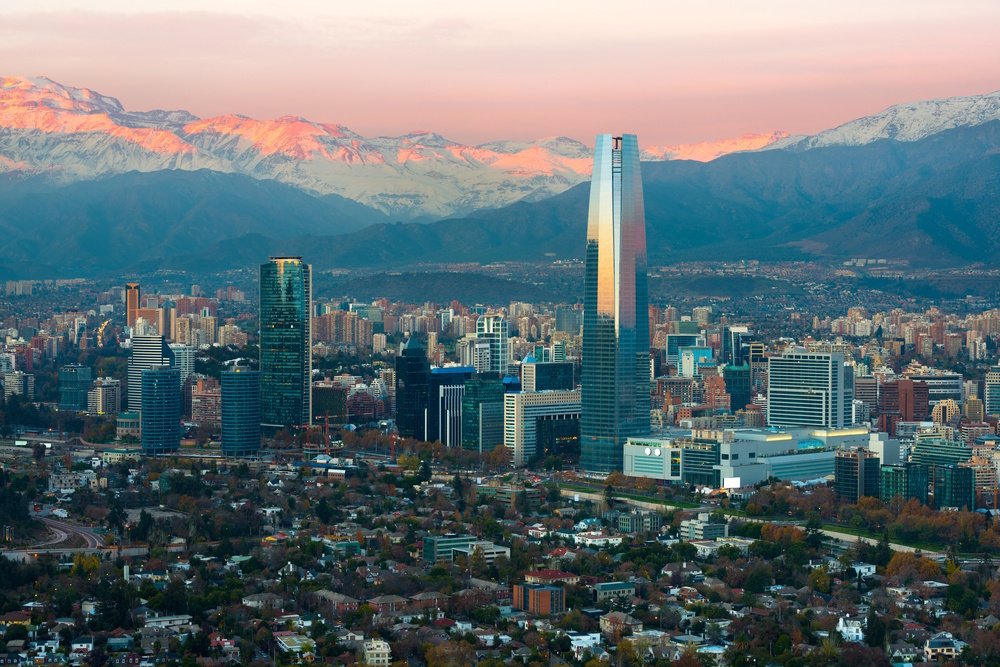
Santiago stands supreme as the monumental capital and financial heart of Chile, resting on the fertile plain of the central valley at the foot of the snow-capped Andes Mountains. Founded in 1541 by Spanish conquistador Pedro de Valdivia on the banks of the Mapocho River, the metropolis accommodates over six million residents, representing more than forty percent of the country’s total population. The city skyline is dominated by the Gran Torre Santiago at Costanera Center, rising three hundred meters as the tallest skyscraper in South America.
Santiago presents a compelling architectural contrast between historic monuments like the neoclassical Moneda presidential palace and the Metropolitan Cathedral on Plaza de Armas, and ultra-modern business districts in Las Condes, nicknamed Sanhattan. Extensive green sanctuaries like San Cristóbal Hill and Santa Lucía Hill provide panoramic vistas across the urban valley, while an immaculate, modern underground metro system transports millions of citizens daily.
Conclusion
Chile’s largest cities capture an inspiring balance between desert copper wealth, Pacific maritime traditions, and modern metropolitan innovation. From the high-rise financial avenues of Santiago and the bohemian hills of Valparaíso to the Patagonian ports of Puerto Montt, these ten urban centers anchor the cultural and economic life of this Andean nation.