Few artists in history reinvented painting as relentlessly as Pablo Picasso. Across a career spanning nearly eight decades, the Spanish-born painter, sculptor, and printmaker co-founded Cubism, pioneered collage, and created some of the 20th century’s most recognizable works of art.
From his 23-word baptismal name to the time French police interrogated him over the stolen Mona Lisa, here are 15 fascinating facts about Pablo Picasso.
1. His full baptismal name was 23 words long
When he was born in Málaga, Spain, on October 25, 1881, his parents baptized him with a string of names honoring various saints and relatives: Pablo Diego José Francisco de Paula Juan Nepomuceno María de los Remedios Cipriano de la Santísima Trinidad Ruiz y Picasso.
As a young artist in Barcelona and Paris, he dropped his father’s common surname (Ruiz) in favor of his mother’s more distinctive Italian-origin surname, Picasso.
2. His father was an art professor who gave up painting when Pablo was a teenager
Picasso’s father, Don José Ruiz y Blasco, was a traditional painter and art teacher who specialized in realistic paintings of doves and pigeons. He began teaching young Pablo academic figure drawing at age seven.
According to family accounts, by the time Pablo was 13, his technical skill was so far beyond his father’s that Don José handed over his own brushes and palette and vowed never to paint again.
3. A close friend’s suicide triggered his somber Blue Period
Between 1901 and 1904, a broke and grieving Picasso painted almost exclusively in cold shades of blue and blue-green. The shift began after his close friend, Spanish poet and painter Carles Casagemas, shot himself at a café in Paris following an unrequited love affair.
Working between Barcelona and Paris, Picasso filled his Blue Period canvases with gaunt, lonely figures of beggars, blind musicians, and impoverished mothers.
4. Moving to Montmartre sparked his warmer Rose Period
By 1904, Picasso settled into the dilapidated Bateau-Lavoir studio building in Paris’s Montmartre district and fell in love with bohemian model Fernande Olivier. As his mood lifted, his palette warmed into terracotta pinks, oranges, and earth tones.
During this Rose Period (1904-1906), he visited the Cirque Médrano several nights a week and painted traveling acrobats, harlequins, and circus performers.
5. ‘Les Demoiselles d’Avignon’ shocked even his closest artist friends
In 1907, Picasso spent months working in secret on a large, jagged canvas titled Les Demoiselles d’Avignon, depicting five nude women in a Barcelona brothel with flat, splintered bodies and faces inspired by ancient Iberian sculpture and African masks.
When he first showed the painting in his studio, fellow artists were stunned; Henri Matisse thought it was a hoax meant to ridicule modern art, and Picasso kept the canvas rolled up in his studio for years before exhibiting it publicly.
6. He invented Cubism alongside French painter Georges Braque
Building on that breakthrough, Picasso teamed up with French artist Georges Braque between 1908 and 1914. Working so closely that they compared themselves to “two mountaineers roped together”, they abandoned traditional single-point perspective altogether.
Their new style, dubbed Cubism after a critic complained their work looked like “little cubes”, broke objects down into geometric planes viewed from multiple angles at once.
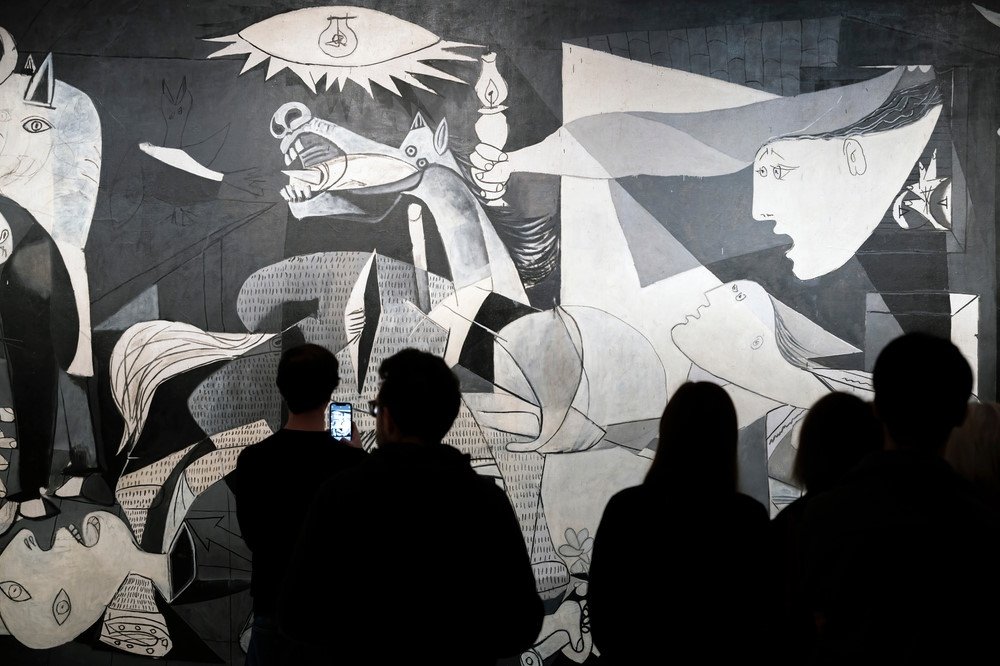
7. He painted ‘Guernica’ in just over a month to protest the bombing of civilians
On April 26, 1937, during the Spanish Civil War, Nazi German and Fascist Italian warplanes bombed the Basque market town of Guernica for three hours, killing hundreds of civilians.
Horrified by newspaper photographs of the rubble, Picasso abandoned his original sketch for the Spanish Republic’s pavilion at the 1937 Paris World’s Fair. In just 35 days, he painted Guernica, a 7.7-meter-wide black, white, and gray mural of screaming mothers, a gored horse, and a bull that became history’s most famous anti-war painting.
8. He was the most prolific artist in recorded history
Picasso worked nearly every single day from childhood until his nineties. According to Guinness World Records, his lifetime output is estimated at roughly 50,000 individual works.
That catalog includes approximately 1,885 paintings, 1,228 sculptures, 2,880 ceramics, 12,000 drawings, and tens of thousands of prints, engravings, tapestries, and rugs.
9. He turned a rusty bicycle seat and handlebars into a famous sculpture
During the German occupation of Paris in 1942, bronze was scarce, and Picasso scavenged scrap metal. One day he spotted a discarded leather bicycle saddle and a pair of rusted handlebars in a junk pile.
Placing the narrow saddle vertically beneath the curved handlebars, he cast them together as Bull’s Head, one of the wittiest examples of found-object sculpture in modern art.
10. Bulls and the Minotaur haunted his art for his entire life
Having attended Spanish bullfights with his father as a small boy in Málaga, Picasso returned to the imagery of the bullfighting ring throughout his career.
In the 1930s, he adopted the mythical half-man, half-bull Minotaur as his personal alter ego in his Vollard Suite etchings, using the creature to represent raw creative instinct, passion, and violence.
11. He drew the world’s most famous Peace Dove in 1949
After the liberation of Paris in 1944, Picasso joined the French Communist Party and remained a member for the rest of his life. In 1949, poet Louis Aragon visited his studio and chose a simple lithograph of a white pigeon Picasso had drawn for a poster advertising the World Peace Congress in Paris.
Picasso’s clean, single-line drawing of a white dove became the universal international symbol of the peace movement; he even named his daughter born that same week Paloma, the Spanish word for dove.
12. Every major romantic partner inspired a new artistic style
Art historians often map Picasso’s stylistic shifts alongside the women in his life. His marriage to Russian ballerina Olga Khokhlova coincided with his return to neoclassical portraits; his secret affair with Marie-Thérèse Walter brought soft, curving pastel forms; and his years with surrealist photographer Dora Maar produced his famous “Weeping Woman” portraits.
Later, painter Françoise Gilot and his second wife, Jacqueline Roque, each inspired new phases of ceramics, prints, and late canvases.
13. French police interrogated him in 1911 over the theft of the ‘Mona Lisa’
When Leonardo da Vinci’s Mona Lisa vanished from the Louvre in August 1911, Paris police had no leads. Weeks later, authorities discovered that Picasso’s friend, the poet Guillaume Apollinaire, had employed a secretary who had stolen ancient Iberian stone statuettes from the Louvre and sold two of them to Picasso.
Terrified of being deported, Picasso and Apollinaire nearly threw the statues into the Seine at midnight before turning them in. Police hauled both men into court for questioning, though the magistrate quickly realized neither of them had anything to do with the missing Mona Lisa.
14. He kept painting right up to his death at age 91
Picasso never retired. Living in his hilltop villa in Mougins in the south of France, he painted furiously through his eighties and nineties, producing bold, energetic canvases faster than ever to outrun mortality.
On the evening of April 7, 1973, after entertaining friends at dinner, his final words to his guests were reportedly: “Drink to me, drink to my health, you know I can’t drink anymore.” He died the next morning at age 91.
15. His heirs paid his massive estate tax with artworks, creating the Musée Picasso
Because Picasso refused to write a will, his death triggered years of legal negotiations over his vast estate and billions of francs in French inheritance taxes.
Under a special French law passed a few years earlier (known as dation), his heirs settled the tax bill by handing over thousands of Picasso’s personal paintings, notebooks, and sculptures directly to the French state, forming the core collection of the Musée Picasso in Paris. Which period of Picasso’s work do you like best? Let us know in the comments below.