In Hinduism, Vishnu stands alongside Brahma and Shiva at the center of the divine triad. While Brahma is associated with creation and Shiva with destruction and renewal, Vishnu is the preserver who keeps the universe in balance.
From his ten earthly avatars to the cosmic serpent on which he rests, here are 13 fascinating facts about Vishnu.
1. He is the guardian of cosmic order
Within Hindu tradition, Vishnu’s primary role is to protect the universe and uphold dharma, the moral and cosmic order that holds existence together.
Whenever chaos, tyranny, or evil threatens to throw the world off balance, Vishnu steps in to restore peace and protect both gods and mortals.
2. He forms the Trimurti together with Brahma and Shiva
Classical Hindu theology groups the three great cosmic functions into the Trimurti (“three forms”). Brahma creates the universe, Vishnu preserves it, and Shiva dissolves it so a new cycle can begin.
For Vaishnavas, the hundreds of millions of Hindus who worship Vishnu as the supreme deity, Vishnu encompasses all three roles within himself.
3. He descends to Earth in ten principal avatars
When the world faces a crisis that mortals cannot solve alone, Vishnu descends in a physical form known as an avatar (from the Sanskrit word for “descent”).
The best-known list of these incarnations is the Dashavatara, ten major avatars that trace a path from aquatic life to human heroes and kings.
4. His first avatar was a giant horned fish that saved humanity from a great flood
In his very first earthly appearance, Vishnu took the form of Matsya, a tiny fish found by the righteous king Manu. After growing too large for a jar, a pond, and even the Ganges River, Matsya warned Manu that a catastrophic flood would soon sweep away the world.
Manu built a great ship loaded with seeds, animals, and sages, and Matsya towed the vessel to safety by a rope tied to his horn until the waters receded.
5. Rama and Krishna are his two most widely worshiped incarnations
Two of the most beloved figures in Hindu scripture are avatars of Vishnu. Prince Rama, the seventh avatar and hero of the Ramayana, embodies honor, duty, and royal justice.
Krishna, the eighth avatar, appears in the Mahabharata and delivers the spiritual teachings of the Bhagavad Gita on the battlefield of Kurukshetra.
6. Between cosmic ages, he sleeps on a thousand-headed serpent
During the quiet intervals between the destruction of one universe and the birth of the next, Vishnu reclines on the primeval Ocean of Milk (Kshira Sagara).
His bed is the giant cosmic serpent Shesha (also called Ananta, meaning “endless”), whose thousand cobra hoods arch over Vishnu’s head like a royal canopy.
7. A lotus growing from his navel gives birth to the creator god Brahma
According to Puranic myth, when the time comes for a new universe to begin, a golden lotus flower sprouts from the navel of the sleeping Vishnu.
Sitting inside the open petals of that lotus is the four-faced god Brahma, who awakens and sets to work shaping the new material world.
8. Artists depict him with sky-blue skin
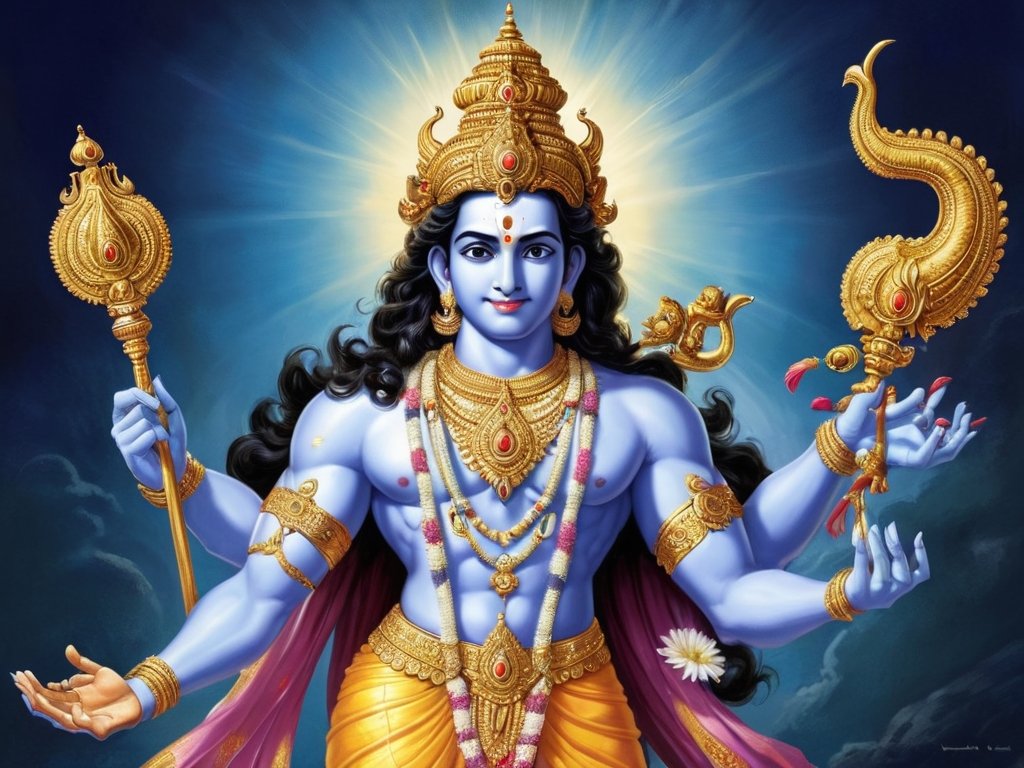
In paintings and temple sculptures, Vishnu is almost always shown with pale or deep blue skin, the color of a cloudless sky and the deep ocean.
In Hindu iconography, blue symbolizes the infinite and immeasurable nature of a deity who pervades every corner of space.
9. His four hands hold four symbolic objects
Vishnu is traditionally portrayed with four arms, each holding an object that represents one of his divine powers.
He carries the Panchajanya (a conch shell whose trumpet blast represents the primeval sound of creation), the Sudarshana Chakra (a spinning, razor-sharp discus that cuts down evil), the Kaumodaki (a golden mace symbolizing strength and natural law), and a lotus flower representing purity and spiritual liberation.
10. He rides through the heavens on the eagle-king Garuda
Every major Hindu deity travels on a sacred mount or vahana. Vishnu’s mount is Garuda, a giant mythical creature with the golden body and limbs of a man and the beak, talons, and wings of an eagle.
A sworn enemy of serpents, Garuda flies faster than the wind and carries Vishnu wherever his help is needed.
11. His consort Lakshmi is the goddess of fortune and prosperity
Vishnu’s wife is Lakshmi, the goddess of wealth, good fortune, beauty, and abundance, who rose from the Ocean of Milk when the gods and demons churned the sea.
Whenever Vishnu incarnates on Earth as a mortal, Lakshmi accompanies him: when he came as Rama, she was his devoted wife Sita; when he came as Krishna, she appeared as Rukmini and Radha.
12. The largest religious monument on Earth was built in his honor
While thousands of temples across India are dedicated to Vishnu, his grandest sanctuary stands in Southeast Asia.
In the early 12th century, Khmer King Suryavarman II built the massive temple complex of Angkor Wat in Cambodia as a Hindu state temple dedicated specifically to Vishnu before it later became a Buddhist site.
13. His tenth and final avatar, Kalki, is still to come
According to Hindu cosmology, humanity currently lives in the Kali Yuga, the fourth and darkest age of the cosmic cycle, marked by greed and moral decline.
Scriptures foretell that at the very end of this age, Vishnu will appear one last time as Kalki, riding a white horse with a blazing sword in hand to defeat wickedness and usher in a new golden age of truth (Satya Yuga). Which aspect of Hindu mythology do you find most interesting? Let us know in the comments below.