Standing inside the Galleria dell’Accademia in Florence, Michelangelo’s David is one of the most famous sculptures in human history. Over five centuries after it was carved from a single block of white marble, the statue still draws millions of visitors a year.
Here are 10 remarkable facts about Michelangelo’s masterpiece and the story behind its creation.
1. Michelangelo was only 26 years old when he got the commission
In August 1501, the overseers of Florence Cathedral commissioned a 26-year-old Michelangelo Buonarroti to carve a colossal statue of the biblical hero David. Having recently stunned Rome with his Pietà, the young sculptor worked in secrecy behind wooden walls for more than two years.
When he finished the statue in 1504, it cemented his reputation as the foremost artist of the Italian Renaissance.
2. He carved it from a ruined block of marble other sculptors had abandoned
The massive slab of Carrara marble, nicknamed “The Giant”, had been sitting exposed to the weather in the cathedral workshop courtyard for nearly forty years. Two earlier sculptors, Agostino di Duccio in 1464 and Antonio Rossellino in 1475, had chiseled into the stone before giving up.
They complained the marble was too narrow, brittle, and riddled with tiny holes. Michelangelo took the neglected block and managed to carve a complete standing figure out of it without adding a single piece.
3. The statue stands over five meters tall and weighs more than five tons
Visitors who have only seen photographs are often surprised by the sheer scale of the sculpture. Without its pedestal, David stands 5.17 meters (17 feet) tall and weighs roughly 5,660 kilograms (over 12,400 pounds).
The statue was originally meant to be hoisted high onto a roofline buttress of Florence Cathedral, but once completed, everyone realized it was far too heavy and too detailed to place on a roof.
4. Unlike earlier artists, Michelangelo showed David before the battle
Previous Renaissance sculptors such as Donatello and Verrocchio had always depicted David after his victory, standing over the severed head of Goliath with a sword in hand.
Michelangelo broke with tradition by capturing the tense moment right before the fight. David stands alert with furrowed brows, his sling draped over his left shoulder and the stone held in his right hand as he sizes up his giant opponent.
5. Leonardo da Vinci sat on the committee that chose where to put it
Because the statue could not go on the cathedral roof, Florence convened a committee of thirty prominent citizens and artists, including Leonardo da Vinci and Sandro Botticelli, to decide where it should stand.
In June 1504, the statue was placed outside the Palazzo Vecchio, the seat of civic government. There, the giant-slayer became a political symbol of the Florentine Republic’s determination to defend its independence against larger rival states and the powerful Medici family.
6. David’s head and right hand are intentionally oversized
If you look closely at the statue’s anatomy, you will notice that the head and especially the right hand are larger than normal human proportions. Art historians point out two reasons for this deliberate choice.
First, because the statue was designed to be viewed from below, slightly enlarging the upper features made it read clearly from ground level. Second, it was a visual pun on David’s medieval Latin nickname, manu fortis (“strong of hand”).
7. His pose is a classic example of contrapposto
Michelangelo positioned David with almost all of his weight resting on his right leg while his left leg relaxes forward. Known as contrapposto, this classical Greek stance tilts the hips and shoulders in opposite directions, giving the marble figure a lifelike sense of movement.
Even the veins on the back of his lowered right hand bulge naturally from gravity, while his raised left hand shows no swollen veins.
8. The original moved indoors in 1873 after standing outside for 369 years
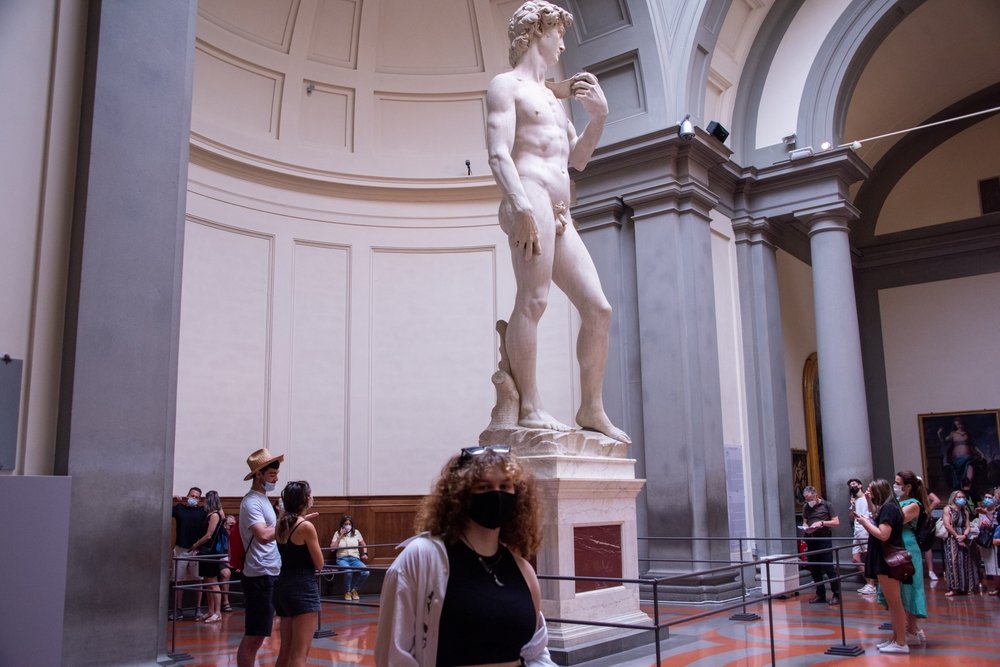
Photo: lucarista Shutterstock.com
For nearly four centuries, the marble statue stood outdoors in the Piazza della Signoria, enduring rain, frost, lightning strikes, and political riots. During an uprising in 1527, rioters threw a heavy wooden bench from a palace window and shattered David’s left arm into three pieces.
To protect the aging marble from further damage, authorities moved the original sculpture indoors in 1873 to a custom-built rotunda inside Florence’s Galleria dell’Accademia.
9. A full-scale marble replica has stood on the original square since 1910
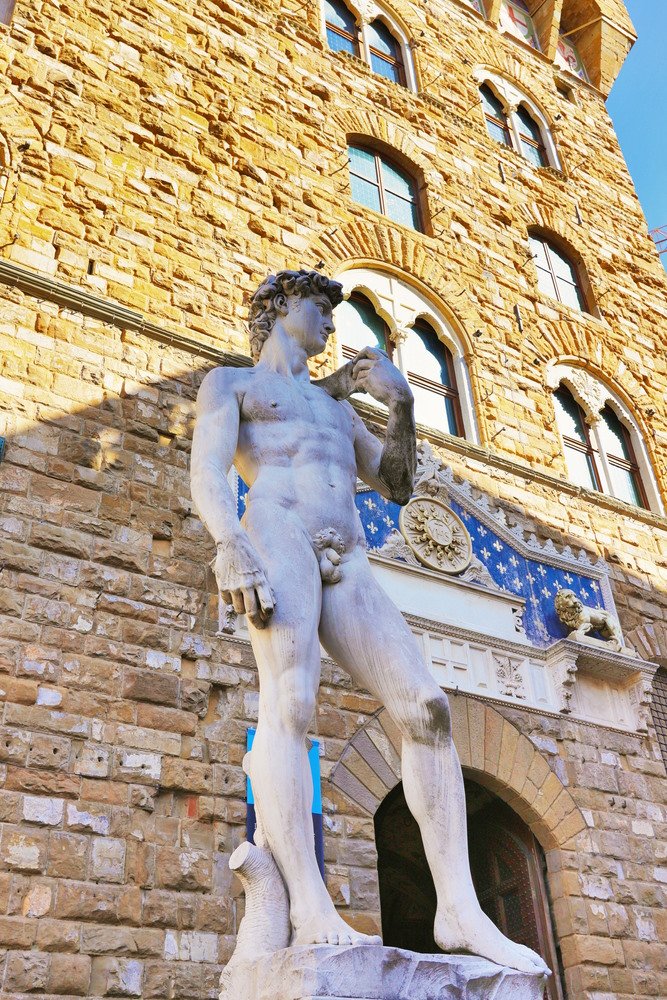
After the original statue was moved to the museum, the spot outside the Palazzo Vecchio remained empty for decades. In 1910, sculptor Luigi Arrighetti carved an exact marble copy that still stands on the original outdoor pedestal today.
A second famous copy, cast in bronze, overlooks the city from the panoramic terrace at Piazzale Michelangelo.
10. Hairline cracks in the ankles require constant protection
Because the statue stood at a slight tilt in the open square for centuries, the five-ton load put uneven stress on its narrow ankles. Restorers later discovered a network of tiny micro-fractures in both lower legs, particularly the supporting right ankle and the tree-stump brace behind it.
Today, the gallery floor is equipped with anti-seismic shock absorbers to shield the marble from street traffic vibrations, minor earthquakes, and the footsteps of millions of visitors. Have you ever seen Michelangelo’s David in person? Let us know in the comments below.