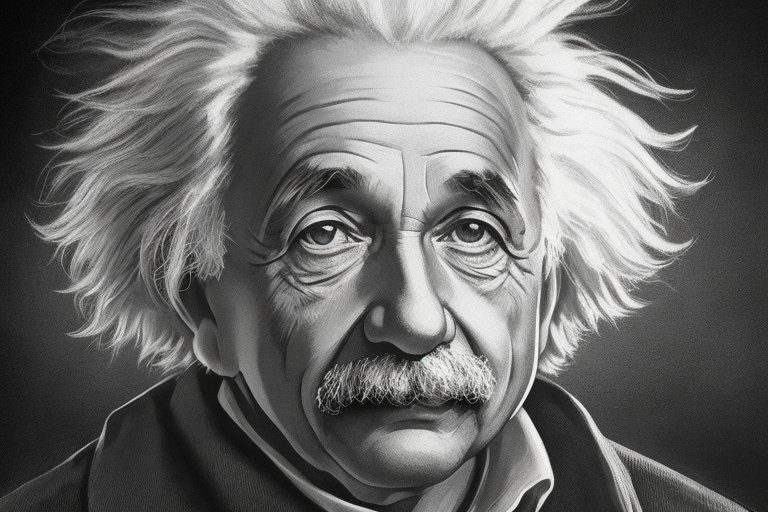
When you talk about famous scientists, you talk about Albert Einstein. He was one of the greatest physicists of the 20th century, and his name has become a synonym for genius. But he also led an eventful and sometimes surprising life.
These are ten surprising facts about Albert Einstein.
10. He failed his first university entrance exam
Even the most famous scientist in the world was not always top of the class. In 1895, at the age of 16, two years younger than usual, Einstein took the entrance exam for the Polytechnic in Zurich. He did very well in mathematics and physics, but failed the general part of the exam, including subjects such as French and botany. He spent an extra year at a school in Aarau in Switzerland and was admitted a year later.
The story that Einstein failed mathematics at school, however, is a myth. He was excellent at it from a young age.
9. He married his cousin
Einstein married twice. His first wife was Mileva Marić, a Serbian physics student he met in Zurich. His parents were not happy with the relationship. Before they married, Mileva gave birth to a daughter, Lieserl, whose fate is unknown, and the couple later had two sons. The marriage fell apart, partly because of Einstein’s affairs.
After the divorce in 1919, Einstein married Elsa Löwenthal, who was his first cousin on his mother’s side and a second cousin on his father’s side. They had known each other since childhood and remained married until Elsa’s death in 1936.
8. The FBI kept a file on him for over twenty years
Einstein left Germany for the United States in 1933, shortly after Hitler came to power. Unlike many scientists, he was outspoken about politics: he was a pacifist, a socialist sympathizer and a campaigner for civil rights. The FBI under J. Edgar Hoover suspected him of communist sympathies and kept a file on him from 1932 until his death, which eventually grew to around 1,400 pages. They never found anything incriminating.
7. His letter helped start the atomic bomb
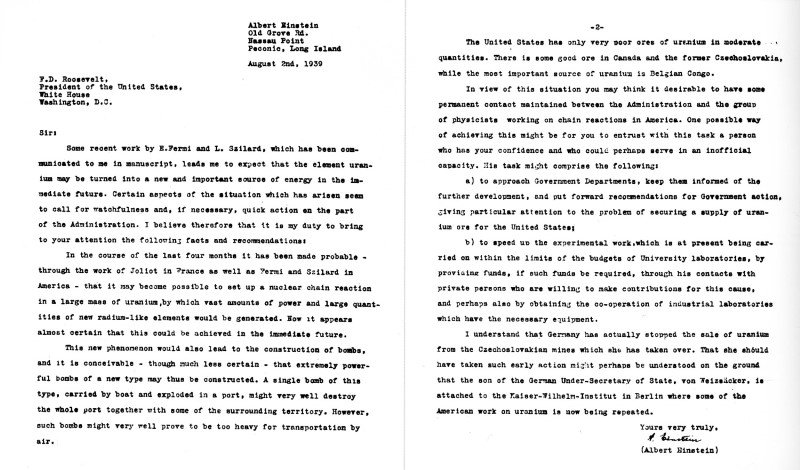
In August 1939, Einstein signed a letter to President Franklin D. Roosevelt, drafted with physicist Leó Szilárd, warning that Nazi Germany might develop an atomic bomb and urging the United States to start its own research. The letter helped lead to the Manhattan Project. Einstein himself did not work on the bomb. After the atomic bombings of Hiroshima and Nagasaki, he deeply regretted his role and later said that signing the letter was “the one great mistake” of his life.
6. He turned down the presidency of Israel
Einstein had strong ties to the Jewish community and supported the founding of the Hebrew University of Jerusalem. When Israel’s first president, Chaim Weizmann, died in November 1952, the Israeli government offered the presidency to Einstein. He politely declined, writing that he lacked “both the natural aptitude and the experience to deal properly with people and to exercise official functions”.
5. He refused life-saving surgery
In April 1955, Einstein suffered an internal bleeding caused by the rupture of an aneurysm in his abdominal aorta, which had been operated on years earlier. Surgery might have prolonged his life, but he refused. “I want to go when I want,” he said. “It is tasteless to prolong life artificially. I have done my share; it is time to go.” He died on 18 April 1955 in Princeton, at the age of 76.
4. His brain was taken without permission
During the autopsy, pathologist Thomas Harvey removed Einstein’s brain, reportedly without the family’s permission, and kept it for decades, cut into hundreds of pieces. Studies of the brain have claimed various differences, such as an unusual number of glial cells or an unusual shape of certain regions. But critics point out that the studies compared it with very few other brains, and that the researchers knew which brain was Einstein’s, which could lead to bias.
3. He hated socks and haircuts
Einstein was famous for his eccentric habits. He hated wearing socks, because his big toe always made holes in them, so he simply stopped wearing them. He also disliked going to the barber and preferred his wild, messy hair. His appearance became part of his legend: the famous photo of Einstein sticking out his tongue, taken on his 72nd birthday in 1951, is one of the most recognizable portraits of the 20th century.
2. Galileo was one of his heroes
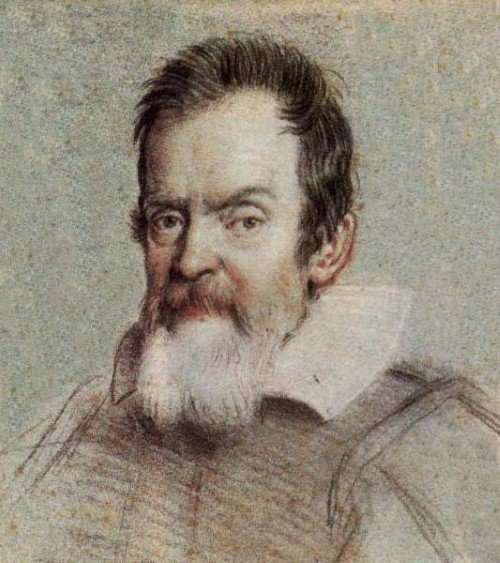
Einstein greatly admired Galileo Galilei, calling him “the father of modern physics, indeed of modern science altogether”. Galileo had already formulated an early principle of relativity in the 17th century: the laws of motion are the same whether you are standing still or moving at a constant speed. Einstein built on that idea. He also had portraits of Isaac Newton, Michael Faraday and James Clerk Maxwell in his study.
1. He did not win the Nobel Prize for relativity
The theory of relativity is Einstein’s most famous achievement, and it turned physics upside down. Yet when he received the Nobel Prize in Physics for 1921, it was not for relativity, which was still considered too controversial. Instead, the prize was awarded “for his services to theoretical physics, and especially for his discovery of the law of the photoelectric effect”, based on a paper he published in 1905. That work helped lay the foundations of quantum physics.