 Grindstone Media Group / Shutterstock.com
In the Netherlands we look with pride at the Johan Cruijff ArenA and De Kuip, which, with more than fifty thousand seats each, are among the largest stadiums in our country. However, at a global level, these arenas pale into insignificance. Outside Europe, governments and sports associations have built gigantic concrete amphitheaters that can easily accommodate double the number of spectators. Many of these behemoths owe their size to world championships, political prestige projects or continental tournaments. These are the 10 largest football stadiums in the world, ranked by their official capacity for football matches.
Which one of these deserves the top spot? Cast your votes below and let us know your personal ranking in the comments!
Cast your vote - the ranking shifts live based on the votes.
Rungrado May 1 Stadium (North Korea: 114,000 seats)
On an island in the Taedong River, in the middle of the North Korean capital Pyongyang, stands the absolute giant of the sports world. The Rungrado 1 May Stadium, which opened in 1989, immediately stands out because of its remarkable roof construction with sixteen concrete arches, which give the structure the appearance of a budding magnolia flower. For years the regime claimed that the stadium could accommodate 150,000 spectators. After a modernization in which the wooden benches were replaced by individual chairs, the international athletics federation set the actual capacity at 114,000 seats: still more than enough to claim the global number 1 position. Although the national team occasionally plays a qualifying match there, the gigantic arena mainly serves as the setting for the famous Arirang mass games, in which tens of thousands of gymnasts and extras synchronously perform propaganda for the ruling Kim dynasty.
Spotify Camp Nou (Spain: 99,354 seats)
Camp Nou in Barcelona has been the proud giant of European club football since 1957. The steep, open stands breathe the glory of generations of ball magicians: from Johan Cruijff and Diego Maradona to Ronaldinho and Lionel Messi. With an official capacity of 99,354 seats, it was for decades the only football stadium in Europe that almost reached the magical limit of one hundred thousand spectators. To meet modern commercial requirements, the sanctuary went under the knife from 2023 for the large-scale project *Espai Barça*. The old, draughty third ring was completely demolished to make way for a hypermodern covered construction with VIP rings. After its reopening, the Catalan football temple will accommodate no fewer than 105,000 spectators, definitively securing its status as the largest club stadium in the world.
Log in to post a comment.
FNB Stadium / Soccer City (South Africa: 94,736 seats)
On the edge of the famous township of Soweto in Johannesburg is the largest football arena on the African continent. The stadium was completely rebuilt for the 2010 World Cup and was nicknamed *The Gourd*, because of its striking mosaic facade in earth tones, reminiscent of a traditional African cooking pot. The complex is steeped in South African history. Nelson Mandela gave his very first mass speech here in 1990 after his release from prison, and made his very last public appearance during the closing ceremony of the 2010 World Cup. For Dutch football fans, Soccer City evokes mixed feelings: it was the setting where Andrés Iniesta ended the Dutch World Cup dream in the 116th minute of extra time.
Log in to post a comment.
Misr Stadium (Egypt: 93,940 seats)
In the middle of the desert, about 45 kilometers east of Cairo, Egypt is rapidly building its brand new government city: the New Administrative Capital. The Misr Stadium was built there as a sporting crown jewel, which officially opened its doors in the spring of 2024. The stadium's architectural design is inspired by the headdress of the legendary Ancient Egyptian queen Nefertiti. With a capacity of exactly 93,940 covered seats, this arena immediately dethroned the Borg El Arab Stadium as the largest stadium in the country. It is the showpiece of the Egyptian sports complex with which the country aims to organize the Olympic Games and the Football World Cup.
Log in to post a comment.
The Rose Bowl (United States: 92,542 seats)
Although the Rose Bowl in Pasadena, California is best known as the setting for prestigious American football games between college teams, this outdoor amphitheater has left an indelible mark on global football. The stadium dates back to 1922 and can accommodate no fewer than 92,542 spectators. In the sweltering heat of July 1994, Italian star player Roberto Baggio shot his fateful penalty sky-high over the goal, making Brazil world champions for the fourth time. Five years later, the bowl was the setting for the 1999 Women's World Cup final, where more than 90,000 spectators watched Brandi Chastain score the decisive penalty kick: a global turning point for the popularity of women's football.
Log in to post a comment.
Wembley Stadium (England: 90,000 seats)
Wembley is the cradle of modern football. After a billion-dollar renovation in 2007, the original *Empire Stadium* from 1923 with its characteristic Twin Towers made way for a hypermodern sanctuary for 90,000 spectators, spanned by an iconic steel arch of 133 meters high. The arena has no regular club players, but is reserved for the England national team, the FA Cup finals and major European tournaments. With its perfect sight lines, steep stands and a roof that can be partially closed in typical English bad weather, Wembley remains the benchmark for stadium comfort in the Western football world.
Log in to post a comment.
Estadio Azteca (Mexico: 87,523 seats)
No stadium in the world exudes as much historical grandeur as the Estadio Azteca in Mexico City. Located more than 2,200 meters above sea level, this legendary arena is the only stadium in the world where two of the greatest footballers of all time lifted the World Cup: Pelé with the wonderful Brazil in 1970, and Diego Maradona with Argentina in 1986. It was also the setting for Maradona's famous 'Hand of God' and 'Goal of the Century' against England. In its heyday, more than 107,000 spectators squeezed into the stands, but after modernizations and the addition of more luxurious boxes, the capacity is around 87,500 places. With the 2026 World Cup, the Aztec Stadium will once again write history: it will be the very first arena to host matches at three different world championships.
Log in to post a comment.
Bukit Jalil National Stadium (Malaysia: 87,411 seats)
On the south side of the Malaysian capital Kuala Lumpur, the Bukit Jalil National Stadium towers like a futuristic bowl. The complex was opened in 1998 for the Commonwealth Games and subsequently became the impregnable fortress of Malaysia's national team, the Harimau Malaya (Malaysian Tigers). With 87,411 brightly colored seats, this is the largest football stadium in Southeast Asia. The arena is known for its innovative membrane roof that protects spectators from the heavy tropical monsoon rains, while the open facade structure provides natural ventilation in Kuala Lumpur's hot and humid air.
Log in to post a comment.
Borg El Arab Stadium (Egypt: 86,000 seats)
Fifty kilometers west of the historic port city of Alexandria, a gigantic concrete fortress arose in the desert at the beginning of this century. The Borg El Arab Stadium was pitched as the showpiece of Egypt's bid for the 2010 World Cup. Although FIFA ultimately awarded the tournament to South Africa, Egypt was left with one of the largest arenas on the African continent. With a capacity of 86,000 spectators and a characteristic athletics track around the lawn, the stadium serves as an alternate port for the top clubs Al-Ittihad and Smouha. However, the complex is mainly famous as the place where the Egyptian national team plays its most important World Cup qualifiers, always supported by a deafening noise from tens of thousands of frenzied fans.
Log in to post a comment.
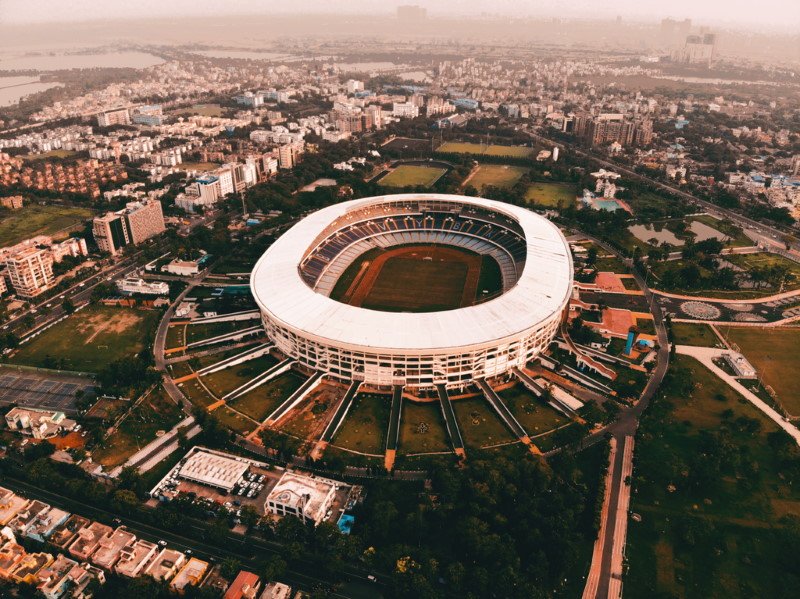
Salt Lake Stadium (India: 85,000 seats)
Anyone who thinks that India is all about cricket has never visited the city of Kolkata (Calcutta). In the state of West Bengal, football is an almost religious affair. The Salt Lake Stadium (officially the Vivekananda Yuba Bharati Krirangan), opened in 1984, was specially built to accommodate the huge crowds surrounding the local top clubs Mohun Bagan and East Bengal. In its early years, the bowl had simple concrete benches, which attracted a staggering record crowd of 131,781 spectators for the 1997 charged Calcutta derby. For the Under-17 World Cup in 2017, the complex underwent a major renovation with modern folding chairs installed everywhere. As a result, the capacity dropped to 85,000 places, which is still more than enough for the title of largest football arena in South Asia.
Log in to post a comment.
Missing an item in this list?
Log in or create a free account to add an item yourself.
Log in / create account
Log in to post a comment.