 Skyshark Media / Shutterstock.com
England is considered the cradle of modern football and nowhere in the world can you taste the tradition as intensely as around the British stadiums. While in many European countries you will find drafty concrete boxes far outside the center, the English arenas are often still located in the middle of working-class neighborhoods, wedged between red-brick terraced houses. At the same time, the commercial explosion of the Premier League has led to a wave of state-of-the-art mega-stadiums with retractable pitches and in-house microbreweries. These are the 10 largest football stadiums in England, ranked by official spectator capacity.
Which one of these deserves the top spot? Cast your votes below and let us know your personal ranking in the comments!
Cast your vote - the ranking shifts live based on the votes.
Wembley Stadium (London)
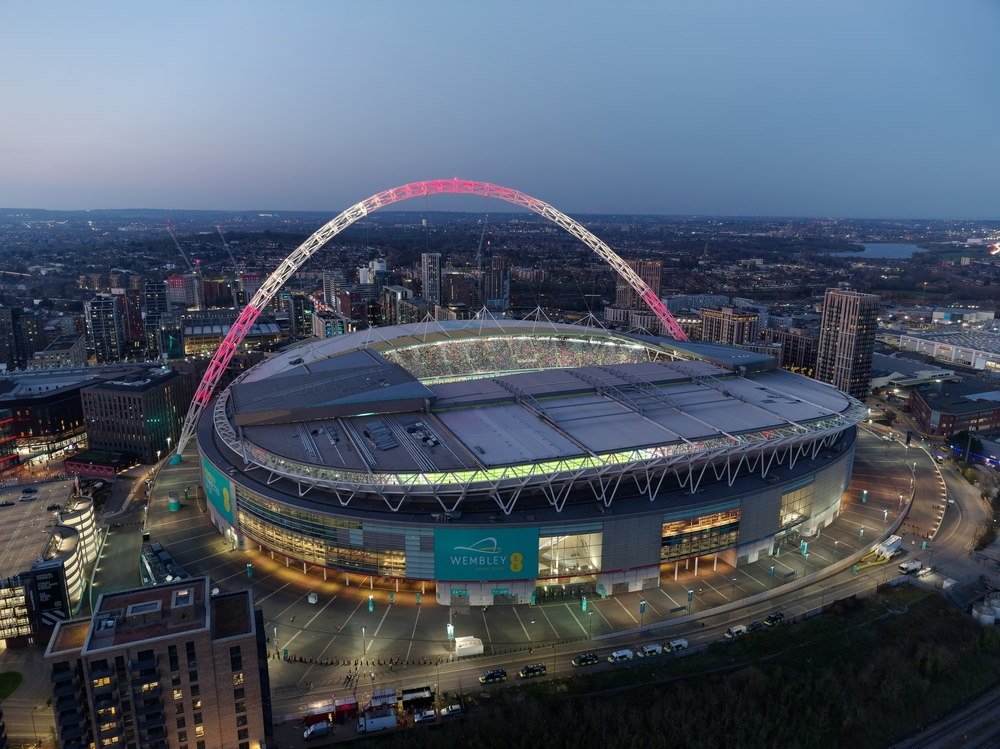
With a breathtaking capacity of exactly 90,000 indoor seats, Wembley is the undisputed sanctuary of English football. The famous 'Twin Towers' of the original 1923 stadium made way for a 133-metre-high steel arch when it reopened in 2007, which can be seen from all over London on a clear day and supports the world's longest continuous roof structure. Wembley has no regular club players, but is the exclusive domain of the English national team, the cup finals and promotion play-offs. Climbing the 107 steps to the Royal Box to collect the silver cup remains the ultimate dream of every English professional footballer. The stadium is considered the second largest football stadium on the European continent after Camp Nou.
Old Trafford (Manchester)
Once affectionately dubbed 'The Theater of Dreams' by club icon Sir Bobby Charlton, Old Trafford remains by far the largest club stadium in all of Great Britain with 74,310 seats. The arena survived German bombings during the Second World War and provided the backdrop for the club's legendary resurrection after the Munich air disaster in 1958. Yet the aging giant has clearly shown signs of wear and tear in recent years. Leaking roofs and outdated aisles led to sharp criticism from supporters. Since the arrival of co-owner Sir Jim Ratcliffe, revolutionary plans have been on the table: the club is seriously considering building an ultra-modern new mega stadium of 100,000 seats directly next to the current monument, nicknamed the 'Wembley of the North'.
Log in to post a comment.
Tottenham Hotspur Stadium (London)
The absolute technological benchmark in the sports world is in North London. Opened in 2019, the Tottenham Hotspur Stadium, built on the historic ground of White Hart Lane, cost over a billion pounds and is packed with technical feats not seen anywhere else in Europe. Underneath the turf is a complete artificial turf for American Football (NFL). Within 25 minutes, the Premier League grass field splits into three sections and rolls on rails under the south stand, so that concerts or NFL matches can be played directly on the plastic floor. With 62,850 seats, its own microbrewery that taps tens of thousands of pints per hour and Britain's steepest covered single-deck stand (The South Stand), Tottenham set a new standard for stadium comfort.
Log in to post a comment.
London Stadium (London)
When West Ham United left the atmospheric Boleyn Ground (Upton Park) for the former London 2012 Olympic Stadium in 2016, it led to huge protests among their own supporters. Supporters complained about the enormous distance from the pitch and the lack of the raucous working-class atmosphere of east London. In the following years, however, the athletics castle was adapted for pure football use with millions of investments. The lower stands were moved closer to the playing field on rails and the official football capacity was gradually increased to 62,500 spectators. This means that West Ham has the second largest club stadium in the English capital.
Log in to post a comment.
Anfield (Liverpool)
Instead of moving to a soulless new-build location, Liverpool FC opted for a risky but brilliant renovation strategy: expanding the historic Anfield brick by brick while still playing football. Following the renovation of the Main Stand, the massive new Anfield Road Stand was also completed in early 2024. This increased the capacity to 61,276 places, the highest spectator number at Anfield in more than seventy years. Despite the modern steel extensions, the soul of Anfield remains intact. The legendary stand *The Spion Kop* (nowadays with folding chairs) provides a unique cauldron at European top nights, led by the anthem “You'll Never Walk Alone”. Outside the gates, the Grade II listed Hillsborough Memorial commemorates the 97 supporters who lost their lives during the 1989 Cup match in Sheffield.
Log in to post a comment.
Emirates Stadium (London)
In 2006, Arsenal said goodbye with a heavy heart to Highbury, the iconic art-deco stadium where the club celebrated its greatest successes. The move to the Emirates Stadium, just a stone's throw away, cost hundreds of millions of pounds and forced coach Arsène Wenger to bite the bullet in the transfer market for years. The result, however, was a financial gold mine. With 60,704 covered seats, a turf billiard cloth and state-of-the-art VIP facilities, the Emirates Stadium transformed the London club into a commercial giant. Although supporters in the early years complained about a lack of atmosphere compared to cozy Highbury, the arena has turned into a seething fortress again under manager Mikel Arteta.
Log in to post a comment.
Etihad Stadium (Manchester)
Before Manchester City stormed the global football top with billions from Abu Dhabi, this complex was the central setting of the 2002 Commonwealth Games. After the athletics event, the Manchester municipality had the athletics track dug out and the stands extended to the grass, after which City finally left the intimate but outdated Maine Road behind. The stadium currently seats 53,400 supporters. In May 2012, it provided the backdrop for the most insane final act in the history of the Premier League, when Sergio Agüero scored the winning goal against QPR in the 94th minute. To keep up with the competition with London clubs, City is currently expanding the North Stand with a hotel and sky bar, increasing the capacity to 60,000 spectators.
Log in to post a comment.
St James' Park (Newcastle upon Tyne)
Like an asymmetrical spaceship of steel and glass, St James' Park towers above the hills of Newcastle. Because historic mansions on the east side of the site are a protected cityscape, the club was not allowed to expand in that direction. The architects therefore chose to increase the height of the north and west stands to enormous heights. The result is a capacity of 52,305 spectators and one of the strangest perspectives in world football: away fans placed on the top tier of the Leazes End sit so high that they literally look into the mist when there is low cloud. The acoustics under the gigantic cantilevered roof simultaneously ensure that the singing of the 'Toon Army' resounds throughout the entire city center.
Log in to post a comment.
Stadium of Light (Sunderland)
The fact that a stadium in a northern port city bears the poetic name 'Stadium of Light' has nothing to do with star allure and everything to do with heavy industrial history. The arena was built in 1997 on the foundations of the Monkwearmouth Colliery, one of the deepest coal mines in Europe. The name is a direct tribute to the tens of thousands of miners who, for generations, descended into the earth with their Davy safety lamp to power the city. With 48,707 red and white seats, Sunderland AFC has one of the most impressive stadiums outside the traditional top clubs. Even when the club dropped to the third tier (League One), tens of thousands of loyal supporters continued to crowd the stands, a passion that was seen worldwide in the famous documentary series Sunderland 'Til I Die.
Log in to post a comment.
Villa Park (Birmingham)
The graceful brick facade of the Holte End immediately reveals that you are dealing with pure football nobility here. Villa Park dates from 1897 and was partly designed by the legendary Scottish architect Archibald Leitch, the man who laid the foundation for classic British stadium construction with cast iron fencing and steep wooden stands. With a capacity of 42,640 spectators, Aston Villa's home ground is the largest football stadium in the English Midlands. For decades it was the traditional neutral venue for the FA Cup semi-finals. Because Aston Villa is once again participating in the European top, advanced plans are now in place to renovate the North Stand and increase the capacity beyond 50,000 seats.
Log in to post a comment.
Missing an item in this list?
Log in or create a free account to add an item yourself.
Log in / create account
Log in to post a comment.