The saber-toothed cat is one of the most iconic predators of prehistory. This impressive animal, known to scientists as Smilodon, ruled the plains and forests of the Americas for more than two million years. With its enormous canine teeth and muscular body, it was one of the most feared hunters of its time.
These are 15 impressive facts about the saber-toothed cat.
1. It was not a tiger
Despite its popular name, “saber-toothed tiger”, Smilodon was not a tiger and not closely related to tigers or lions. It was a cat, but it belonged to an extinct group called the Machairodontinae, which split off from the ancestors of modern cats millions of years ago. Any similarity with tigers is superficial, which is why scientists prefer the name saber-toothed cat.
2. Its fangs were up to 28 centimeters long
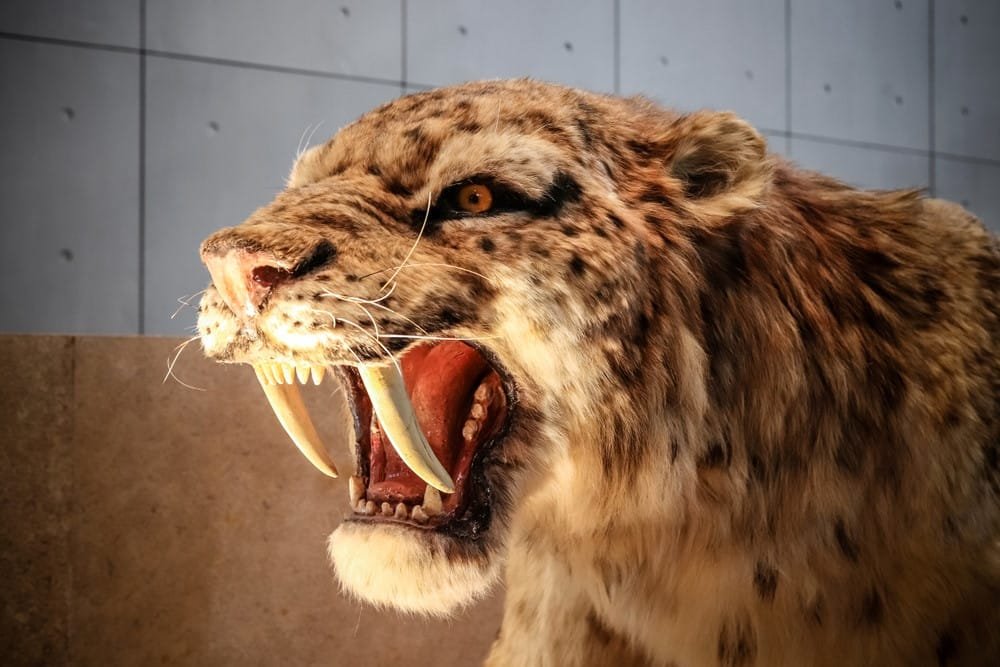
The upper canines of the largest saber-toothed cats could reach a length of about 28 centimeters, including the part hidden in the skull. They stuck out of its mouth even when it was closed. The teeth were not round but flattened from side to side, with finely serrated edges like a steak knife, ideal for slicing through soft tissue.
3. There were several species
The best-known species is Smilodon fatalis from North America, but there were three in total. Smilodon populator from South America was the largest and heaviest, possibly weighing more than 400 kilograms, which makes it one of the largest cats that ever lived. Smilodon gracilis was the smallest and oldest of the three.
4. It did not use its teeth for fighting
The canines were impressive but also fragile. They were not built for contact with bone or for fights with other predators. Most scientists think Smilodon used them for a single, precise purpose: a quick bite to the throat or neck of its prey, cutting through major blood vessels and the windpipe. After that, the prey would quickly collapse.
5. It had incredibly muscular front legs
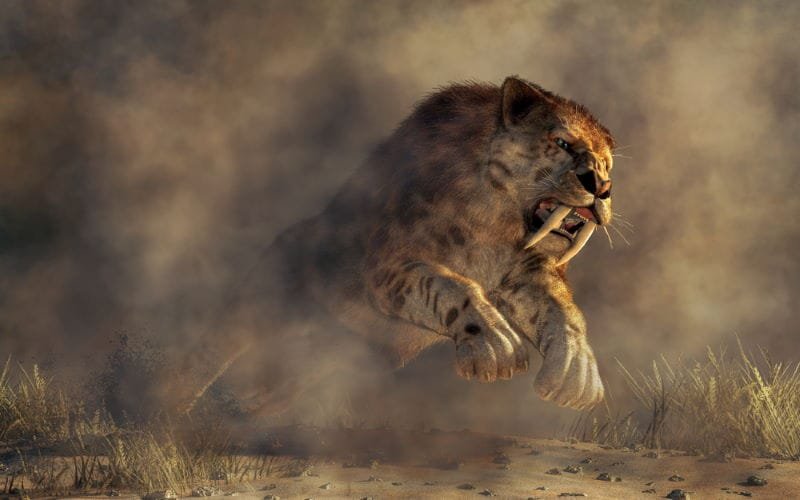
Smilodon had a heavier, more robust body than any modern big cat. Its front legs and shoulders in particular were extremely powerful, more like those of a bear. It needed this strength to grab large prey, wrestle it to the ground and hold it still before delivering the fatal bite, so that its precious teeth would not break.
6. It hunted large prey
Saber-toothed cats specialized in big game, such as bison, horses, camels, deer, ground sloths and probably young mammoths and mastodons. This fits its hunting method: not a long chase, but a short, powerful attack from ambush.
7. It lived in North and South America
Smilodon was an American animal. Its fossils have been found from Canada to southern South America. Smilodon fatalis dominated North America and the west coast of South America, while Smilodon populator lived in the east of South America. They adapted to a variety of landscapes, from open plains to dense forests.
8. It was not a fast runner
Its heavy build, relatively short legs and short tail show that the saber-toothed cat was not a fast pursuit hunter like the cheetah. It was an ambush predator that sprang at its prey from cover. Once it had grabbed hold, its strength did the rest, not its speed.
9. Broken teeth were dangerous
However impressive the teeth were, they could break on contact with bone. Fossils of Smilodon with broken canines have been found, which shows that this did happen occasionally. A broken fang would have made hunting much harder, although some injured animals clearly survived for a long time.
10. It had a surprisingly short tail
Compared to modern big cats, Smilodon had a remarkably short, bobcat-like tail. Cats such as cheetahs use their long tail for balance during fast turns while chasing prey. The short tail of Smilodon fits its profile as a powerful ambush hunter that did not need great speed or agility.
11. Thousands were found in the La Brea Tar Pits
The La Brea Tar Pits in Los Angeles have yielded the remains of more than 2,000 saber-toothed cats, making it the second most common large mammal found there, after the dire wolf. The sticky asphalt acted as a trap: large animals got stuck, predators were attracted by the easy meal and got trapped themselves. That is why there are far more predators than prey animals in the tar pits.
12. It may have lived in groups
For a long time, scientists thought Smilodon was a solitary hunter. But some fossils from La Brea show severe injuries that had healed, such as broken bones and damaged hips. Some researchers believe that such injured animals could only have survived with the help of others, for example by sharing food, which would suggest that Smilodon lived in groups, like lions. Not all scientists agree, and the debate continues.
13. It could open its mouth to about 120 degrees
To use its long canines effectively, the saber-toothed cat had to be able to open its mouth extremely wide. Research suggests it could open its jaws to an angle of around 110 to 120 degrees, far wider than a modern lion, which manages about 65 degrees. This was possible thanks to a different structure of its jaw joint and skull.
14. It went extinct around 10,000 years ago
At the end of the last Ice Age, around 10,000 years ago, Smilodon disappeared along with much of the American megafauna, such as mammoths, ground sloths and giant camels. Climate change and the disappearance of its large prey played a role, and the arrival of humans as hunters and competitors may have been the final blow. As a specialist in big game, Smilodon could not adapt to a world without it.
15. It was a top predator
As an adult, Smilodon had few natural enemies. Only other large predators, such as the American lion, the short-faced bear and packs of dire wolves, could compete with it, mainly for food. For more than two million years, the saber-toothed cat was one of the dominant predators of the Americas.