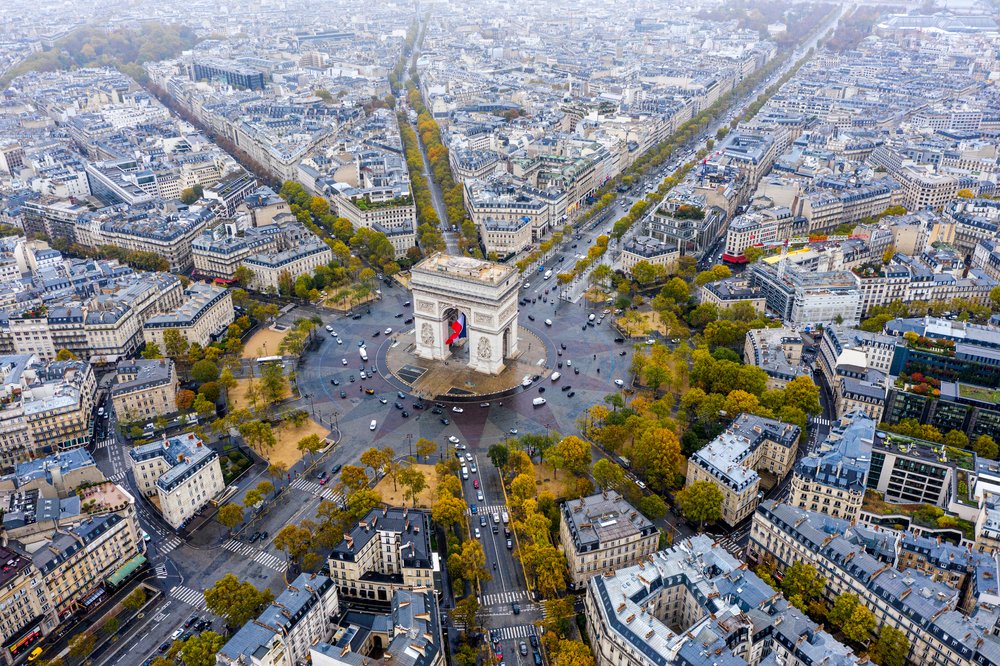
Towering over the western end of the Champs-Élysées, the Arc de Triomphe is one of the most recognizable landmarks in Paris. Although Emperor Napoleon Bonaparte ordered the monument built to celebrate his armies, he never lived to see it finished.
From a daredevil biplane flight right through its arch to the eternal flame burning beneath its vault, here are 15 fascinating facts about the Arc de Triomphe.
1. Napoleon ordered it built right after the Battle of Austerlitz
After crushing the Russian and Austrian armies at the Battle of Austerlitz in December 1805, Napoleon promised his soldiers: “You will return home through arches of triumph.”
In February 1806, he signed an imperial decree commissioning a grand monument at the edge of Paris dedicated to the glory of the French Grande Armée.
2. Construction took 30 years and Napoleon never saw it completed
Work began on August 15, 1806, Napoleon’s 37th birthday. Just laying the massive underground foundations took two full years, and when Napoleon married the Austrian Archduchess Marie-Louise in 1810, the arch was still only a few meters high, so the architect built a full-scale painted wood-and-canvas mockup for the wedding parade.
Construction stalled completely after Napoleon’s defeat at Waterloo in 1815. King Louis-Philippe finally completed and inaugurated the monument on July 29, 1836, fifteen years after Napoleon died in exile on Saint Helena.
3. The Tomb of the Unknown Soldier rests directly beneath the vault
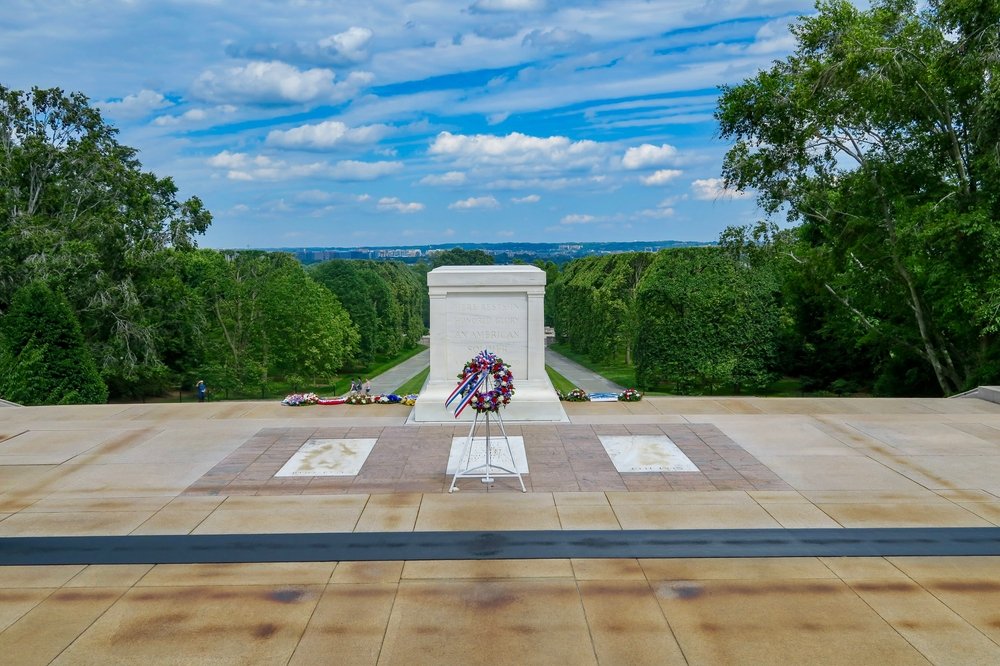
On Armistice Day in 1920, an unidentified French soldier killed during the First World War was placed in a chapel inside the arch and buried beneath the central vault on January 28, 1921. The inscription on the slab reads: “Here lies a French soldier who died for the fatherland, 1914-1918.”
An eternal flame was lit on the tomb on November 11, 1923. It has burned continuously ever since and is ceremonially rekindled every evening at 6:30 p.m.
4. Its most famous sculpture is nicknamed ‘La Marseillaise’
Four giant high-relief sculptures decorate the lower facades of the arch’s pillars. The most famous of the four, carved by sculptor François Rude on the east pillar facing the Champs-Élysées, is officially titled The Departure of the Volunteers of 1792.
Depicting the winged personification of Liberty rallying citizens to defend the French Republic, the energetic carving became so closely associated with France’s national anthem that everyone simply calls it La Marseillaise.
5. It stands nearly 50 meters tall
Designed by architect Jean-François Chalgrin in the Neoclassical style and inspired by the Roman Arch of Titus, the monument is built on a colossal scale. It measures 49.5 meters (162 feet) high, 45 meters wide, and 22 meters deep.
For more than a century, it was the largest triumphal arch in the world, until taller monuments were built in Mexico City in 1938 and Pyongyang in 1982.
6. The names of 660 generals are carved into its stone walls
Engraved along the inner walls of the arch are the names of 660 French generals and marshals who served during the First French Republic and Napoleon’s Empire.
If you look closely, some of the names are underlined: an underline indicates that the general was killed in action on the battlefield.
7. In 1919, a fighter pilot flew a biplane straight through the arch
During the 1919 World War I victory parade in Paris, the French military ordered airmen to march on foot rather than fly. Insulted on behalf of his fellow pilots, 20-year-old war ace Charles Godefroy decided to make a statement.
On the morning of August 7, 1919, Godefroy banked his Nieuport 11 biplane (which had a wingspan of 7.5 meters) down the avenue and flew clean through the 14.6-meter-wide opening of the Arc de Triomphe, with a photographer filming the stunt from the ground.
8. Twelve grand avenues radiate from its chaotic traffic circle
The monument stands at the center of the Place Charles de Gaulle, historically called the Place de l’Étoile (“Square of the Star”). Twelve straight boulevards fan out from the roundabout like the points of a star, a layout perfected by Baron Haussmann in the mid-19th century.
The multi-lane roundabout has no lane markings at all and is notorious among drivers; standard insurance companies in France typically split fault 50-50 for any fender-bender that happens on the circle.
9. It anchors Paris’s eight-kilometer ‘Historical Axis’
The Arc de Triomphe sits squarely on the Axe historique, a straight historic line running through western Paris.
Looking east from the roof of the arch, you can gaze straight down the Champs-Élysées to the Luxor Obelisk on the Place de la Concorde, the Tuileries Garden, and the courtyard of the Louvre. Looking west, the line continues straight to the modern Grande Arche of La Défense.
10. Visitors climb 284 steps to reach the rooftop viewing terrace
Inside the monument’s pillars, a spiral staircase of 284 steps leads up to a museum space inside the attic level and out onto the open-air rooftop platform.
From the top, visitors get one of the clearest views in Paris, looking straight down the twelve radiating avenues with the Eiffel Tower rising nearby.
11. Napoleon’s funeral carriage finally passed beneath it in 1840
Four years after the arch was completed, King Louis-Philippe arranged with Britain to bring Napoleon’s remains back from Saint Helena to France.
On a freezing December 15, 1840, a gilded funeral carriage carrying the Emperor’s coffin rolled slowly beneath the Arc de Triomphe before hundreds of thousands of onlookers on its way to Les Invalides.
12. Twice a year, the sun sets right inside the arch
Because the Champs-Élysées is aligned on a straight east-west axis toward the setting sun, a striking visual alignment occurs twice a year, around May 10 and August 1.
If you stand two kilometers away at the Place de la Concorde on a clear evening on those dates, the sun sinks directly inside the central archway.
13. The Tour de France has circled the monument every July since 1975
Since 1975, the final stage of the Tour de France has finished on the Champs-Élysées. During the closing circuits, the peloton races up the cobblestones toward the Arc de Triomphe and sweeps around the Place Charles de Gaulle before sprinting back down the avenue.
14. Artists Christo and Jeanne-Claude wrapped the entire arch in fabric in 2021
Back in 1961, conceptual artists Christo and Jeanne-Claude sketched a plan to wrap the Arc de Triomphe in fabric. Although neither artist lived to see it happen, their team carried out the project in September 2021.
For sixteen days, the entire 50-meter monument was draped in 25,000 square meters of recyclable silvery-blue polypropylene fabric held in place by 3,000 meters of red rope.
15. Pedestrians are banned from crossing the street to reach it
Because the surrounding twelve-avenue roundabout is so dangerous on foot, pedestrians are strictly forbidden from trying to run across the traffic lanes.
Instead, visitors reach the island safely by walking through the Passage du Souvenir, an underground pedestrian tunnel at the top of the Champs-Élysées. Have you ever climbed to the top of the Arc de Triomphe? Let us know in the comments below.