Most border crossings take you from one country into another. At roughly 175 geographic spots around the globe, however, three international borders converge at a single point known to geographers as a tripoint.
Some of these tripoints sit atop misty jungle plateaus or inside Arctic lakes, while others stand in the middle of bustling European cities where commuters cross three countries before breakfast. Here are ten of the world’s most remarkable multi-border meeting points.
1. Vaalserberg: The Three-Country Point (Netherlands, Belgium, and Germany)

At 322.4 meters above sea level, the wooded hill of Vaalserberg in the southern province of Limburg is the highest point on the European mainland of the Netherlands, and the exact spot where Dutch, Belgian, and German borders meet.
Today visitors walk around a stone boundary marker, climb viewing towers, and navigate a hedge maze. Even more remarkably, between 1816 and 1919 Vaalserberg was a true four-country point: because Prussia and the Netherlands could not agree on ownership of a valuable zinc mine nearby, they created a tiny neutral territory called Neutral Moresnet that met the other three borders right on the hilltop.
2. Treriksroset (Sweden, Norway, and Finland)
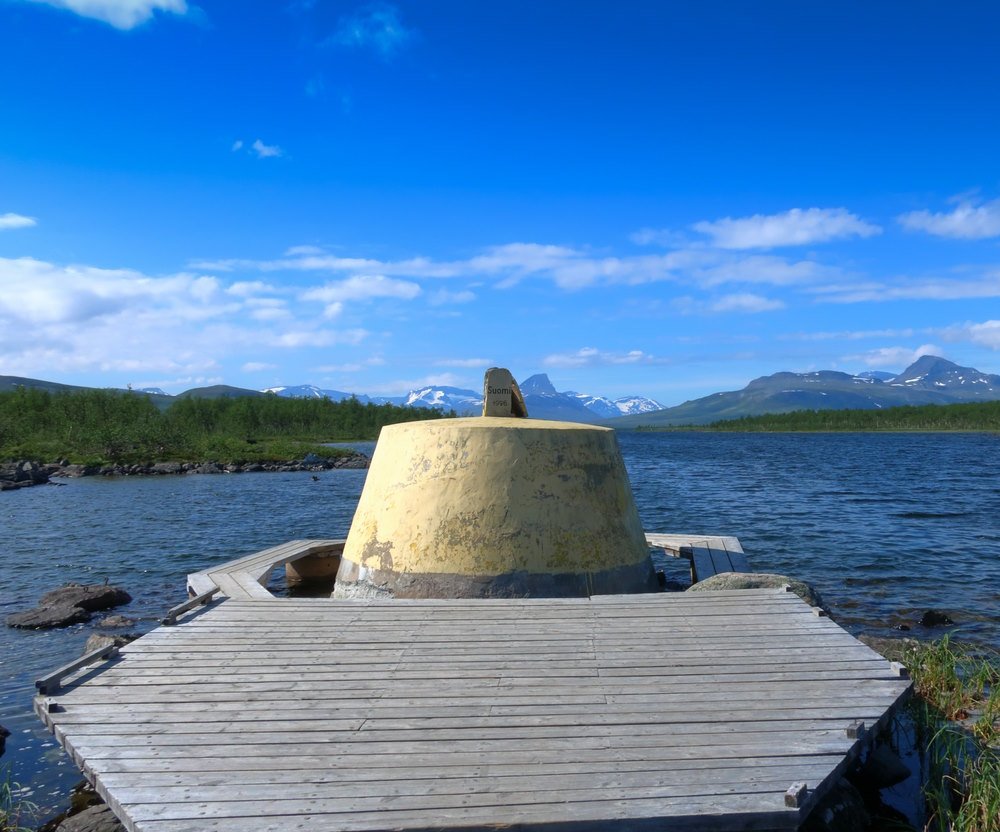
Sitting in the shallow waters of Lake Goldajavri nearly 300 kilometers north of the Arctic Circle, Treriksroset (Three-Country Cairn) is the northernmost international tripoint on Earth. Built as a dome-shaped yellow concrete monument in 1926 and reachable via an 11-kilometer wilderness hike or boat ride from Kilpisjarvi, the cairn lets visitors walk around a narrow wooden boardwalk and cross through Sweden, Norway, and Finland in less than ten seconds.
3. Mount Roraima (Venezuela, Brazil, and Guyana)
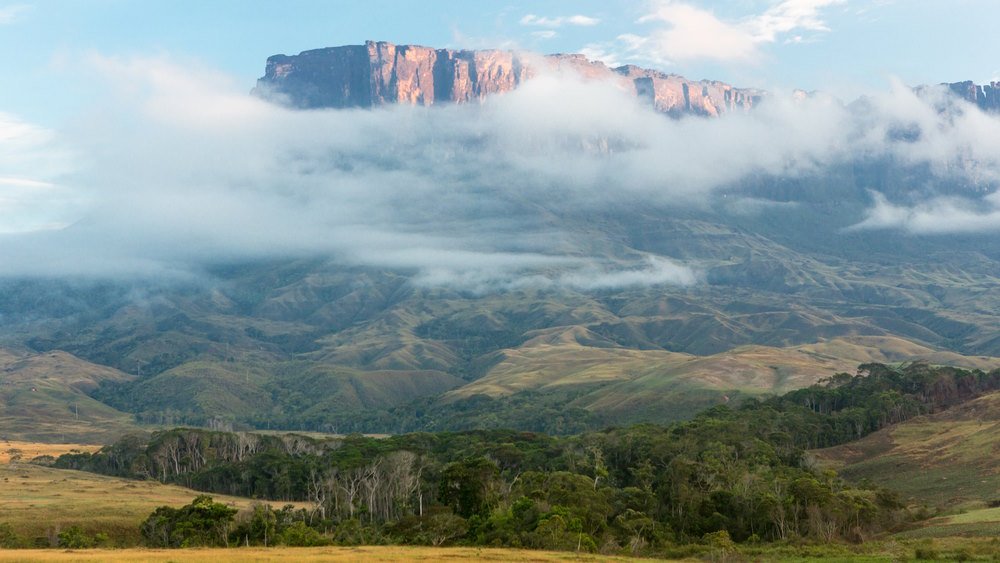
Rising 2,810 meters above the clouds with sheer 400-meter cliffs on every side, Mount Roraima is the highest of South America’s ancient flat-topped tepui table mountains.
A white pyramidal concrete marker atop its 31-square-kilometer summit plateau marks the remote tripoint of Venezuela, Brazil, and Guyana, a prehistoric landscape of quartz rock formations, carnivorous plants, and waterfalls that inspired Sir Arthur Conan Doyle’s 1912 adventure novel The Lost World.
4. Dreilandereck Basel (Switzerland, Germany, and France)
The exact tripoint of Switzerland, Germany, and France lies in the middle of the Rhine River on the northern edge of Basel, marked onshore by a futuristic steel pylon shaped like a rocket fin on a harbor peninsula. Life across this border is so integrated that Basel’s international airport (EuroAirport Basel-Mulhouse-Freiburg) sits entirely on French soil, is connected to Switzerland by a customs-free road, and is jointly operated by both countries.
5. Kazungula: The World’s Closest Near-Quadripoint (Zambia, Botswana, Zimbabwe, and Namibia)

For decades, trivia books claimed that Kazungula on the Zambezi River was the only place on Earth where four countries met at a single point.
Closer surveying revealed that instead of a true four-way intersection, two separate tripoints sit just 135 meters apart in the river channel where the Chobe River joins the Zambezi. That 135-meter water boundary between Botswana and Zambia is now spanned by the curved Kazungula Bridge, opened in 2021 so freight trucks can cross directly between Botswana and Zambia without entering Zimbabwe or Namibia.
6. Schengen on the Moselle River (Luxembourg, France, and Germany)
Few small villages have left a bigger mark on everyday European travel than Schengen, a winemaking town of 5,000 people tucked into the southeastern corner of Luxembourg where the Moselle River forms the tripoint with France and Germany. On June 14, 1985, representatives from five European nations boarded the riverboat Princesse Marie-Astrid anchored right at this tripoint to sign the Schengen Agreement, abolishing routine passport controls across what is now a 29-country borderless travel zone.
7. Tres Fronteras of the Amazon: Leticia, Tabatinga, and Santa Rosa (Colombia, Brazil, and Peru)
Deep in the Amazon rainforest, the Colombian town of Leticia and the Brazilian town of Tabatinga have grown into a single continuous urban area where residents walk or ride motorbikes across the border street without stopping at a checkpoint, while Peru’s Santa Rosa de Yavari sits on an island just across the Amazon River channel a five-minute boat ride away.
8. Treriksroysa at Muotkavaara (Norway, Finland, and Russia)
Marked by a stone cairn in the boreal wilderness near Lake Inari, Treriksroysa is the only place in the world where three different time zones met for years (Central European Time in Norway, Eastern European Time in Finland, and Moscow Time in Russia). Unlike the friendly boardwalk at Treriksroset further west, walking around this cairn is strictly illegal: crossing even a single foot into the Russian sector without a visa and border clearance carries heavy fines.
9. The Triple Frontier at Iguazu (Argentina, Brazil, and Paraguay)
Just downstream from the thundering cataracts of Iguazu Falls, the Iguazu River flows into the Parana River to form the Triple Frontier of Argentina, Brazil, and Paraguay. Each of the three nations has erected a stone obelisk painted in its national colors on its own riverbank, allowing visitors in Puerto Iguazu, Foz do Iguacu, and Presidente Franco to gaze across the water at two foreign countries simultaneously.
10. Lake Constance / Bodensee (Germany, Austria, and Switzerland)

Fed by the Alpine Rhine, Lake Constance (the Bodensee) is shared by Germany, Austria, and Switzerland, yet it holds a fascinating legal quirk: the three countries have never signed a treaty defining where their borders meet across the main body of the lake (the Obersee). Switzerland holds that the border runs through the middle of the water, Austria argues the lake beyond the shallow shoreline is a shared condominium owned jointly by all three states, and Germany officially leaves the question open, making the center of Lake Constance one of Europe’s most peaceful undefined borders.