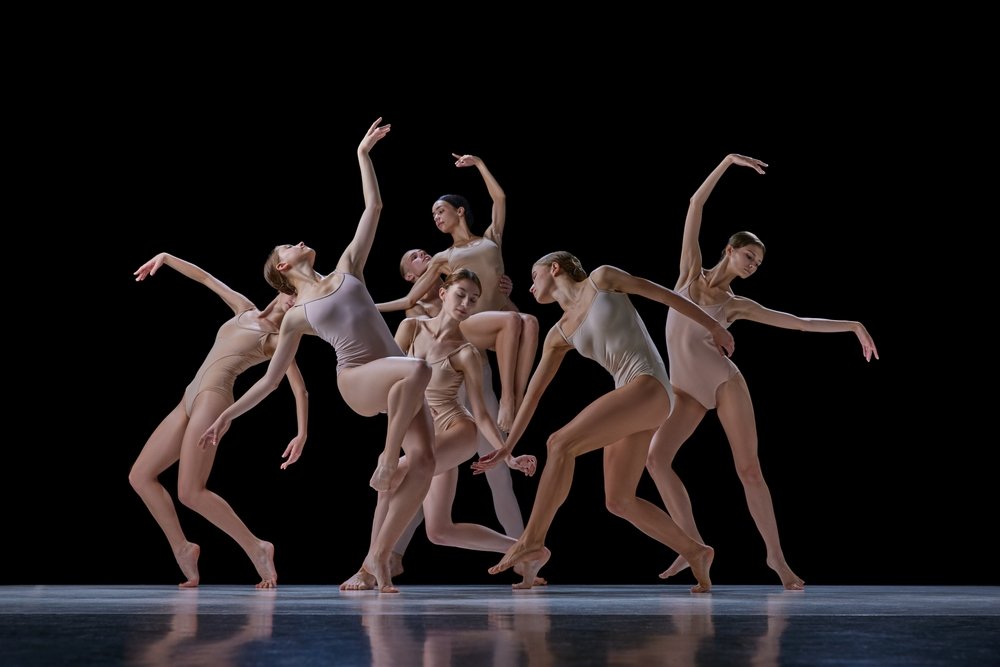
Dancers come in all kinds. One shines in a Hollywood musical, another fills an opera house with classical ballet, a third changes pop culture with a single move on television. What they share is that their names live on, sometimes a century after their last performance.
These are ten dancers who shaped the art of dance, counting down to number one.
10. Josephine Baker
Josephine Baker grew up in poverty in St. Louis and left home at the age of thirteen. In October 1925, she opened in La Revue Nègre at the Théâtre des Champs-Élysées in Paris, with a wild, energetic act called the Danse Sauvage. She was nineteen, and within a week she was the talk of the town. The famous skirt of artificial bananas came a year later, at the Folies Bergère.
Her dancing was a mix of the Charleston, wild improvisation and pure clowning, and she played deliberately with the prejudices of her audience. During the Second World War, she worked for the French Resistance and intelligence services. In 2021, she became the first Black woman to be honored in the Panthéon in Paris.
9. Gene Kelly
Gene Kelly is one of the biggest names of classic Hollywood. His best-known film is Singin’ in the Rain from 1952, which he co-directed with Stanley Donen. His style was athletic and down-to-earth, far removed from the floating elegance that had dominated the genre. Kelly often danced in casual clothes and loafers, where others wore white tie and tails.
He mixed ballet, tap and modern dance into something entirely his own. Singin’ in the Rain was only a modest success when it was released, but it now regularly tops lists of the greatest musicals ever made.
8. Margot Fonteyn
Margot Fonteyn joined the Vic-Wells Ballet school, the forerunner of the Royal Ballet, as a teenager and stayed with the company for her entire career. Choreographer Frederick Ashton created many roles especially for her, including Ondine and Marguerite and Armand. She is regarded as Britain’s first world-class ballerina.
In February 1962, she danced Giselle with the young Soviet defector Rudolf Nureyev for the first time. She was 42 and he was 23, and she had hesitated because of the age difference. It became one of the most famous dance partnerships of all time and lasted for years. In 1979, the Royal Ballet gave her the rare title of prima ballerina assoluta.
7. Martha Graham
Martha Graham founded her own dance company in New York in 1926 and is regarded as one of the founders of modern dance. Her work was a radical break with the strict rules of ballet. She wanted to strip away the decoration and reveal the emotion underneath.
The core of her technique is “contraction and release”, a principle based on breathing, combined with movements close to the floor, spirals through the torso and sharp, angular gestures. Graham created around 180 works, including Lamentation and Appalachian Spring, and kept performing on stage herself until she was in her seventies.
6. Fred Astaire
Fred Astaire and Ginger Rogers made ten films together between 1933 and 1949. They started as supporting players in Flying Down to Rio and within a year were the most famous dance couple in Hollywood. Their numbers combined ballroom, tap and soft shoe, with Top Hat and Swing Time considered the highlights.
What made their scenes different from what came before was the way they were filmed: long takes, few cuts, and the dancers always visible from head to toe. Astaire insisted that the audience should be able to see that the dancing was real, not a camera trick. For generations of dancers, he remains the benchmark.
5. Mikhail Baryshnikov
Mikhail Baryshnikov was born in 1948 in Riga, in what was then Soviet Latvia, to Russian parents. He studied ballet in Riga and later in Leningrad, and joined the Kirov Ballet in 1967. In June 1974, he defected to the West during a tour in Toronto.
In the West, he danced with American Ballet Theatre and New York City Ballet, and from 1980 to 1989 he was artistic director of ABT. He received an Oscar nomination for his role in the 1977 film The Turning Point. A new generation knows him as the Russian artist Aleksandr Petrovsky from the final season of Sex and the City.
4. Michael Jackson
On 25 March 1983, Michael Jackson performed “Billie Jean” for the TV special Motown 25: Yesterday, Today, Forever, which was broadcast in May. During the song, he glided backwards across the stage for a few seconds. An estimated 47 million Americans were watching. From that moment on, the moonwalk was his trademark.
The move itself was not his invention. The “backslide” had been circulating in street dance for years, and Jackson learned it from dancers such as Jeffrey Daniel. What he added was timing and stage presence. Jackson later said he was disappointed with his own performance that night, because he had wanted to hold a spin on his toes longer.
3. Rudolf Nureyev
Rudolf Nureyev was born in 1938 on a Trans-Siberian train, into a Tatar family. He only started formal ballet training at seventeen, at the famous school in Leningrad, and became a soloist with the Kirov Ballet in 1958. He was considered both brilliant and impossible to control.
In June 1961, at Le Bourget airport near Paris, he was ordered to fly back to Moscow. Instead, he asked the French police for asylum. As one of the first Soviet stars to defect during the Cold War, he became world news. In London, he helped put the male dancer back at the center of ballet, at a time when ballerinas received almost all the attention.
2. Vaslav Nijinsky
Parisian audiences called him le dieu de la danse, the god of dance. Vaslav Nijinsky was born in Kyiv around 1889, grew up poor and trained at the Imperial Theatre School in St. Petersburg. From 1909, he was the star of Sergei Diaghilev’s Ballets Russes. Spectators claimed he seemed to hang in the air during his leaps.
As a choreographer, he pushed the boundaries. His L’Après-midi d’un faune from 1912 was called obscene by part of the Paris press, and the premiere of The Rite of Spring in 1913 ended in uproar. His career lasted less than ten years. In 1919, he suffered a breakdown and was diagnosed with schizophrenia. He never danced in public again and died in 1950.
1. Anna Pavlova
Anna Pavlova was born in St. Petersburg in 1881 and danced with the Imperial Russian Ballet and briefly with the Ballets Russes. Her most famous role is The Dying Swan, a short solo that Michel Fokine created for her in 1905.
With her own company, she was the first ballerina to tour the entire world, from South America and Mexico to India and Australia, bringing ballet to audiences who had never seen it before. Because she had extremely high arches, she reinforced her pointe shoes with a piece of hard leather and flattened the tip. Some contemporaries called it cheating, but her adaptation became the basis of the modern pointe shoe. She died of pleurisy in The Hague in January 1931, at the age of 49, during what was meant to be another tour. Her last words are said to have been: “Prepare my swan costume.”