 Piotr Piatrouski / Shutterstock.com
With the hottest city derbies in Europe, monumental football temples and a rich tradition of technical attacking play, Spain is a dream destination for football fans. While clubs in England often opt for compact, brick stadiums, the Spaniards built gigantic concrete amphitheaters to offer tens of thousands of socios a place in the sun. Many of these arenas have undergone a major transformation in recent years in view of the 2030 World Cup, which Spain is organizing together with Portugal and Morocco. These are the 10 largest football stadiums in Spain, ranked by official spectator capacity.
Which one of these deserves the top spot? Cast your votes below and let us know your personal ranking in the comments!
Cast your vote - the ranking shifts live based on the votes.
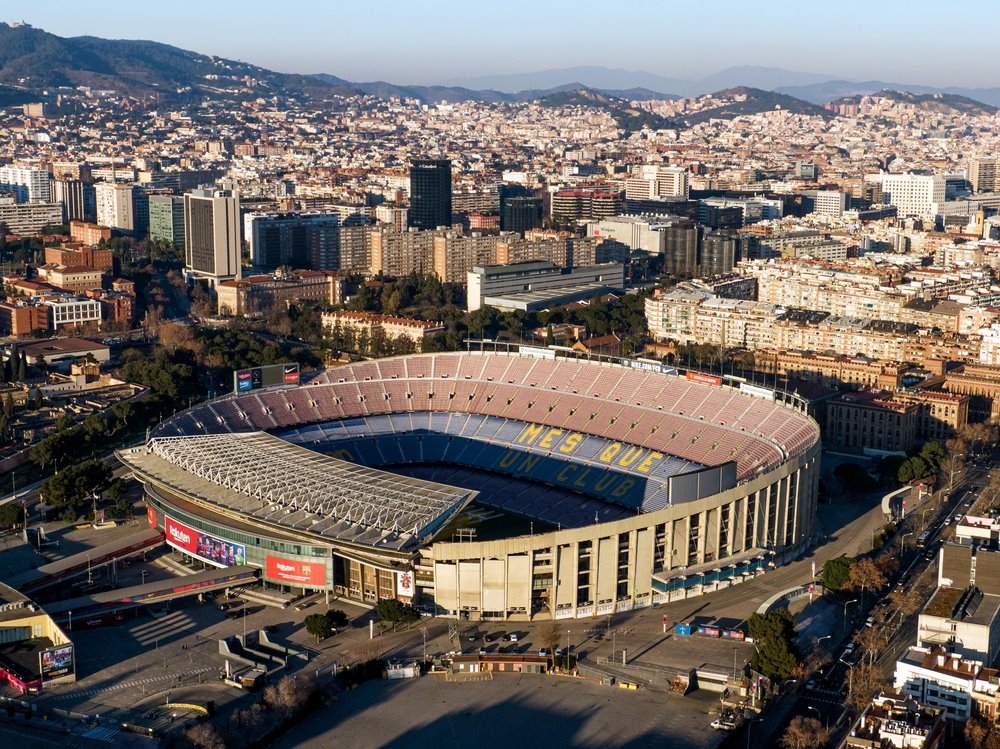
Spotify Camp Nou (Barcelona)
With an original capacity of 99,354 spectators, Camp Nou was the undisputed giant of the European continent for decades. The colossal structure was opened in 1957 because the old Les Corts stadium had simply become too small to accommodate all the fans of strongman László Kubala. The open concrete and the gigantic steep stands formed the stage where legends such as Johan Cruijff, Diego Maradona and Lionel Messi wrote football history. In 2023, the club broke ground on the multi-billion dollar project Espai Barça. The iconic, but outdated third ring was completely razed to the ground to make way for a hyper-modern, covered construction. Once the work is completed, the Catalan football temple will seat no fewer than 105,000 spectators, meaning Spotify Camp Nou will not only retain its number 1 position in Spain, but will also remain by far the largest stadium in all of Europe.
Estadio Santiago Bernabéu (Madrid)
The epicenter of the royal club Real Madrid underwent one of the most spectacular renovations in modern construction history between 2019 and 2024. The iconic stadium on Paseo de la Castellana was wrapped in a futuristic shell of stainless steel slats and equipped with a gigantic 360-degree video screen and a fully retractable roof. However, the absolute technical feat is located underground. The playing field can be divided into six segments and lowered thirty meters via enormous hydraulic lifts into an underground greenhouse (the so-called hypogeum). There, the grass is cared for with UV light, irrigation systems and air conditioning, so that the 84,000 spectators in the stands above can immediately enjoy concerts, tennis tournaments or NFL matches on a concrete floor the next day.
Log in to post a comment.
Riyadh Air Metropolitano (Madrid)
It hurt many Atlético Madrid supporters when the club said goodbye to the cozy, dilapidated Estadio Vicente Calderón on the banks of the Manzanares River in 2017. The move to the former athletics stadium 'La Peineta' on the eastern edge of Madrid initially seemed like a cold business move, but turned into a golden opportunity. After a renovation costing hundreds of millions of euros, the arena can accommodate 70,460 enthusiastic spectators. Thanks to an innovative membrane roof, the stadium works like a gigantic sound box, so coach Diego Simeone and his team can count on an intimidating cauldron. In 2019, the complex already formed the backdrop for the Champions League final between Liverpool and Tottenham Hotspur.
Log in to post a comment.
Estadio Benito Villamarín (Seville)
The beating, green and white heart of Real Betis is located on the chic Avenida de la Palmera in South Seville. The stadium originally dates from 1929, but was thoroughly renovated around the turn of the century and in 2017. With 60,721 seats, the Villamarín is considerably larger than the stadium of arch-rival Sevilla FC on the other side of the city. The arena has a mythical status in Spanish football memory. On December 21, 1983, the Spanish national team had to beat Malta by at least eleven goals to qualify for the 1984 European Championship. A miracle took place in front of a frenzied audience: Spain won 12-1, one of the most legendary results in football history.
Log in to post a comment.
Estadio La Cartuja (Seville)
Seville has the rare luxury of three huge football stadiums. However, unlike Sánchez-Pizjuán and Villamarín, La Cartuja does not have a permanent player. The stadium with almost 60,000 covered seats was built in 1999 for the World Athletics Championships and then threatened to become a very expensive 'white elephant', because neither Sevilla nor Real Betis wanted to move in. However, the Spanish Football Federation came to the rescue. La Cartuja was declared the official national stadium for the Copa del Rey finals. When Bilbao withdrew from the 2021 European Championship due to strict corona restrictions, La Cartuja stepped in at the last minute to host Spain's group matches. With a view to the 2030 World Cup, the stadium is currently being modernized even further.
Log in to post a comment.
Estadi Olímpic Lluís Companys (Barcelona)
On top of the Montjuïc hill lies a stadium with a storied history. It was built in 1929 for the World Exhibition and in 1936 would form the backdrop for the 'People's Olympiad', a protest event against Nazi Germany's Olympic Games in Berlin. However, the outbreak of the Spanish Civil War threw a spanner in the works. It was not until the 1992 Summer Olympics that the stadium experienced its sporting triumph. With a capacity of 55,926 places, the stadium served for many years as the home stadium of Espanyol, which left in 2009. In the summer of 2023, the monumental arena had an unexpected new resident: arch-rival FC Barcelona temporarily rented the mountain colossus to play Champions League and La Liga matches there for a season and a half during the renovation of Camp Nou.
Log in to post a comment.
San Mames (Bilbao)
In the Basque Country they don't just call their stadium a sports park, but La Catedral (The Cathedral). That nickname arose because the original stadium from 1913 was located right next to the church of Saint Mammes. In 2013, a brand new arena for 53,331 spectators was built right next to the old ground, which immediately won architectural prizes. The outside of the stadium is covered with thousands of LED panels that glow blood red in the evening when Athletic Bilbao goals are scored. The stadium is home to a unique football culture: the club has refused to attract foreign players for more than a century and only fields footballers with Basque roots. That club feeling creates a deafening noise that lingers perfectly within the stands thanks to the innovative wavy roof.
Log in to post a comment.
Estadio Mestalla (Valencia)
For people with a fear of heights, the upper ring of Mestalla is a real ordeal. The stands of the football temple, which opened in 1923, are among the steepest in Europe: anyone sitting at the top looks almost vertically down on the turf. With 49,430 seats, the stadium exudes pure nostalgia and an intense, raw football atmosphere. At the same time, Mestalla is the symbol of one of the biggest real estate fiascos in top football. On the other side of Valencia, the half-finished concrete skeleton of Nou Mestalla has been languishing since 2009, where construction was halted for more than fifteen years due to sky-high debts. While supporters wait for the move, the beloved, creaking Mestalla remains the battleground of Valencia CF.
Log in to post a comment.
Estadio Ramón Sánchez-Pizjuán (Seville)
The home base of Sevilla FC is located in the middle of the lively Nervión district. Anyone standing in front of the stadium will immediately see the monumental ceramic mosaic on the facade, designed for the 1982 World Cup. During that World Cup, the stadium with its extensive standing areas still offered space for 66,000 spectators, but after strict UEFA safety requirements and the switch to pure seating, the capacity was reduced to 43,883 seats. For visiting European clubs, this is one of the most feared stadiums in the world. Between 2006 and 2023, Sevilla built an unlikely reputation here by winning the UEFA Cup and Europa League seven times. The loud “Himno del Centenario”, which blares through tens of thousands of throats a cappella before every kick-off, makes many opponents weak in the knees.
Log in to post a comment.
RCDE Stadium (Barcelona / Cornellà)
For years, RCD Espanyol, the smaller brother of FC Barcelona, wandered through the city in search of its own identity. It was not until 2009 that the club found its permanent home in the suburb of Cornellà de Llobregat. With a capacity of 40,500 seats, the club did not build a drafty Olympic pool, but a modern, English-style football stadium where the audience sits right on the chalk lines. The stadium is considered one of the most environmentally friendly sports locations in Southern Europe: the entire roof is covered with solar panels that feed energy back into the local network. In March 2022, the complex wrote history when the Spanish national team played a friendly match against Albania. It was the first time in eighteen years that La Roja set foot on Catalan soil again.
Log in to post a comment.
Missing an item in this list?
Log in or create a free account to add an item yourself.
Log in / create account
Log in to post a comment.