Kate Bush is not merely a musician; she is an enigmatic auteur who redefined the boundaries of art-pop, theatrical performance, and female autonomy in the modern recording industry. Bursting onto the scene in 1978 as a nineteen-year-old prodigy with literary brilliance and an astonishing four-octave vocal range, Bush shattered every existing stereotype of the female pop singer. Rather than serving as an interpreter of other people’s melodies, she wrote every word, produced her own records, and pioneered groundbreaking studio production techniques, embracing the Fairlight CMI synthesizer to build entire universes of sound.
Her work explores psychological vulnerability, gothic romance, folklore, Cold War existential dread, and mystical maternal power with fearless imagination. Following the cultural resurgence of her masterwork in the 2020s, an entirely new generation has fallen under her hypnotic spell. Restoring her catalog to a complete 10-track canon, here are the top 10 best songs by Kate Bush.
10. Breathing
Released in April 1980 as the lead single from her third studio album Never for Ever, “Breathing” is one of the most daringly ambitious political pop tracks of the Cold War era. Written from the harrowing perspective of an unborn fetus inside its mother’s womb during a catastrophic nuclear fallout, the song explores planetary annihilation through the biological lens of respiration.
The lyrics depict the unborn child absorbing plutonium and radiation with every breath the mother takes.
9. This Woman’s Work
The song portrays a prospective father waiting in agony in a hospital hallway while his partner and unborn child endure life-threatening complications during childbirth, confronting past selfishness and mortality. Framed by Bush’s sparse, resonant piano chords, delicate vocal layering, and Michael Kamen’s soaring orchestral arrangements, the track possesses an almost sacred intimacy.
Bush’s falsetto soars into striking registers on the line “Give me these moments back,” delivering a universal meditation on love, sacrifice, and the fragility of human existence.
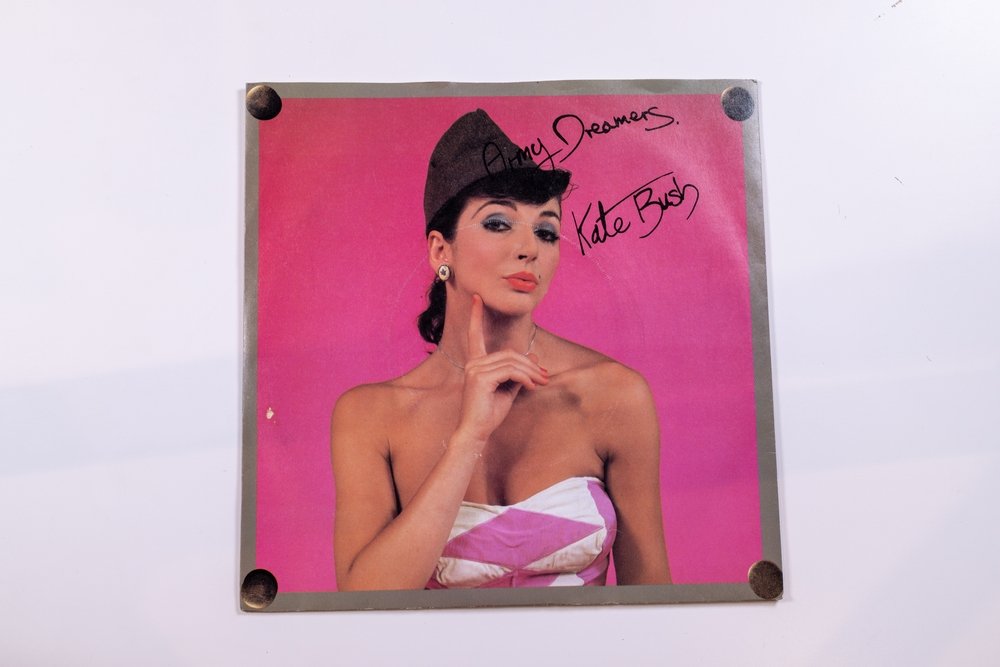
8. Army Dreamers
Also culled from 1980’s Never for Ever, “Army Dreamers” is an anti-war waltz disguised as a pastoral lullaby. Bush adopts the voice of a grieving mother mourning her young son, who joined the military out of economic desperation and lack of career options, only to return home in a military coffin: “He should have been a rock star, but he didn’t have the money for a guitar.”
Set in a jaunty 3/4 waltz time signature, the composition employs mandolins, bodhráns, and acoustic instruments to evoke British folk traditions, juxtaposed chillingly with the rhythmic mechanical sound effects of guns cocking and loading.
7. Babooshka
One of Bush’s most theatrical and commercially triumphant international hits, “Babooshka” peaked at number five on the UK Singles Chart in the summer of 1980. The narrative revolves around a paranoid wife who devises a cunning psychological trap for her husband: fearing he has lost interest in her, she adopts the pseudonym “Babooshka,” sending him scented love letters and setting up an illicit rendezvous to test his loyalty.
The production is notable for its innovative use of early digital sampling on the Fairlight CMI synthesizer, specifically the sound effect of shattered glass that punctuated the explosive choruses.
6. The Hounds of Love
The title track of her 1985 magnum opus, “The Hounds of Love” is a cinematic examination of the terror of falling in love and surrendering emotional control. The song famously opens with a sample from the 1957 British horror film Night of the Demon, with actor Maurice Denham’s ominous line: “It’s in the trees!
Propelled by Stuart Elliott’s thunderous, galloping tribal drums and lush string arrangements by the Medici Sextet, Bush portrays love not as a gentle sanctuary, but as a ravenous pack of hunting hounds pursuing a terrified fugitive across open moors.
5. Don’t Give Up (with Peter Gabriel)
Featured on Peter Gabriel’s landmark 1986 album So, “Don’t Give Up” is one of the most poignant duets in modern pop history. Inspired by the Great Depression photographs of Dorothea Lange and the severe economic devastation wrought by Thatcherite deindustrialization across the United Kingdom, Gabriel portrays an unemployed, disenfranchised man crushed by shame, self-doubt, and suicidal despair.
Gabriel initially approached Dolly Parton for the track, but upon her decline, reached out to Bush.
4. Cloudbusting
One of Bush’s most lyrically extraordinary triumphs, “Cloudbusting” was inspired by Peter Reich’s 1973 memoir A Book of Dreams, which chronicles his childhood relationship with his father, controversial psychoanalyst and inventor Wilhelm Reich. Reich had constructed elaborate “cloudbuster” machines designed to draw rain from the sky using orgone energy, leading to his eventual arrest and imprisonment by the U.S. government.
Bush constructs the song entirely around the lush, repetitive rhythmic drive of the Medici String Sextet and the military boom of an acoustic snare drum, completely eschewing traditional rock guitar instrumentation.
3. Running Up That Hill (A Deal with God)
The lead single from 1985’s Hounds of Love, “Running Up That Hill” originally bore the title “A Deal with God,” which record executives forced Bush to modify out of fear of religious backlash in the United States. The central thesis of the song is deeply philosophical: Bush muses that if a man and a woman could make a pact with God to swap bodies and psychological perspectives, all interpersonal conflict and gender misunderstandings would vanish.
Built upon a hypnotic LinnDrum percussion pattern and shimmering Fairlight CMI synthesizer chords programmed in Bush’s home studio, the track possesses an inexorable, propulsive momentum.
2. The Man with the Child in His Eyes
It remains one of the most astonishing prodigy achievements in recorded music history: Kate Bush wrote “The Man with the Child in His Eyes” when she was just thirteen years old, and recorded it at Abbey Road Studios with a full 40-piece orchestra arranged by Andrew Powell at age sixteen. Pink Floyd guitarist David Gilmour, who funded and mentored her initial demo tapes, recognized instantly that Bush possessed generational genius.
The ballad is striking in its melodic elegance and emotional maturity, capturing the delicate line between childhood innocence, romantic awakening, and male vulnerability.
1. Wuthering Heights
Released in January 1978, “Wuthering Heights” remains one of the most revolutionary debut singles in the history of popular music. Written by an eighteen-year-old Bush after watching the final ten minutes of a BBC television adaptation of Emily Brontë’s 1847 novel, Bush discovered that she shared her July 30 birthday with the reclusive author.
She penned the song from the ghostly perspective of Catherine Earnshaw, pleading at Heathcliff’s frosted windowpane to be let in: “Heathcliff, it’s me, Cathy, I’ve come home, I’m so cold!”
Which choice on this list is your personal favorite? Share your thoughts and rankings in the comments below.