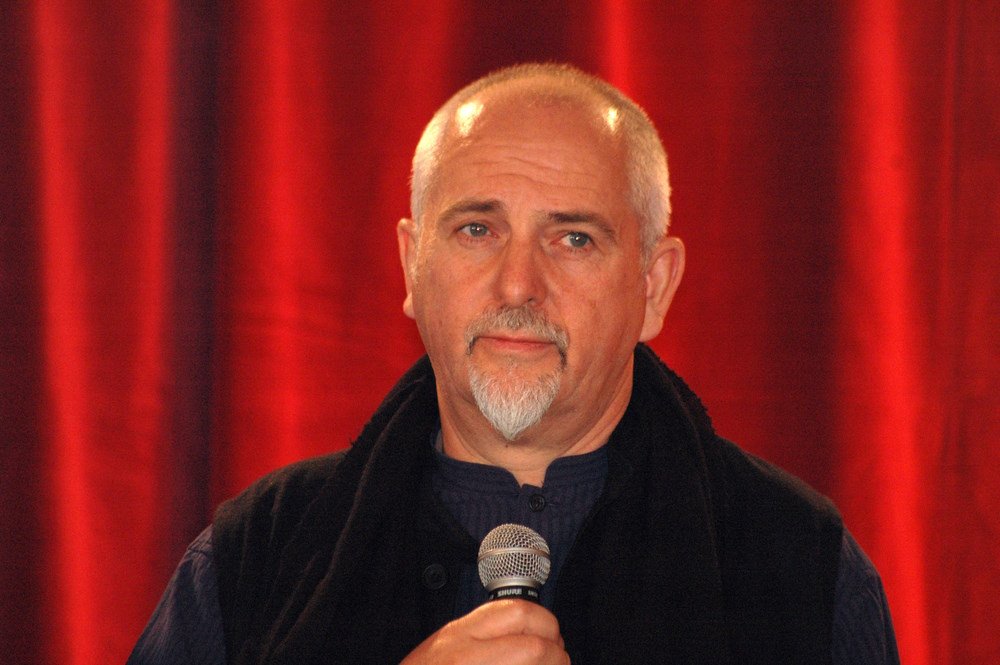
Few artists in modern music history have continually redefined the boundaries of progressive rock, worldbeat polyrhythms, digital synthesizer production, and groundbreaking audiovisual art quite like Peter Brian Gabriel.
First rising to international prominence in the early 1970s as the theatrical, shape-shifting frontman of progressive rock legends Genesis, Gabriel walked away from the band in 1975 to forge an extraordinary, uncompromising solo career.
10. Solsbury Hill
Serving as his debut solo single in 1977 following his dramatic departure from Genesis, “Solsbury Hill” is an uplifting, spiritually liberating declaration of personal independence. Written after a mystical experience atop Little Solsbury Hill in Somerset, England, Gabriel uses an unconventional 7/4 time signature to evoke a joyful, galloping release from creative confinement: “Climbing up on Solsbury Hill / I could see the city light / Wind was blowing, time stood still / Eagle flew out of the night / He was something to observe / Came in close, I heard a voice / Standing stretching every nerve / Had to listen, had no choice.”
Highlighted by Steve Hunter’s acoustic 12-string guitar picking and Gabriel’s exuberant vocal delivery, the song reached the UK Top 20 and remains an immortal anthem of rebirth and artistic courage.
9. Don’t Give Up (with Kate Bush)
Inspired by Dorothea Lange’s Great Depression photographs and the devastating economic devastation of British industrial towns under Thatcherism in the mid-1980s, “Don’t Give Up” from 1986’s So is one of the most poignant duets in modern music history. Gabriel originally approached country legend Dolly Parton, but when she declined, he turned to close friend and avant-pop genius Kate Bush.
Gabriel delivers a heartbreaking, despairing verse as an unemployed working man contemplating suicide, answered by Bush’s ethereal, maternal embrace offering unconditional hope: “Don’t give up, ’cause you have friends / Don’t give up, you’re not the only one / Don’t give up, no reason to be ashamed.”
8. Sledgehammer
A high-voltage homage to 1960s Memphis soul and Otis Redding, “Sledgehammer” catapulted Peter Gabriel to the summit of the US Billboard Hot 100 in July 1986 (famously displacing Genesis’s “Invisible Touch” from the number-one spot). Built around a sampled bamboo shakuhachi flute, Manu Katché’s thunderous drum pocket, and the Memphis Horns, Gabriel delivers playfully suggestive, muscular soul hooks.
The song achieved pop immortality through its historic stop-motion claymation and pixilation music video directed by Stephen R. Johnson alongside Aardman Animations.
7. Biko
Featured on his 1980 third eponymous album (often dubbed Melt), “Biko” was a historic political protest song honoring South African anti-apartheid activist Steve Biko, who was murdered by police in custody in September 1977. Rejecting cymbals entirely (a strict studio rule enforced by Gabriel), the track opens with the funeral song “Senzeni Na?” and heavy, funeral-march surdo drums played by Phil Collins.
Gabriel delivers a solemn, defiant eulogy that warned the apartheid regime that state violence cannot extinguish truth: “You can blow out a candle / But you can’t blow out a fire / Once the flames begin to catch / The wind will blow it higher / Yihla Moja, Biko.”
6. In Your Eyes
The spiritual centerpiece of So, “In Your Eyes” smoothly weaves African polyrhythms into a extraordinary love song. Featuring Senegalese superstar Youssou N’Dour delivering soaring Wolof vocals during the climax, the song explores the boundary between romantic passion and divine connection: “In your eyes, the light the heat / In your eyes, I am complete / In your eyes, I see the doorway to a thousand churches.”
Immortalized in Cameron Crowe’s 1989 film Say Anything… when John Cusack’s character Lloyd Dobler holds a boombox above his head outside his sweetheart’s bedroom window, “In Your Eyes” became an eternal romantic touchstone of late-80s cinema and culture.
5. Mercy Street
Dedicated to the tragic American confessional poet Anne Sexton, who took her own life in 1974, “Mercy Street” (named after Sexton’s play 45 Mercy Street) is an ambient, dreamlike meditation on clinical depression and the longing for peace. Driven by a gentle Brazilian forró triangle rhythm and Larry Klein’s double-tracked fretless bass, Gabriel records his lead vocal in two octaves simultaneously, one whispered in a low register, one sung tenderly above.
The atmosphere of shadowy intimacy and spiritual longing makes “Mercy Street” one of the most hauntingly beautiful and psychologically profound compositions Gabriel has ever recorded.
4. Red Rain
The thunderous opening track of So, “Red Rain” originated from a recurring dream Gabriel had of swimming in a backyard pool filled with red wine, which he expanded into an apocalyptic metaphor for nuclear fallout, environmental devastation, and emotional isolation. The track features Police drummer Stewart Copeland delivering crisp hi-hat cymbal patterns alongside Jerry Marotta’s heavy tom-toms.
Gabriel sings with apocalyptic urgency over Tony Levin’s driving bass and sweeping keyboards: “Red rain is coming down / Red rain / Red rain is pouring down / All over me.”
3. Digging in the Dirt
The lead single from his dark, confessional 1992 album Us, “Digging in the Dirt” was written during an intense period of psychodynamic therapy following the painful collapse of his marriage and his subsequent relationship with Rosanna Arquette. Gabriel explores his own repressed anger, violent impulses, and subconscious demons: “This time you’ve gone too far / This time you’ve gone too far / Told you, told you, told you, told you / Digging in the dirt / To find the places we got hurt.”
Driven by an aggressive, industrial-funk groove and David Rhodes’ abrasive guitar scratches, the track won the Grammy Award for Best Short Form Music Video for its disturbing stop-motion clip depicting Gabriel decaying underground before resurrecting.
2. Games Without Frontiers
The breakthrough single from his 1980 third album, “Games Without Frontiers” satirizes nationalism, Cold War military gamesmanship, and jingoism by comparing international diplomacy to childish playground games. Taking its title from the European television gameshow Jeux Sans Frontières, the song features Kate Bush singing the haunting French refrain: “Jeux sans frontières.”
Built around a whistling hook, a robotic synthesizer pulse, and Hugh Padgham’s revolutionary “gated reverb” drum sound (discovered during these sessions and later popularized on Phil Collins’ “In the Air Tonight”), the single reached number four in the UK, establishing Gabriel as a subversive pop visionary.
1. Here Comes The Flood
Originally recorded in 1977 with heavy, symphonic production by Bob Ezrin, an arrangement Gabriel famously felt was over-cluttered: “Here Comes The Flood” reached its true, immortal majesty when Gabriel stripped it down to solitary piano and voice (first recorded with Robert Fripp on 1979’s Exposure and later revisited on Shaking the Tree). The song envisions a telepathic cataclysm where human beings are suddenly able to hear each other’s unspoken thoughts, drowning in an emotional tidal wave of shared vulnerability.
Gabriel delivers a vocal performance of striking, biblical grandeur, singing of spiritual surrender and rebirth: “Lord, here comes the flood / We’ll say goodbye to flesh and blood / If again the seas are silent in any skull / Then find the quiet heart that could / Hear the song of the flood.”
Which choice on this list is your personal favorite? Share your thoughts and rankings in the comments below.