
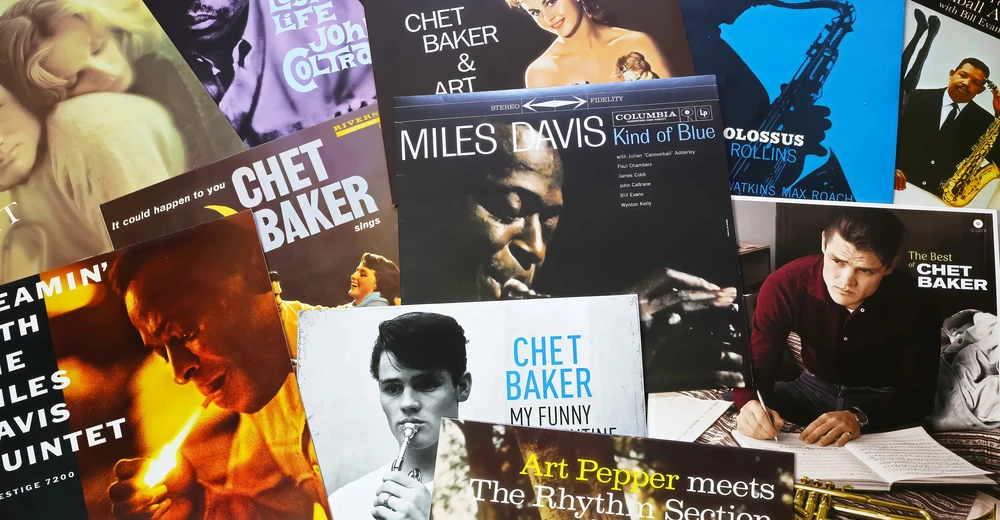
Jazz is the art of the unexpected: a revolutionary American art form that united breathtaking improvisation, harmonic sophistication, and deep emotional soul. From the smoky speakeasies of New Orleans and Chicago dancehalls to the avant-garde lofts of New York City, jazz fundamentally altered the DNA of modern music.
Its greatest innovators weren't just exceptional instrumentalists—they were sonic philosophers who challenged conventions and bent time, rhythm, and tone to their will. Here are the twenty greatest jazz musicians and virtuosos of all time.
Which one of these deserves the top spot? Cast your votes below and let us know your favorites in the comments!
Cast your vote - the ranking shifts live based on the votes.
Miles Davis
In just two recording sessions in the spring of 1959, Miles Davis revolutionized the musical landscape with 'Kind of Blue'. By abandoning rigid chord progressions in favor of modal scales, he gifted musicians unprecedented artistic breathing room. Paul Chambers's walking bassline and Davis's whispering, melancholic Harmon-muted trumpet on 'So What' remain the eternal pinnacle of effortless musical cool.
John Coltrane
A spiritual force of nature on the tenor and soprano saxophone, John Coltrane stretched the technical and emotional limits of music to infinity. On 1965's 'A Love Supreme', his iconic four-note mantra formed the launchpad for a transcendent journey of devotion, technical transcendence, and sheer passion. Coltrane didn't just play jazz; he treated every performance as an ecstatic prayer.
Log in to post a comment.
Louis Armstrong
Modern popular music simply would not exist without Louis Armstrong. His breathtaking opening cadenza on 1928's 'West End Blues' stands as the holy grail of jazz soloing: brilliantly articulated, rhythmically daring, and drenched in profound blues expression. 'Satchmo' established the soloist as the central figure of jazz and introduced swing phrasing to the entire world.
Log in to post a comment.
Thelonious Monk
Thelonious Monk played the piano like an architect searching for the hidden spaces between the keys, using jarring dissonances, sudden pauses, and percussive attacks. His nocturnal masterpiece ''Round Midnight' remains the most recorded jazz standard of all time, packed with bittersweet harmonies and startling logic. Monk proved that musical genius lies just as much in the notes you don't play.
Log in to post a comment.
Chet Baker
With his whispering, fragile trumpet tone and languid, intimate vocal style, Chet Baker became the poster boy and bittersweet soul of West Coast cool jazz. The tender simplicity of his phrasing on 'My Funny Valentine' connected directly with deep vulnerability and romantic melancholy. Baker showed that quiet restraint and delicate melody could be infinitely more powerful than sheer volume.
Log in to post a comment.
Charlie Parker
Charlie 'Bird' Parker played the alto saxophone faster and with greater harmonic daring than anyone thought humanly possible. Teaming up with Dizzy Gillespie in the 1940s, he sparked the bebop revolution with dizzying sixteenth-note runs and sophisticated chord substitutions on tracks like 'Ko-Ko'. Parker fundamentally altered how musicians conceived of melody, rhythm, and improvisation.
Log in to post a comment.
Ella Fitzgerald
Blessed with a three-octave range and impeccable pitch, 'The First Lady of Song' remains the benchmark for vocal jazz perfection. When she famously forgot the lyrics to 'Mack the Knife' live in Berlin, she instantly improvised one of the most legendary scat solos in recording history. Fitzgerald's joyful swing, warmth, and rhythmic precision made her an untouchable vocal virtuoso.
Log in to post a comment.
Dave Brubeck
Teaming up with alto saxophonist Paul Desmond, Dave Brubeck took the jazz world by storm with 1959's 'Take Five', composed in an audacious 5/4 time signature. Driven by Joe Morello's hypnotic drum vamp and Desmond's dry-martini sax tone, this daring rhythmic experiment became the best-selling jazz single in history. Brubeck proved that complex odd meters could achieve massive crossover pop success.
Log in to post a comment.
Bill Evans
Bill Evans introduced the delicate, impressionistic harmonies of French composers like Debussy and Ravel into the classic jazz piano trio format. His tender, poetic touch on 'Waltz for Debby' revealed a singing tone and harmonic depth that influenced generations of modern pianists. Evans's conversational trio dynamic elevated collaborative improvisation to sublime artistic heights.
Log in to post a comment.
Herbie Hancock
A restless innovator with boundless musical curiosity, Herbie Hancock has seamlessly traversed hard bop, modal jazz, jazz-funk fusion, and electronic hip-hop. His 1964 standard 'Cantaloupe Island' merged modal melodies with an irresistible, earthy piano groove that later birthed Us3's 1990s hit 'Cantaloop'. Hancock remains one of the most vital, genre-bending architects of modern sound.
Log in to post a comment.
Duke Ellington
As a composer, arranger, and bandleader, Duke Ellington brought aristocratic elegance and unmatched compositional ambition to the big-band swing era. Transforming Billy Strayhorn's 'Take the A Train' into an unstoppable locomotive of rhythm, his orchestra operated as a single, multi-faceted instrument. Ellington elevated jazz into the upper echelons of serious American orchestral music.
Log in to post a comment.
Charles Mingus
Known as 'The Angry Man of Jazz', Charles Mingus was a ferocious bassist and composer who poured volcanic emotion into his sprawling, gospel-infused arrangements. His haunting elegy 'Goodbye Pork Pie Hat', written in honor of the late Lester Young, wraps mournful tenor saxophone leads in dark, bruising blues chords. Mingus created visceral, deeply human music of breathtaking intensity.
Log in to post a comment.
Billie Holiday
Few songs in history carry such a chilling, courageous emotional weight as Billie Holiday's 1939 recording of 'Strange Fruit'. Her hushed, devastating delivery protesting the lynching of African Americans in the South pierced through commercial entertainment like a scalpel. 'Lady Day' transformed pop singing into a vehicle of raw emotional truth and profound social courage.
Log in to post a comment.
Sonny Rollins
The 'Saxophone Colossus' brought his vibrant Caribbean heritage to the jazz canon on the joyous, calypso-infused classic 'St. Thomas'. Renowned for his endless well of thematic improvisation and robust, muscular tenor tone, Rollins could dissect a simple melody for twenty minutes without repeating an idea. He remains one of the most celebrated and tireless improvisers in jazz history.
Log in to post a comment.
Nina Simone
The 'High Priestess of Soul' was a classically trained pianist whose fierce intellect and rich, dark contralto voice commanded total reverence. Her theatrical, slow-burning rendition of 'Feeling Good' builds from a dramatic a cappella opening into a triumphant brass explosion of liberation and pride. Simone fearlessly blurred the lines between jazz, blues, classical music, and civil rights activism.
Log in to post a comment.
Stan Getz & João Gilberto
When Stan Getz's whispering, feather-light tenor saxophone collided with João Gilberto's gentle bossa nova guitar on 'The Girl from Ipanema', they ignited a worldwide sensation. Featuring Astrud Gilberto's cool, unadorned vocals, this historic fusion of American jazz harmony and Brazilian rhythm captured breezy tropical elegance. It remains the ultimate standard of relaxed sophistication.
Log in to post a comment.
Dizzy Gillespie
With his trademark bulging cheeks, upturned bell trumpet, and effervescent showmanship, Dizzy Gillespie stood as the co-architect of bebop and Afro-Cuban jazz. Classics like 'A Night in Tunisia' merged complex bebop lines with syncopated Latin percussion and fiery brass fanfares. Gillespie's blazing technique and irrepressible humor made him an enduring ambassador of the art form.
Log in to post a comment.
Sarah Vaughan
Possessing a near-operatic four-octave range and rich vibrato, 'The Divine One' could glide effortlessly from warm, sultry contralto depths to sparkling soprano leaps. Her recording of 'Lullaby of Birdland' is a masterclass in vocal control, harmonic intuition, and effortless scatting agility. Sarah Vaughan stood as one of the most technically gifted vocalists the world has ever known.
Log in to post a comment.
Ornette Coleman
Ornette Coleman shattered the musical rulebook in 1959 by pioneering 'free jazz', abandoning predetermined chord charts in favor of raw melodic emotion. His desolate, aching masterpiece 'Lonely Woman' sounds like a cry straight from the human soul, prioritizing mood and intuition over strict harmonic structures. Coleman's radical vision opened entirely new frontiers of avant-garde expression.
Log in to post a comment.
Wayne Shorter
As the house composer for Miles Davis's legendary Second Great Quintet and co-founder of Weather Report, Wayne Shorter penned some of jazz's most enigmatic compositions. His haunting standard 'Footprints' uses a hypnotic 6/4 bass groove as a canvas for searching, philosophical tenor saxophone explorations. Shorter was a true musical mystic whose compositional genius shaped modern jazz.
Log in to post a comment.
Missing an item in this list?
Log in or create a free account to add an item yourself.
Log in / create account
Log in to post a comment.