With a spiraled ivory tusk jutting up to three meters straight out of its head, the narwhal looks like a creature pulled straight out of medieval folklore. Yet this elusive whale is a real Arctic survivor that dives more than a kilometer beneath the pack ice.
Here are 15 fascinating facts about the narwhal, the “unicorn of the sea”.
1. Narwhals live exclusively in freezing Arctic waters
You will never see a narwhal in tropical or temperate seas. They spend their entire lives above the Arctic Circle, primarily in the icy waters of Baffin Bay, Davis Strait, and the fjords of northern Canada, Greenland, Svalbard, and Russia.
Wait-and-see masters of the ice edge, they migrate with the seasonal advance and retreat of the Arctic pack ice.
2. The famous ‘horn’ is actually an overgrown canine tooth
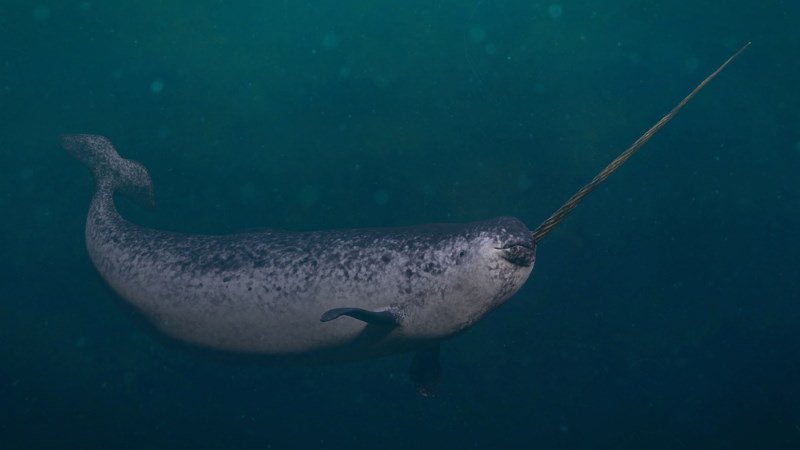
Despite its nickname, the narwhal’s tusk is not a horn at all. It is an elongated upper-left canine tooth that pierces right through the whale’s upper lip and grows in a tight counter-clockwise spiral.
A full-grown tusk can reach lengths of 2.5 to 3 meters (up to 10 feet) and weigh around 10 kilograms. Almost all male narwhals grow one, while only about 15 percent of females develop a tusk, and about one in 500 males grows two tusks at once.
3. The tusk is packed with 10 million nerve endings
Human teeth have a hard, insensitive outer shell of enamel and a soft nerve center inside. A narwhal’s tusk is built inside-out: its outer surface is soft, porous cementum riddled with microscopic tubules leading straight to a central pulp containing 10 million nerve endings.
Scientists led by Harvard dental researcher Martin Nweeia discovered that the tusk acts as a hydrodynamic sensor, allowing the whale to detect tiny changes in water temperature, salinity, and pressure.
4. Drone footage revealed they use their tusks to stun Arctic cod
For centuries, biologists debated whether the tusk was purely a visual status symbol for attracting mates or a weapon. In 2017, drone video captured by researchers in Tremblay Sound, Canada, showed narwhals using their tusks for hunting.
Swinging the tip of the tusk with quick, precise taps, the whales stunned schooling Arctic cod so they could easily swallow the fish whole.
5. They are among the deepest-diving mammals on Earth
During the winter months, narwhals make up to 15 deep dives a day to feed on Greenland halibut and squid near the ocean floor. Satellite tags have recorded narwhals diving more than 1,500 meters (nearly 5,000 feet) deep and staying submerged for 25 minutes on a single breath.
To survive the crushing pressure at that depth, a narwhal’s ribcage is flexible enough to compress as its lungs collapse, and its muscles store massive amounts of oxygen in myoglobin.
6. They navigate pitch-black waters using rapid-fire clicks
Below the thick winter ice sheet, no sunlight penetrates the water. To hunt in total darkness and find narrow breathing cracks in the ice ceiling above, narwhals rely on biosonar.
They produce directional bursts of up to 1,000 clicks per second, listening to the returning echoes to build a detailed mental map of their surroundings.
7. Thousands of narwhals gather in summer fjords

Narwhals are highly social whales that travel in small family pods of five to twenty individuals during the winter. When the coastal ice breaks up in summer, dozens of pods come together in shallow Arctic bays and fjords, forming super-herds of several thousand whales.
8. Their name comes from an Old Norse word for ‘corpse whale’
The English word “narwhal” comes from the Old Norse nárhvalr, combining nár (“corpse”) and hvalr (“whale”).
Viking sailors gave the animal that grim name because an adult narwhal’s mottled gray-and-white skin and habit of floating motionlessly at the surface reminded them of a drowned sailor.
9. They have no dorsal fin so they can swim right under solid ice

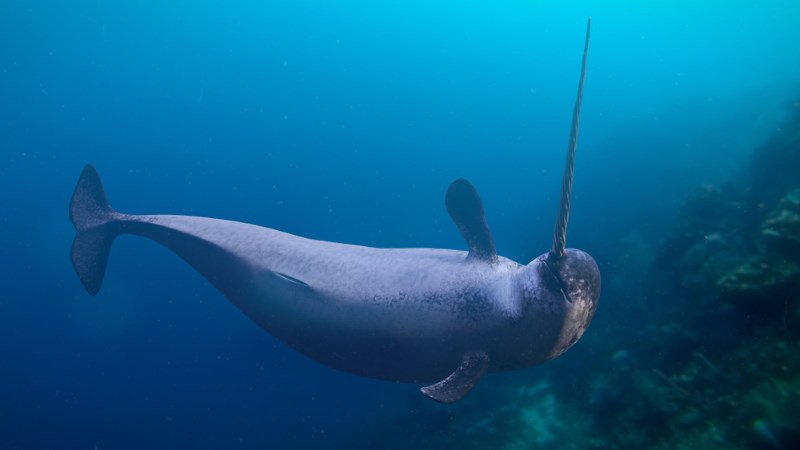
Like their closest living relative, the white beluga whale, narwhals have no dorsal fin on their backs. Instead, they have a low, tough fibrous ridge running along their spine.
Without a tall fin sticking up, narwhals can swim flush against the underside of sea ice and even use their backs to push through thin newly formed ice to take a breath.
10. Viking traders sold narwhal tusks as ‘unicorn horns’ for their weight in gold
During the Middle Ages and Renaissance, Norse traders brought narwhal tusks to European markets without revealing what animal they came from. Sold as genuine unicorn horns, the tusks were believed to neutralize poison and cure melancholy.
Queen Elizabeth I of England reportedly paid 10,000 pounds (the price of a castle) for a single carved narwhal tusk, and the Danish monarchs built an entire coronation throne out of narwhal tusks in the 1660s.
11. Their skin changes color as they age
You can tell a narwhal’s approximate age just by looking at its skin. Newborn calves are a solid bluish-gray, which darkens to almost black when they are juveniles.
As they mature into adults, white patches spread across their bellies and backs, and very old narwhals are almost completely white, sometimes leading observers to mistake them for belugas.
12. Sudden freezes can trap entire pods in a single breathing hole
Because narwhals can only hold their breath for about 20 to 25 minutes, they cannot swim more than a couple of kilometers without finding an open lead or crack in the ice. If Arctic winds suddenly shift and temperatures plunge, open channels can freeze shut overnight.
Known in Greenlandic as a sassat, such an ice trap can force hundreds of narwhals to crowd into a single shrinking hole in the ice, leaving them vulnerable to starvation or polar bears.
13. You have never seen a narwhal in an aquarium for a reason
Unlike beluga whales or bottlenose dolphins, you will not find a narwhal in any aquarium in the world. In 1969 and 1970, aquariums in New York and Vancouver briefly attempted to keep young narwhals in captivity.
Every single one died within a few months from pneumonia and stress, as the deep-diving, wide-ranging whales proved impossible to keep healthy in artificial tanks.
14. A ten-centimeter coat of blubber keeps them warm in sub-zero water
Arctic seawater sits right around minus 1.8 degrees Celsius. To keep their core body temperature steady, narwhals are wrapped in a layer of blubber up to 10 centimeters (4 inches) thick, accounting for more than a third of their total body weight.
15. Shrinking sea ice is bringing killer whales into their refuge
For millennia, dense summer pack ice acted as a shield for narwhals: killer whales (orcas), which have tall dorsal fins up to 1.8 meters high, avoided heavy ice for fear of damaging their fins or getting trapped.
As Arctic sea ice melts earlier and freezes later due to climate change, pods of orcas are swimming further north into Canadian and Greenlandic fjords for longer periods each summer, putting growing pressure on narwhal populations. What do you find most surprising about the narwhal? Let us know in the comments below.