A paradox is an apparent contradiction: a line of reasoning that starts from perfectly sensible premises and follows logical steps, but ends in a conclusion that seems impossible.
For centuries, mathematicians, philosophers and physicists have used paradoxes to test the limits of our knowledge. These are ten of the most famous ones.
1. Zeno’s paradox: Achilles and the tortoise

In the 5th century BC, the Greek philosopher Zeno of Elea imagined a race between the hero Achilles and a slow tortoise, which gets a head start. To overtake it, Achilles first has to reach the point where the tortoise started. But by then, the tortoise has moved a little further. When Achilles reaches that point, it has moved on again, and so on forever.
So Achilles can never catch up? Of course he can. It took the development of calculus to show that an infinite series of ever-smaller steps can add up to a finite distance and time.
2. The grandfather paradox
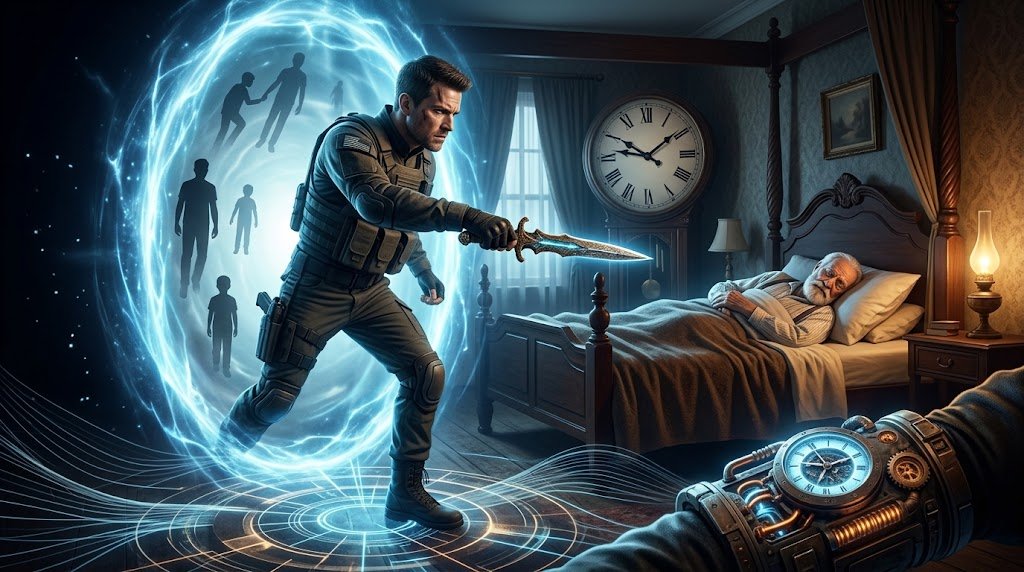
The classic objection to time travel: a time traveler goes back in time and kills his own grandfather before his parent is born. But then the time traveler would never have been born, so who killed the grandfather?
Physicists have proposed several ways out. One idea is that the laws of physics would simply prevent any action that creates a paradox. Another is that the time traveler would end up in a parallel timeline.
3. Schrödinger’s cat

In 1935, physicist Erwin Schrödinger came up with this thought experiment, not to defend quantum mechanics, but to show how absurd some interpretations of it were. A cat is locked in a box with a radioactive atom, a Geiger counter and a vial of poison. If the atom decays, the poison is released and the cat dies.
According to one interpretation of quantum mechanics, the unobserved atom is in a superposition, both decayed and not decayed. Does that mean the cat is both alive and dead until someone opens the box? The question goes to the heart of one of physics’ biggest puzzles: where does the strange quantum world end and our everyday world begin?
4. The Ship of Theseus
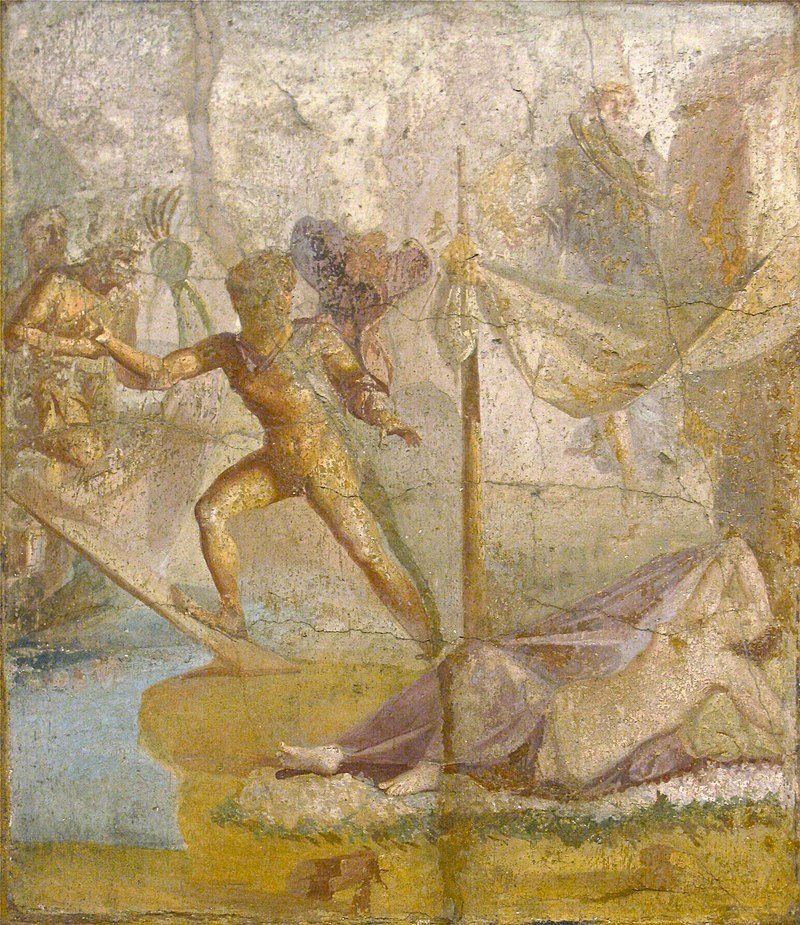
According to the Greek writer Plutarch, the Athenians preserved the ship of the hero Theseus for centuries. As its planks rotted, they were replaced one by one, until eventually not a single original piece was left. Was it still the same ship?
The philosopher Thomas Hobbes made it even trickier: what if someone collected all the old planks and built a second ship from them? Which one would then be the real Ship of Theseus? The same question applies to the human body, whose cells are constantly replaced.
5. Russell’s paradox and the barber

Around 1901, British philosopher Bertrand Russell discovered a paradox that shook the foundations of mathematics. Consider the set of all sets that do not contain themselves. Does that set contain itself? If it does, it should not. If it does not, it should.
The popular version is the barber paradox: in a village, the barber shaves all men who do not shave themselves, and only them. Who shaves the barber? If he shaves himself, he breaks the rule. If he does not, he must shave himself. The conclusion: such a barber cannot exist, and mathematicians had to rebuild set theory on stricter foundations.
6. The liar paradox

The purest form of this ancient paradox is just four words long: “This sentence is false.” If it is true, then it is false. But if it is false, then it is true.
This seemingly silly word game helped inspire one of the greatest discoveries in logic. In 1931, Kurt Gödel used a similar self-referential trick to prove that in any sufficiently powerful mathematical system, there are true statements that can never be proven within that system.
7. The Monty Hall problem
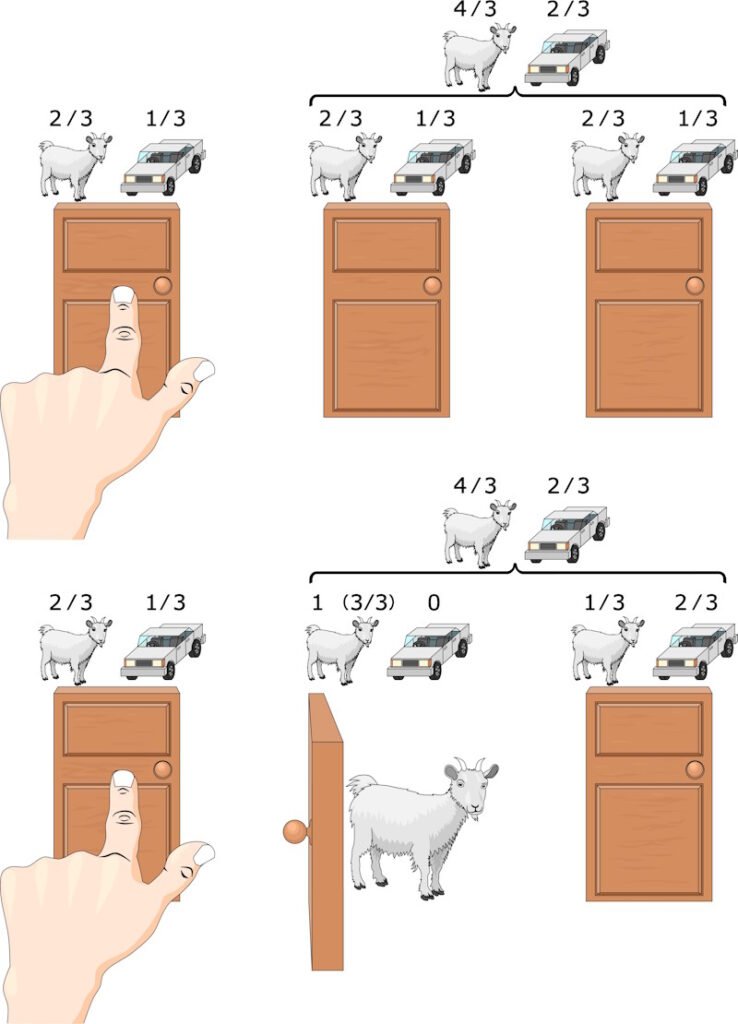
Named after the host of the TV show Let’s Make a Deal, this puzzle fools almost everyone. You face three doors: behind one is a car, behind the other two are goats. You pick door 1. The host, who knows where the car is, opens door 3 to reveal a goat and asks: do you want to switch to door 2?
Most people think it does not matter, since there are two doors left. In fact, switching doubles your chances. Your first pick had a 1 in 3 chance. The other two doors together had a 2 in 3 chance, and by opening one of them with a goat, the host concentrates that entire 2 in 3 on the remaining door. When a columnist explained this in 1990, thousands of readers, including mathematicians, wrote in to tell her she was wrong. She was right.
8. The Fermi paradox
During a lunch in 1950, physicist Enrico Fermi asked a simple question: “Where is everybody?” The universe has billions of galaxies, many with Earth-like planets far older than ours. Even at slow speeds, an advanced civilization could spread across our galaxy in a few million years.
So why have we never seen any sign of them? Possible answers range from the unsettling to the depressing: maybe civilizations always destroy themselves, maybe they deliberately ignore us, or maybe we really are alone.
9. The twin paradox
According to Einstein’s theory of relativity, time passes more slowly for objects moving at high speed. Imagine twins: one stays on Earth, the other travels to a distant star at nearly the speed of light and returns. The traveler comes home years younger than the twin who stayed behind.
But here is the paradox: from the traveler’s point of view, it was Earth that was moving, so shouldn’t the twin on Earth be younger? The answer: the situations are not symmetrical, because only the traveler had to slow down, turn around and speed up again. Time dilation is real: GPS satellites have to correct for it every day, or your navigation would quickly go wrong.
10. Simpson’s paradox
Simpson’s paradox shows how dangerous it is to draw conclusions from combined data. A trend can appear in several separate groups but reverse completely when the groups are combined.
A famous example comes from the University of California, Berkeley, in 1973. Overall, 44 percent of male applicants were admitted compared to 35 percent of women, which looked like discrimination. But department by department, women were admitted at similar or even higher rates. The difference arose because women applied more often to highly competitive departments with low admission rates.