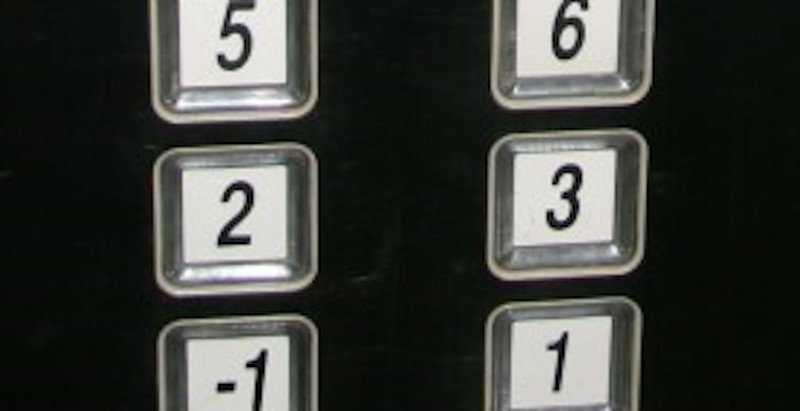
Numbers are universal, superstition is not. What brings happiness in one country is a harbinger of disaster elsewhere. Some unlucky numbers are based on religion, others on linguistic coincidences, still others on historical events that are subsequently linked to a certain number. These are the ten numbers people worldwide prefer to avoid – on license plates, floors, hotel rooms and wedding dates.
Which one of these deserves the top spot? Cast your votes below and let us know your personal ranking in the comments!
Cast your vote - the ranking shifts live based on the votes.
Four (4) – East Asia
In China, Japan, Korea and large parts of Southeast Asia, four is the unlucky number par excellence. The reason is purely phonetic: in Mandarin, “four” (sì) sounds almost identical to “death” (sǐ). In Japanese and Korean, the pronunciation is even completely identical – both words are pronounced “shi” or “sa”. This fear has its own name: tetraphobia. The practical consequences are enormous. Elevators in Chinese and Japanese buildings often skip the fourth floor; immediately after the third comes the fifth, or the fourth is referred to as “3A” or “F”. Hospitals avoid room number 4, especially in wards for the seriously ill. In some Hong Kong
Thirteen (13) – Western world
The most universal unlucky song in the West. Triskaidekaphobia – fear of thirteen – is so widespread that 80 percent of American skyscrapers do not have a thirteenth floor. Airlines skip row 13. The origin is probably Christian: at the Last Supper, thirteen people sat at the table, of which Judas was the betrayer. Another theory points to the “perfect” duodecimal system (twelve months, twelve apostles, twelve zodiac signs), thirteen disrupts that harmony. In 1907, the American novel Friday, the Thirteenth by Thomas Lawson was published, in which an unscrupulous stock trader mi
Log in to post a comment.
Seventeen (17) – Italy
While the rest of Europe fears thirteen, Italy shudders at seventeen. The explanation lies in the Roman numerals: XVII can be rearranged to VIXI, Latin for “I have lived” – or “I am dead”. The association with epitaphs and the end of life makes seventeen a number that Italians prefer to avoid. The Italian airline Alitalia did not have row 17 on its planes. And the American parody film Shriek if You Know What I Did Last Friday the Thirteenth was released in Italy as Shriek – Hai impegni per venerdì 17? Ironically, thirteen is considered a lucky number in Italy – the Italia
Log in to post a comment.
Nine (9) – Japan
In addition to the fear of four, Japan has a second unlucky number: nine. The Japanese word for nine, “ku,” sounds identical to the word for suffering or torture. Hospitals in Japan avoid both room 4 and room 9. Gifts are not given in numbers of four or nine. At weddings and other important occasions, tables with these numbers are skipped.
Log in to post a comment.
Six hundred and sixty-six (666) – Christian world
The “number of the beast” from the Bible book of Revelation has become synonymous with the antichrist and ultimate evil. John writes, “Here is wisdom: let him who has understanding calculate the number of the beast: for it is the number of a man, and his number is six hundred and sixty-six.” The fear of this number is called hexakosioihexekontahexaphobia.
Log in to post a comment.
Thirty-nine (39) – Afghanistan
In Afghanistan, 39 is highly charged because it sounds like “morda-gow” – literally “dead cow”, but in practice a swear word for pimp. The association with prostitution and loss of honor makes the number so charged that it permeates everyday life. Cars with license plate 39 are virtually unsellable; owners cover the number or pay fines to get another license plate.
Log in to post a comment.
Eighty-seven (87) – Australian cricket
This is an unlucky number that only exists within one sport in one country. In Australian cricket, 87 is known as “the devil's number”. Its origins date back to December 1929, when ten-year-old Keith Miller watched as his hero Don Bradman, the greatest cricketer of all time, was unexpectedly bowled out on 87 runs. Miller was so shocked that he became obsessed with the number. When he later became a professional cricketer himself, he told the story to anyone who would listen. The superstition spread through the Australian cricket world. The irony: Later research showed that Bradman was probably 89 that day
Log in to post a comment.
Twenty-six (26) – India
India has a specific fear of the number 26, based on a grim series of coincidences. The devastating earthquake in Gujarat occurred on January 26, 2001. The tsunami that hit South Asia struck on December 26, 2004. The terrorist attack on Mumbai – known as “26/11” – happened on November 26, 2008. In Indian numerology, 26 is considered inauspicious because it adds up to 8 (2+6=8), the number of Saturn, the planet that brings both success and misfortune. The combination of 2 (the moon) and 6 (Venus) is seen as astrologically conflicting.
Log in to post a comment.
One hundred and eleven (111) – English cricket
In the world of British cricket, a score of 111 is feared as “The Nelson”. The name refers to the legendary Admiral Horatio Nelson. Legend has it that by the end of his career, Nelson only had one eye, one arm and one leg – a visual match with the numbers 1-1-1. Although historians confirm that Nelson actually still had both legs, the myth of the “battered admiral” is inextricably linked to this number. The fear of 911 is not only based on the admiral, but also on what you see on the field. The three ones resemble the three stumps of the wicket without the crossbars
Log in to post a comment.
Tuesday the Thirteenth – Spanish and Greek World
While the Anglo-Saxon world fears Friday the thirteenth, in Spain, Latin America and Greece, Tuesday the thirteenth is considered unlucky. The Spanish name for Tuesday, “martes,” is derived from Mars, the god of war – a day of conflict and chaos. A Spanish proverb says: “ En martes, ni te cases ni te embarques ” (don't get married or board a ship on Tuesday). In Greece, Tuesday the thirteenth is especially feared because of the fall of Constantinople, which took place on Tuesday, May 29, 1453. Moreover, “Triti” (Tuesday) literally means “the third,” and bad news comes in threes. The combination of thirteen and d
Log in to post a comment.
Missing an item in this list?
Log in or create a free account to add an item yourself.
Log in / create account
Log in to post a comment.