Harry Houdini, born Erik Weisz, is without doubt one of the most legendary magicians in history. His spectacular escapes made him world famous, and more than a century later, his name is still a byword for escaping the inescapable. These are ten facts about the life of Harry Houdini.
1. He chose his name in honor of another magician
He was born in Budapest, Hungary, in 1874 as Erik Weisz. When he was four, his family emigrated to the United States, where his name became Ehrich Weiss. As a young man, he was fascinated by magic, and in particular by the famous French magician Jean-Eugène Robert-Houdin.
When he began his own career in the 1890s, he honored his hero by adding an “i” to the name Houdin, creating the stage name Harry Houdini. In a strange twist, he later turned against his former idol, accusing him of stealing tricks from other magicians in his 1908 book The Unmasking of Robert-Houdin.
2. He became the “Handcuff King”
As a young magician, Houdini struggled to break through, and even considered giving up and opening a magic school. His breakthrough came in 1899, when the vaudeville manager Martin Beck booked him for a tour and advised him to make escapes the centerpiece of his act.
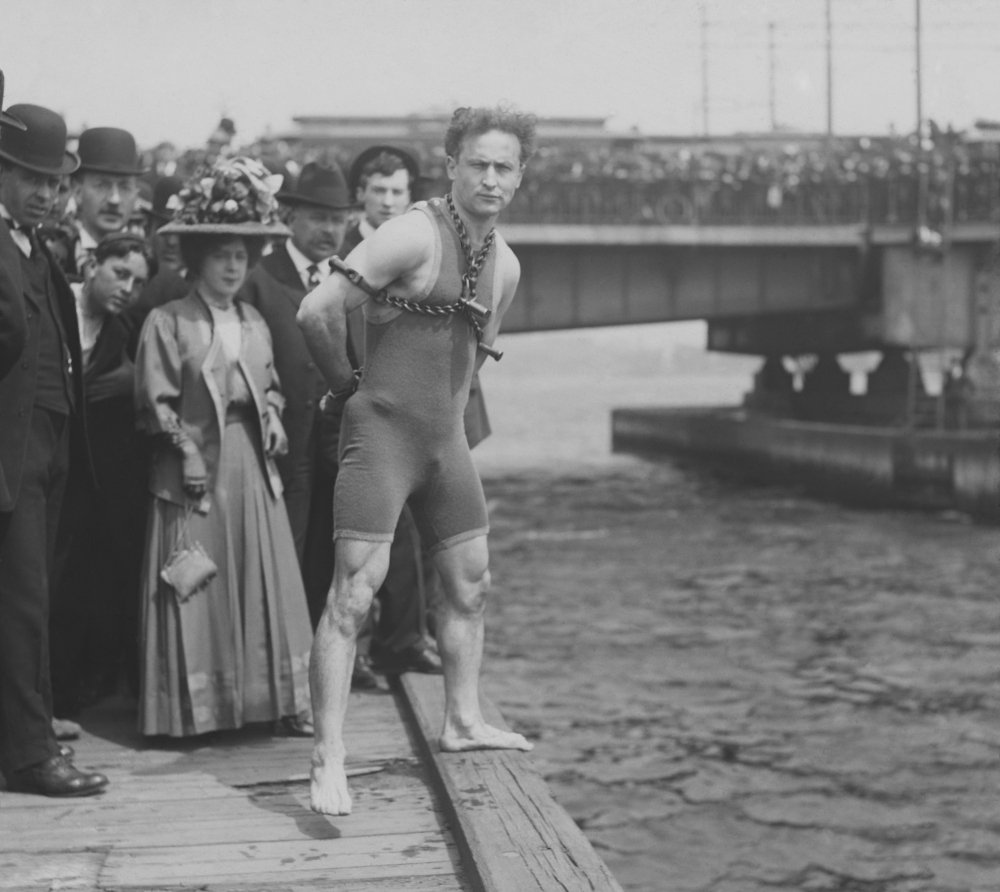
Houdini challenged audiences and police to tie him up or handcuff him, and promoted his shows by escaping from local jails. The routine was a huge success, and he soon became known as “the Handcuff King”, performing to sold-out theaters in Europe and the United States.
3. His brother was also a successful escape artist
Houdini’s younger brother Theodore, who had been his partner early in his career, also became an escape artist, under the stage name Hardeen. The brothers even staged a fake rivalry to attract more publicity. Although Hardeen was overshadowed by his famous brother, he is credited with performing the straitjacket escape in full view of the audience, a version that became a fixture of Houdini’s act. After Houdini’s death, Hardeen inherited much of his equipment.
4. He was a marketing genius
Houdini was not only a master of escapes, but also of publicity. He understood how important media attention was for his career. He regularly performed spectacular free stunts in public, such as escaping from a straitjacket while hanging upside down from a crane or a skyscraper, in front of tens of thousands of spectators. These stunts were announced well in advance, made the front pages and boosted ticket sales for his shows.
5. His most famous escapes
In the Milk Can Escape, introduced in 1908, Houdini was locked in an oversized milk can filled with water. The danger of drowning made the audience hold their breath with him. His most famous act was the Chinese Water Torture Cell, from 1912, in which he was locked upside down, with his feet in stocks, in a glass-fronted tank filled with water, and escaped behind a curtain.
He also performed the Metamorphosis, in which he swapped places with his assistant, usually his wife Bess, in a locked trunk in a matter of seconds, and jumped handcuffed from bridges into icy rivers. In the Overboard Box Escape, he was nailed into a crate weighed down with lead and thrown into New York harbor, and surfaced within minutes.
6. He escaped from the belly of a “sea monster”
In 1911, a group of businessmen in Boston challenged Houdini to one of the most bizarre stunts of his career: escaping from the belly of a strange sea creature that had washed up nearby, reportedly a kind of whale or large fish weighing hundreds of kilos. In front of a large crowd, Houdini was handcuffed, chained and stuffed into the smelly carcass, which was then closed with chains. He emerged triumphant about 15 minutes later, although he later said the fumes inside had almost overcome him.
7. He was an aviation pioneer
Houdini developed a passion for aviation and bought a French-built Voisin biplane in 1909. Despite crashing on one of his first attempts in Germany, he kept practicing. In March 1910, during a tour of Australia, he made three successful flights near Melbourne, which were long celebrated as the first powered flights in Australia. Historians dispute this claim, because another aviator, Colin Defries, had flown, briefly, a few months earlier. Houdini soon lost interest and never flew again after leaving Australia.
8. He had his own film studio
Houdini’s career as a silent film star began in 1919 with The Master Mystery, a 15-part adventure serial in which he played an undercover agent who used his escape skills to foil criminals. It also featured one of the first robots in film history.
He starred in several more films and even founded his own film company, the Houdini Picture Corporation. But none of his films were a big box-office success, and in 1923, he left the film industry for good.
9. He exposed fake mediums
As the world’s greatest illusionist, Houdini had little patience for anyone who claimed supernatural powers. After his beloved mother died in 1913, he visited mediums who claimed they could contact her, and was disgusted by their tricks. From the 1920s onwards, he began a second career as a professional skeptic, exposing mediums, psychics and spiritualists who claimed to contact the dead.
He often attended séances in disguise to expose their methods, even testified before the US Congress, and offered a reward of 10,000 dollars to anyone who could produce supernatural phenomena he could not explain. This campaign cost him his friendship with Arthur Conan Doyle, the creator of Sherlock Holmes, who was a firm believer in spiritualism.
10. His mysterious death
Harry Houdini died on Halloween, 31 October 1926, in a hospital in Detroit, of peritonitis caused by a ruptured appendix. What makes his death intriguing is what happened in the days before. In Montreal, a student named J. Gordon Whitehead visited Houdini in his dressing room and asked whether it was true that he could withstand any punch to the stomach. Before Houdini could prepare himself, the student punched him several times.
Houdini continued performing despite increasing pain and fever, and only went to hospital when it was too late. Whether the punches caused his appendix to rupture, or whether he already had appendicitis, is still debated. For years after his death, his wife Bess held séances on Halloween, hoping that he would send her a coded message he had agreed with her. He never did.