 Aleksandr Medvedkov / Shutterstock.com
For avid groundhoppers, Italy is a true place of pilgrimage. Nowhere in Europe will you find so many monumental concrete colossi that have been visibly gnawed by the ravages of time, often with an authentic cinder track around the field and a raw, unfiltered football atmosphere. Many of these arenas owe their current size to the 1990 World Cup, for which stadiums were massively expanded and modernized. From ultra-modern football temples to dilapidated giants in the lower divisions: these are the 10 largest football stadiums in Italy, ranked by official spectator capacity.
Which one of these deserves the top spot? Cast your votes below and let us know your personal ranking in the comments!
Cast your vote - the ranking shifts live based on the votes.
Stadio Olimpico (Rome)
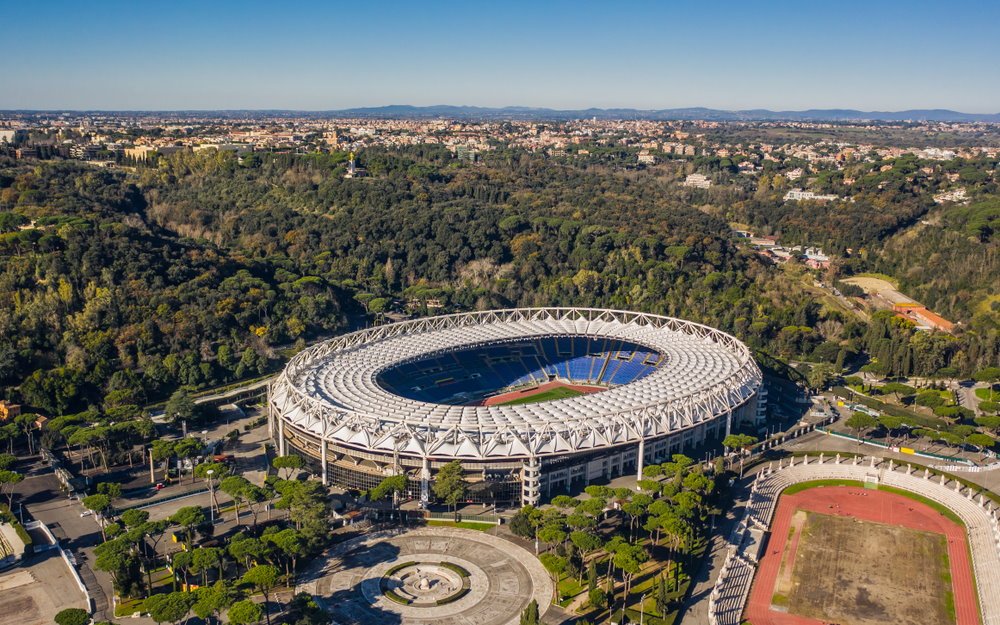
The sporting power center of the Italian capital is located on the banks of the Tiber. The Stadio Olimpico was originally built for the 1960 Olympic Games and was almost completely rebuilt for the 1990 World Cup, including a gigantic white tent roof covering all 70,634 seats. The stadium is the setting for the most charged city derby in the country: the battle between arch-rivals AS Roma (in the Curva Sud) and SS Lazio (in the Curva Nord). In addition, it has been the regular venue for the Coppa Italia final and international matches of the Azzurri for decades.
San Siro / Stadio Giuseppe Meazza (Milan)
With a staggering capacity of over 75,800 spectators (and even more than 80,000 during concerts), San Siro is the undisputed king of Italian football. The gigantic concrete cylinders on the outside and the steep red roof frame give the stadium a raw, industrial look that is visible from all over western Milan. From the steep third ring, supporters look almost vertically down onto the sacred grass. The arena, officially named after two-time world champion Giuseppe Meazza, is shared by rivals AC Milan and Internazionale. For years, both clubs tried to demolish the stadium to make way for a smaller, ultra-modern arena. However, those plans ran aground due to strict Italian heritage laws: because the second ring reached the age of seventy in 2025, the structure was given monumental protection. The 'La Scala of football' will therefore remain exactly where it should be for the time being.
Log in to post a comment.
San Nicola Stadium (Bari)
In the middle of the arid landscape of the southern Italian region of Apulia, a futuristic arena was built for the 1990 World Cup, which the locals immediately renamed L'Astronave (The Spaceship). The stadium was designed by world-renowned top architect Renzo Piano, who divided the upper ring into 26 separate concrete 'petals' to prevent panic during evictions. With no fewer than 58,270 seats, San Nicola is the third largest stadium in the country. In 1991 it was the setting for the European Cup I final between Red Star Belgrade and Olympique Marseille. S.S.C. Bari currently plays in Serie B, which makes this building by far the largest stadium in the second highest division.
Log in to post a comment.
Stadio Diego Armando Maradona (Naples)
The beating heart of Naples is located in the working-class district of Fuorigrotta. Until December 2020, this colossus was simply called Stadio San Paolo, but after the death of the Argentine football god who led the club to two historic league titles in the 1980s, the stadium was renamed Stadio Diego Armando Maradona within days. With a capacity of 54,726 spectators, it is one of the most intimidating stadiums in Europe. The acoustics under the steel roof construction are deafening: when the Neapolitan supporters massively shout “The Chaaaampions” before a Champions League match, seismographs in the city literally register light earthquakes.
Log in to post a comment.
Stadio Artemio Franchi (Florence)
Fiorentina's home is not your average football stadium, but an official national architectural monument. It was designed in 1931 by the world-famous engineer Pier Luigi Nervi and is considered a masterpiece of Italian rationalism. The graceful, open spiral staircases made of reinforced concrete and the slender Marathon Tower are studied by architecture enthusiasts worldwide. However, this monumental status is a curse and a blessing at the same time for the club. The stadium can accommodate 43,147 fans, but because monument protection blocked almost every intervention, most stands lack a roof and the facilities are very outdated. After decades of political wrangling, a large-scale renovation finally started in 2024 in which the historic concrete is preserved, but the comfort is brought into the modern age.
Log in to post a comment.
Allianz Stadium / Juventus Stadium (Turin)
The fact that Italy's most successful club is only in sixth place is no coincidence but a conscious, brilliant business move. For years, Juventus played in the drafty Stadio delle Alpi, which could accommodate almost 70,000 people but was almost never full due to the gigantic cinder track and poor sight lines. In 2011, Juventus demolished the old stadium and became the first Italian top club to build its own, compact facility with 41,507 seats. The stands are right on the field and the atmosphere is intimidating. Although the capacity is considerably smaller than that of the competition in Milan and Rome, the sold-out stands and luxurious business lounges provided an unprecedented financial advantage in Serie A.
Log in to post a comment.
Stadio Marcantonio Bentegodi (Verona)
In 1985, one of the greatest miracles in football history took place in Bentegodi: the modest Hellas Verona won the coveted national title under the leadership of coach Osvaldo Bagnoli. For the 1990 World Cup, the stadium received an extra ring and a striking canopy system, increasing its capacity to 39,371 seats. For years, this stadium was the scene of a special city derby. In addition to traditional club Hellas, the small neighborhood club Chievo Verona also played its home games here at the highest level. After Chievo went bankrupt in 2021 and ceased to exist, the huge structure is again exclusively the domain of the yellow-blue supporters of Hellas.
Log in to post a comment.
Stadio San Filippo – Franco Scoglio (Messina)
The Stadio San Filippo in Messina, Sicily, is a textbook example of Italian megalomania. The stadium was only opened in 2004 when local club ACR Messina was surprisingly promoted to Serie A and a gigantic concrete box for 38,722 spectators was immediately built. However, the fairytale at the highest level lasted only a short time. Due to financial crises, the club sank deep into Italian amateur football and Serie C. The result is a bizarre weekly spectacle: a huge stadium that competes with the European top in terms of size, but where on Sunday afternoons often only a handful of spectators sit in the stands to watch football at the third level.
Log in to post a comment.
Stadio Renato Dall'Ara (Bologna)
In the middle of the east stand of this stadium is a striking piece of political history: the Torre di Maratona. This 42-meter-high red brick tower was built in the 1920s on behalf of dictator Benito Mussolini, who used the stadium as a showcase for the fascist regime. Today, the largely uncovered structure can accommodate 38,279 supporters of Bologna F.C. 1909. Groundhoppers visit the stadium mainly because of the charming, classic arch constructions and the nostalgic atmosphere, although there have been plans for a major modernization for years, which will actually reduce the capacity slightly.
Log in to post a comment.
Renzo Barbera Stadium (Palermo)
Few stadiums in the world have such a dramatic backdrop as the home of Palermo F.C. On the north side of the stands, the steep, bare rock face of Monte Pellegrino towers hundreds of meters into the Sicilian sky, giving the stadium an almost amphitheatre-like character. The structure dates back to 1932, but underwent a complete metamorphosis for the 1990 World Cup, during which a second ring was added. With a capacity of 36,349 spectators, the witches' cauldron, dressed in the striking pink-black club colors, is by far the largest football arena on the island of Sicily.
Log in to post a comment.
Missing an item in this list?
Log in or create a free account to add an item yourself.
Log in / create account
Log in to post a comment.