Jersey numbers and starting numbers are mainly functional: they allow you to quickly identify athletes from the stands. Over the decades, certain numbers have become true cultural icons. In the North American sports world, the tradition of 'retiring' arose: a number is stored away for good and no longer worn by anyone else within the club. In European football and motorsport, superstars actually claimed their number as a global trademark. These are the 10 most iconic jersey and starting numbers in sports history.
Which one of these deserves the top spot? Cast your votes below and let us know your personal ranking in the comments!
Cast your vote - the ranking shifts live based on the votes.
Jackie Robinson: Number 42
From the 1880s onwards, strict racial segregation applied in American professional baseball. Black athletes were only allowed to compete in separate competitions, the so-called Negro Leagues. That sporting apartheid came to a historic end on April 15, 1947 when Jackie Robinson took the field on behalf of the Brooklyn Dodgers wearing jersey number 42. Despite heavy hostility, death threats and racist chants, Robinson remained stoic and was promptly named Rookie of the Year. Robinson became a key figure in the American civil rights movement. Fifty years after its historic debut, on April 15, 1997, Major League Baseball made a historic decision: number 42 was retired for all baseball clubs simultaneously. Every year on April 15, the league celebrates Jackie Robinson Day, with all players, coaches and umpires across MLB wearing jersey number 42 for one day of play.
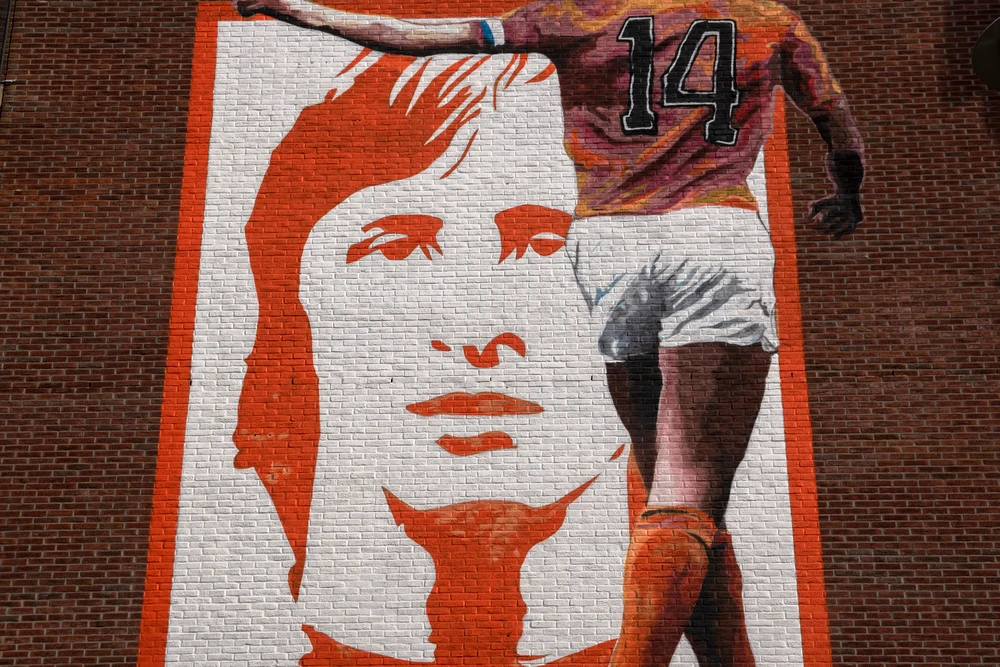
Johan Cruijff: Number 14
In traditional football, basic players used to always be assigned the numbers 1 to 11, with the striker playing with number 9 as standard. Johan Cruijff broke that dogma on October 30, 1970 at Ajax. After having just recovered from an injury, teammate Gerrie Mühren could not find his usual shirt with number 7 for the match against PSV. Cruijff gave Mühren his own shirt with number 9 collegially and randomly fished out a spare shirt from the basket: number 14. Ajax won the charged match 1-0 and the superstitious Cruijff decided never to take off the shirt again. With number 14, he led Ajax to three consecutive European Cups I and won the hearts of millions of football fans with the Dutch national team at the 1974 World Cup with the revolutionary Totaalfootball. Although he had to temporarily play with number 9 again at FC Barcelona due to the Spanish rules in force at the time, he immediately returned to 14 upon his return in 1981. On the occasion of his sixtieth birthday in 2007, Ajax decided to permanently withdraw the number: no one will ever play with number 14 in Amsterdam again.
Log in to post a comment.
Michael Jordan: Number 23
Michael Jordan is almost unanimously regarded as the best basketball player of all time. He won six NBA championships with the Chicago Bulls in the 1990s, being named Finals MVP all six times. Thanks to his phenomenal jumping power and his commercial success through the Air Jordan shoe line, jersey number 23 became the ultimate symbol of sporting greatness worldwide. Jordan chose the number in high school because he looked up to his older brother Larry, who played 45. Michael thought he could be quite satisfied with half of that (rounded to 23). Jordan's impact was so monumental that the Miami Heat decided to retire number 23 in 2003 out of respect for his services to the sport, despite the fact that Jordan had never played a second for that club.
Log in to post a comment.
Pelé, Diego Maradona & Lionel Messi: Number 10
In international football, the shirt number 10 has traditionally been reserved for the creative mastermind who decides matches. That magical status started with Pelé, who led Brazil to the world title in 1958 at the age of seventeen and repeated that feat in 1962 and 1970. Diego Maradona took the song's veneration to an almost religious level when he masterfully made Argentina world champions in 1986. The Argentine Football Association wanted to permanently retire number 10 in 2001 in honor of Maradona, but world football association FIFA prohibited this because selections at the time were required to play with numbers 1 to 23. That turned out to be a blessing: Lionel Messi was able to wear the iconic shirt years later. With his starring role at the 2022 World Cup in Qatar, Messi completed the legendary triptych of tens that have shaped global football. At Napoli (Maradona) and New York Cosmos (Pelé), the number was put away for good at club level.
Log in to post a comment.
Wayne Gretzky: Number 99
In ice hockey, Wayne Gretzky stands alone. The Great One played twenty seasons in the NHL and shattered virtually every offensive record imaginable. He is the only player in history to score more than 200 points in a single season (a feat he accomplished four times) and sits proudly at the top of the all-time rankings with 894 goals and 1,963 assists. As a teenager, Gretzky actually wanted to play number 9, the number of his childhood idol Gordie Howe. Because a teammate already occupied that number, his coach suggested playing with a double nine: number 99 was born. Gretzky's status is so untouchable that the NHL took a unique measure upon his retirement in 2000: number 99 was immediately retired league-wide for all teams in the NHL.
Log in to post a comment.
Babe Ruth: Number 3
George Herman "Babe" Ruth Jr. single-handedly changed American baseball from a tactical tag game into a spectacle full of home runs. In 1920, the ailing Boston Red Sox sold their star player to archrival the New York Yankees, a historic mistake known for decades as The Curse of the Bambino. With the Yankees, Ruth became the greatest sports celebrity of the twentieth century. When the Yankees became one of the first teams to introduce fixed jersey numbers in 1929, players were given their numbers simply based on their position in the batting order. Because Ruth came to bat as the third batter, he was assigned number 3 (his teammate Lou Gehrig was assigned number 4). Ruth hit 714 home runs in his career and won the World Series four times with the club. In June 1948, shortly before his death, number 3 was officially retired by the Yankees.
Log in to post a comment.
Manchester United & Cristiano Ronaldo: Number 7
In European club football, squad numbers are rarely permanently retired. At Manchester United, number 7 grew into a mythical legacy that is passed on from generation to generation. The shirt was worn by club icons such as George Best, Bryan Robson, Eric Cantona and David Beckham. When an eighteen-year-old Cristiano Ronaldo signed for the club in 2003, he asked for number 28, but manager Sir Alex Ferguson demanded that he immediately don the heavy shirt number 7. Ronaldo more than lived up to the reputation and built a global empire around it under the brand name 'CR7'. It also became his trademark at Real Madrid and the Portuguese national team. After Ronaldo's departure, however, the shirt at United proved to be a heavy burden: major signings such as Memphis Depay, Alexis Sánchez and Ángel Di María all succumbed to the enormous pressure attached to the legendary 7.
Log in to post a comment.
Earvin “Magic” Johnson: Number 32
At 2.06 meters tall, Earvin “Magic” Johnson redefined the position of playmaker (point guard) in the NBA. As conductor of the legendary Showtime era of the Los Angeles Lakers in the 1980s, he entertained the crowd with spectacular no-look passes and razor-sharp fastbreaks. Together with his archrival Larry Bird of the Boston Celtics, he definitively put modern professional basketball on the world map. Johnson won five NBA titles and was named the league's Most Valuable Player (MVP) three times. His number 32, which he had worn since his college days at Michigan State, was ceremoniously hoisted into the stadium by the Lakers in 1992. Since then, the song has been untouchable within the franchise.
Log in to post a comment.
Valentino Rossi: Number 46
With nine world titles under his belt, Valentino Rossi is considered one of the greatest motorcycle racers of all time. While it is tradition in motorsport that the reigning world champion drives with starting number 1 the following season, the flamboyant Italian consistently refused. Rossi retained number 46 throughout his career, a tribute to his father Graziano Rossi, who won his very first grand prix with the same number in 1979. Rossi turned starting number 46 in poison yellow into a global billion-dollar brand. Circuit stands from Assen to Mugello were bright yellow with flags and caps for decades. When he retired from MotoGP at the end of 2021 at the age of 42, racing organization Dorna decided to intervene immediately: in May 2022, number 46 was permanently retired during an official ceremony in Mugello. No one will ever be allowed to start with 46 in the premier class of motorsport.
Log in to post a comment.
Dale Earnhardt: Number 3
Driver Dale Earnhardt Sr. was one of the most successful and feared drivers in NASCAR history. Due to his uncompromising and aggressive overtaking style, he was appropriately nicknamed The Intimidator. Earnhardt won the NASCAR Cup championship an impressive seven times, a record he shares with legends Richard Petty and Jimmie Johnson. His jet black Chevrolet with the distinctive white number 3 became one of the most recognizable racing cars on American circuits. On February 18, 2001, tragedy struck when Earnhardt crashed on the final lap of the Daytona 500 and died at the age of 49. After his fatal accident, number 3 was not used in the highest NASCAR class for thirteen years out of respect. Team owner Richard Childress decided to revive the number in 2014 for his grandson Austin Dillon, who promptly won the Daytona 500 with it in 2018. Nevertheless, the stylized '3' will forever remain the symbol of Dale Earnhardt for millions of motorsport fans.
Log in to post a comment.
Missing an item in this list?
Log in or create a free account to add an item yourself.
Log in / create account
Log in to post a comment.