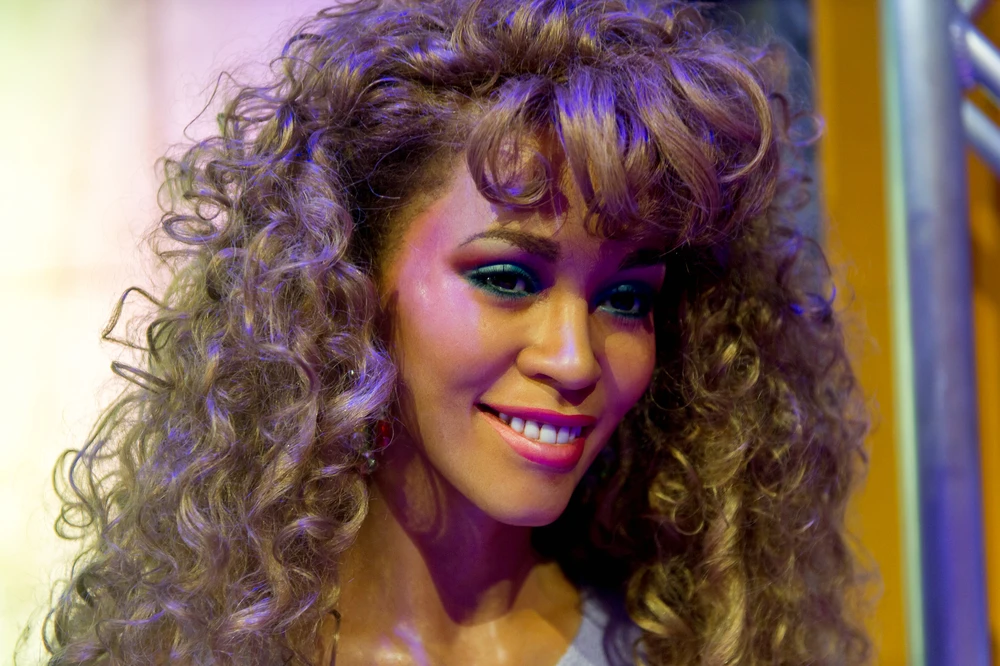
Hailed simply and reverently as “The Voice,” Whitney Elizabeth Houston was a generational miracle of popular music whose peerless vocal instrument permanently redefined the art of singing.
Born into gospel royalty as the daughter of Cissy Houston, cousin of Dionne Warwick, and goddaughter of Aretha Franklin, Whitney possessed a laser-pure three-octave mezzo-soprano voice combining majestic gospel power, pristine pitch, effortless melismatic flexibility, and striking emotional resonance.
10. My Love Is Your Love
The title track and fourth single from her triumphant 1998 comeback album, “My Love Is Your Love” was written and produced by Fugees mastermind Wyclef Jean alongside Jerry Duplessis. Marking a brilliant stylistic pivot into modern reggae-fusion and hip-hop soul, the song is built upon a relaxed, sunny one-drop reggae groove, acoustic guitars, and warm choir chants.
Houston delivers a relaxed, soulful vocal performance that radiates maternal warmth and spiritual devotion, singing of a love so profound that even apocalyptic turmoil cannot sever it.
9. How Will I Know
Originally written by George Merrill and Shannon Rubicam for Janet Jackson (who famously passed on it), “How Will I Know” was reimagined by producer Narada Michael Walden for Houston’s 1985 self-titled debut album. Walden infused the arrangement with infectious dance-pop synthesizers, a propulsive four-on-the-floor beat, and sparkling brass stabs, transforming it into an irresistible bubblegum-pop juggernaut.
At just 22 years old, Houston brought staggering vocal authority to what could have been a lightweight pop song.
8. Saving All My Love for You
Written by Michael Masser and Gerry Goffin, “Saving All My Love for You” was the sultry, jazzy R&B ballad that earned Whitney Houston her very first number-one hit on the Billboard Hot 100 in October 1985. The track features an exquisite, smoky arrangement anchored by Tom Scott’s soulful saxophone solos, warm electric piano, and gentle basslines.
The song tells the controversial, bittersweet story of a woman engaged in an affair with a married man, patiently waiting for him to keep his promises.
7. I Have Nothing
Serving as the third single from the diamond-certified soundtrack to The Bodyguard in 1993, “I Have Nothing” is one of the most vocally challenging and dynamically explosive power ballads ever written. Co-written and produced by David Foster alongside Linda Thompson, the composition demands an astonishing level of vocal control, breath support, and emotional intensity.
Houston delivers a striking vocal performance, singing of unconditional surrender and vulnerability in romance: “Stay in my arms if you dare / Or must I imagine you there / Don’t walk away from me / I have nothing, nothing, nothing if I don’t have you!”
6. Run to You
Another major ballad from The Bodyguard soundtrack, “Run to You” was composed by Jud Friedman and Allan Rich. Originally written as a breakup song, director Mick Jackson and producer David Foster requested that the lyricists rewrite it as a passionate love song to fit the burgeoning romance between Houston’s character Rachel Marron and Kevin Costner’s Frank Farmer.
The arrangement is lush and cinematic, featuring delicate acoustic guitars, grand piano arpeggios, and sweeping orchestral strings.
5. Greatest Love of All
Originally recorded by George Benson in 1977 for the Muhammad Ali biopic The Greatest, Michael Masser and Linda Creed’s inspirational anthem “Greatest Love of All” found its definitive, immortal incarnation in Whitney Houston’s 1985 debut album. Creed, who was battling terminal breast cancer while writing the lyrics, penned the song as an ode to human dignity, self-love, and the vital importance of nurturing the next generation.
Houston’s performance is major. Opening with quiet piano chords, she delivers the famous opening lines: “I believe the children are our future / Teach them well and let them lead the way”, with motherly grace and pure, ringing tone.
4. One Moment in Time
Commissioned by NBC Sports as the official theme song for the 1988 Summer Olympics in Seoul, South Korea, “One Moment in Time” is the ultimate anthem of athletic triumph, human determination, and destiny. Written by Albert Hammond and John Bettis and produced by Narada Michael Walden, the track is built around a majestic, timpani-driven symphonic arrangement that evokes ancient stadium arenas.
Houston delivers a performance of Olympian magnitude.
3. I Wanna Dance with Somebody (Who Loves Me)
The electrifying lead single from her record-shattering 1987 sophomore album Whitney, “I Wanna Dance with Somebody (Who Loves Me)” is four minutes and fifty seconds of pure, unadulterated pop euphoria. Written by George Merrill and Shannon Rubicam and produced by Narada Michael Walden, the track is propelled by a thumping Roland TR-808 cowbell beat, shimmering synth horns, and an unstoppable bass groove.
Beneath the exuberant dance beat lies a poignant lyrical yearning for genuine emotional companionship rather than empty physical attraction.
2. All at Once
One of the most exquisitely painful, beautiful, and emotionally devastating ballads in Whitney Houston’s discography, “All at Once” was co-written by Michael Masser and Jeffrey Osborne for her 1985 debut. While not released as a commercial single in the United States, the song became a massive top-five smash across Europe and stands as a sacred holy grail among vocalists and connoisseurs.
The song explores the sudden, crushing shock of unexpected romantic abandonment, the horrifying moment when you realize that someone who meant the world to you has vanished without warning.
1. I Will Always Love You
Originally written and recorded by Dolly Parton in 1973 as a tender country farewell to her mentor Porter Wagoner, Kevin Costner suggested the composition to Houston for the climax of 1992’s The Bodyguard. Produced by David Foster, Houston completely reinvented the song from the ground up.
The recording begins with forty-five seconds of absolute, unadorned courage: Houston sings completely a cappella, her crystal-clear, unassisted voice echoing in the stereo field without a single instrument to mask a breath or pitch variation.
Which choice on this list is your personal favorite? Share your thoughts and rankings in the comments below.