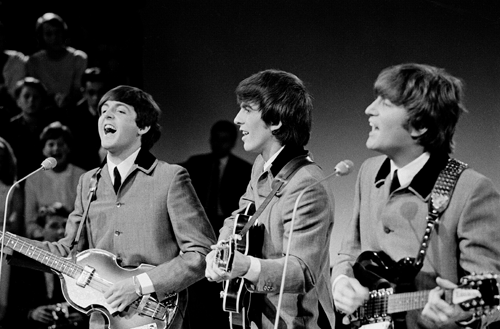
Between their scruffy skiffle beginnings in Liverpool and the Reeperbahn in Hamburg in 1960 and their bitter dissolution on the rooftop of Apple Corps in London in 1970, John Lennon, Paul McCartney, George Harrison, and Ringo Starr, known universally as The Beatles, permanently revolutionized popular music, studio recording, and global culture.
In a strikingly brief eight-year recording career, the Fab Four evolved from matching-suit teen-pop idols igniting Beatlemania into peerless studio auteurs, pioneering multi-tracking, feedback, tape loops, string quartet chamber-pop, psychedelic sitar rāgas, and heavy rock.
10. Something
Written by George Harrison for their 1969 masterpiece Abbey Road, “Something” was the decisive moment the “quiet Beatle” stepped out from the colossal songwriting shadows of Lennon and McCartney to compose what Frank Sinatra famously heralded as “the greatest love song of the past fifty years.” The song features an unforgettable, fluid bassline played by Paul McCartney that weaves counter-melodies around Harrison’s tender vocals, while George Martin’s lush, soaring string arrangement elevates the track into pure romantic bliss.
Harrison delivers what is arguably the finest electric guitar solo of his life, a weeping, perfectly phrased statement that speaks with human emotional clarity.
9. Strawberry Fields Forever
Recorded in late 1966 as the opening salvo for the sessions that would birth Sgt. Pepper’s Lonely Hearts Club Band, John Lennon’s “Strawberry Fields Forever” is the undisputed summit of 1960s psychedelic pop.
Drawing inspiration from his childhood memories of climbing the gates of a Salvation Army children’s home named Strawberry Field in Woolton, Liverpool, Lennon crafted a dreamy, surrealist meditation on isolation and reality.
8. Eleanor Rigby
Released on their groundbreaking 1966 album Revolver, “Eleanor Rigby” was an audacious, revolutionary departure from conventional pop music: not a single Beatle plays a rock instrument on the track. Written by Paul McCartney, the arrangement is scored solely for a double string quartet (four violins, two violas, two cellos) arranged by George Martin, who took inspiration from Bernard Herrmann’s screeching score for Alfred Hitchcock’s Psycho.
Lyrically, the song was a profound, sorrowful examination of modern alienation, loneliness, and spiritual desolation in post-war Britain, asking the immortal question: “All the lonely people, where do they all come from?”
7. Yesterday
The melody of “Yesterday” arrived to Paul McCartney in a dream while sleeping in a top-floor bedroom at his girlfriend Jane Asher’s family home in London in 1964. Terrified that he had subconsciously stolen the melody from another composer, McCartney spent months playing the tune for friends with the placeholder lyric “Scrambled eggs, oh my baby how I love your legs,” before writing the wistful words of romantic loss for 1965’s Help!.
Recorded solely by McCartney on an acoustic Epiphone Texan guitar accompanied by a string quartet arranged by George Martin, the recording marked the first time a Beatle had performed on a record without his bandmates.
6. Here Comes The Sun
Written by George Harrison in April 1969 on an acoustic guitar in the garden of Eric Clapton’s country home while playing truant from a suffocating Apple Corps business meeting, “Here Comes the Sun” from Abbey Road is an immortal hymn of relief, warmth, and spiritual rebirth after a long, freezing English winter. The song is anchored by Harrison’s pristine acoustic fingerpicking in capoed 7th-fret tuning, moving through intricate Indian-inspired time signature changes (shifting effortlessly between 11/8, 4/4, and 7/8).
Harrison also introduced the warmth of a newly acquired Moog synthesizer, which cascades through the stereo channels like golden rays of sunlight breaking through morning fog.
5. While My Guitar Gently Weeps
Featured on their 1968 double album The Beatles (The White Album), “While My Guitar Gently Weeps” was inspired by Harrison reading the ancient Chinese philosophical text I Ching, which posits that everything in the universe is interconnected and purposeful. Observing the societal discord, spiritual materialism, and inner turmoil tearing the world and his band apart, Harrison crafted a heavy, brooding blues-rock masterwork.
Recognizing that tension among his bandmates was hindering the recording, Harrison made a brilliant tactical move: he invited his close friend Eric Clapton into Abbey Road to play lead guitar on his Gibson Les Paul “Lucy.”
4. A Day In The Life
The towering, five-minute crowning climax of 1967’s Sgt. Pepper’s Lonely Hearts Club Band, “A Day in the Life” is universally recognized by musicologists and critics as the absolute masterpiece of the Lennon-McCartney songwriting partnership.
The song brilliantly splices together two completely unfinished, contrasting fragments: John Lennon’s detached, surrealist acoustic reflections on newspaper reports of car crashes and war films, and Paul McCartney’s brisk, upbeat piano vignette of an everyday morning rush to catch a bus.
3. Let It Be
The title track and emotional farewell of their final released studio album in 1970, “Let It Be” was written by Paul McCartney during the tense, fracture-filled sessions of late 1968. In the midst of bitter business disputes and personal exhaustion, McCartney experienced a vivid, comforting dream in which his mother Mary, who had died of cancer when he was just fourteen years old, appeared to him, offering a message of reassurance: “It will be alright, just let it be.”
Built upon McCartney’s rolling, gospel-infused piano chords and Billy Preston’s warm Hammond organ, the track functions as an uplifting, non-denominational secular hymn for humanity.
2. Blackbird
Recorded solely by Paul McCartney on an acoustic guitar with his foot tapping a steady percussion rhythm on the floor of Abbey Road Studio Two for 1968’s The White Album, “Blackbird” is an unadorned miracle of acoustic folk elegance. McCartney adapted the intricate, polyphonic fingerpicking technique from Johann Sebastian Bach’s classical lute suite Bourrée in E minor, which he and George Harrison had learned to play as teenagers.
Lyrically, McCartney wrote the song as an allegorical message of hope and solidarity for Black women living through the tumultuous civil rights movement and racial desegregation struggles in the American South: “Blackbird singing in the dead of night / Take these broken wings and learn to fly / All your life, you were only waiting for this moment to arise.”
1. Hey Jude
Standing as the undisputed, immortal summit of The Beatles’ vast discography, “Hey Jude” is more than a pop song, it is a seven-minute secular hymn of human empathy, communal healing, and extraordinary joy. Written by Paul McCartney in June 1968 while driving out to Weybridge to visit five-year-old Julian Lennon during the painful divorce of his parents John and Cynthia, McCartney began improvising the reassuring melody: “Hey Jules, don’t make it bad, take a sad song and make it better.”
The song begins in intimate vulnerability: McCartney sings over his solitary grand piano and gentle acoustic strumming, offering unconditional solace to a heartbroken child.
Which choice on this list is your personal favorite? Share your thoughts and rankings in the comments below.