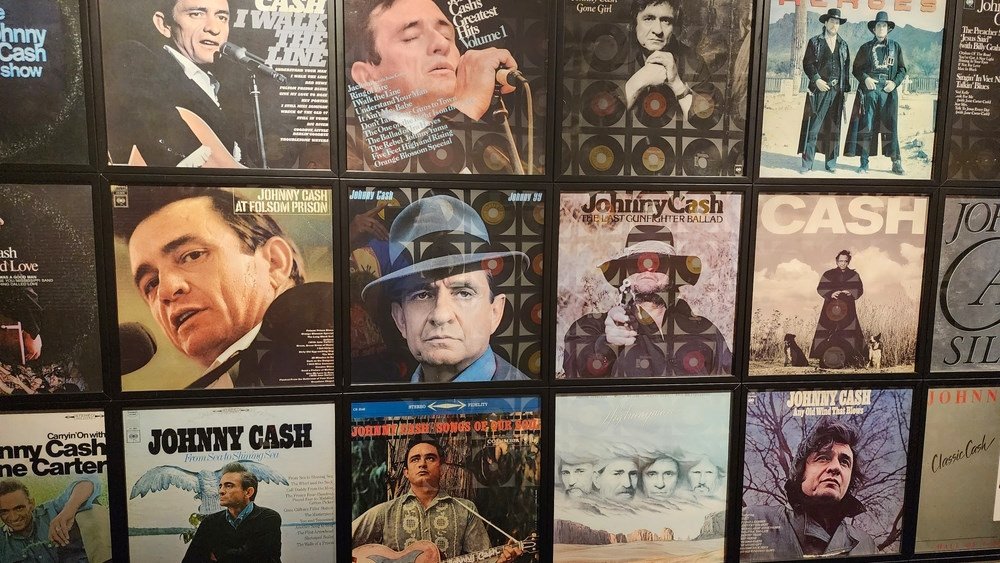
Johnny Cash, affectionately known as “The Man in Black,” remains one of the most towering and enduring figures in American music history. Singing in a gravelly, resonant baritone that carried both biblical weight and working-class grit, Cash smoothly bridged the worlds of country, rockabilly, gospel, and rock.
From his early breakthroughs at Sun Studio alongside Elvis Presley to his electrifying prison concerts and late-career renaissance with Rick Rubin, his music tackled sin, redemption, heartache, and justice. Here are the 10 best songs by Johnny Cash.
10. A Boy Named Sue
Recorded live during his landmark 1969 concert at San Quentin State Prison, “A Boy Named Sue” became Cash’s biggest hit on the Billboard pop charts, climbing all the way to number two on the Hot 100. Written by beloved poet and cartoonist Shel Silverstein, the track delivers a humorous yet hard-boiled narrative of an abandoned boy seeking revenge on the father who gave him a girl’s name.
Cash had barely practiced the lyrics before walking on stage, reading lines straight from a music stand. The unrestrained roar of the inmates, combined with Cash’s razor-sharp comic timing, turned an impromptu performance into an unforgettable concert classic.
9. Ghost Riders in the Sky
Stan Jones composed “Ghost Riders in the Sky” in 1948, but Johnny Cash delivered its definitive, thunderous interpretation on his 1979 album Silver. Backed by the galloping rhythm of The Tennessee Three and dramatic Mariachi horn flourishes, Cash recounts the eerie legend of a cowboy who witnesses a phantom herd of red-eyed cattle stampeding across the stormy sky, chased relentlessly by damned spectral riders.
Cash’s deep, booming baritone gives the old western folktale the gravity of an Old proof warning.
8. Jackson (with June Carter)
Released in 1967, “Jackson” stands as one of the most spirited and dynamic duets in country music history. Written by Billy Edd Wheeler and Jerry Leiber, the song depicts a feuding married couple whose initial passion has cooled.
The husband boasts about heading down to Jackson, Mississippi, to live a reckless bachelor life, while his quick-witted wife effortlessly deflates his fantasies.
7. Sunday Morning Coming Down
Penned by a young, struggling Kris Kristofferson, “Sunday Morning Coming Down” captured loneliness and spiritual desolation with rare poetic honesty. Cash famously championed the track on his national television show.
Network executives pressured him to sanitize the lyric, “On the Sunday morning sidewalk, wishing, Lord, that I was stoned,” but Cash refused to change a single syllable on air.
6. Man in Black
Johnny Cash recorded “Man in Black” in 1971 as a musical statement explaining his stark wardrobe. While other country performers favored colorful rhinestone suits, Cash chose black as a conscious act of solidarity.
In the lyrics, he plainly states that he wears black for the poor, the prisoner, the sick, and those who have fallen through society’s cracks. Coming during the turmoil of the Vietnam War era, the song was a daring political and social declaration.
5. I Walk the Line
Recorded at Sun Studio in Memphis in 1956, “I Walk the Line” gave Johnny Cash his first number-one country hit and introduced him to mainstream pop audiences. Written while touring as a young husband, the song served as a personal pledge of fidelity to his first wife, Vivian.
To create a crisp, percussive backbeat, Cash slipped a piece of paper beneath his guitar strings, producing a distinctive snare-like shuffle.
4. Ring of Fire
June Carter co-wrote “Ring of Fire” with Merle Kilgore, drawing inspiration from her intense feelings for the troubled, charismatic Cash while both were still married to others. Cash famously dreamed the musical arrangement, waking up in the middle of the night with the sound of Mexican Mariachi horns in his head.
Adding brass horn fanfares to a country single was an unconventional move in Nashville at the time, but the gamble paid off brilliantly.
3. Folsom Prison Blues
Cash wrote “Folsom Prison Blues” in 1953 while serving in the U.S. Air Force in West Germany, inspired by the crime film Inside the Walls of Folsom Prison.
He paired the rhythm of a rolling locomotive with stark outlaw storytelling. When he recorded the song live inside Folsom State Prison in January 1968, the room erupted.
2. The Man Comes Around
As the opening track of his 2002 album American IV: The Man Comes Around, this was one of the very last original compositions Johnny Cash completed before his death. Drawing heavily from imagery in the biblical Book of Revelation, the song opens and closes with Cash reciting scripture against a steady, pulsing acoustic guitar.
He paints a stark picture of final judgment, divine reckoning, and mortal fragility. Cash’s weathered, fragile vocals lend the recording profound solemnity, serving as a powerful final proof from an artist contemplating his own mortality.
1. Hurt
When producer Rick Rubin proposed covering Nine Inch Nails’ raw industrial anthem “Hurt,” Trent Reznor was initially skeptical about how the song would translate to country. But Cash’s interpretation stripped away all synth distortion, leaving behind an intensely vulnerable acoustic arrangement.
Delivered in a trembling, worn voice, Cash transformed the song into a heartbreaking meditation on pain, aging, and regret. The music video, directed by Mark Romanek and filmed at Cash’s deteriorating Tennessee museum, captured an American giant facing the end of his life.
Which choice on this list is your personal favorite? Share your thoughts and rankings in the comments below.