


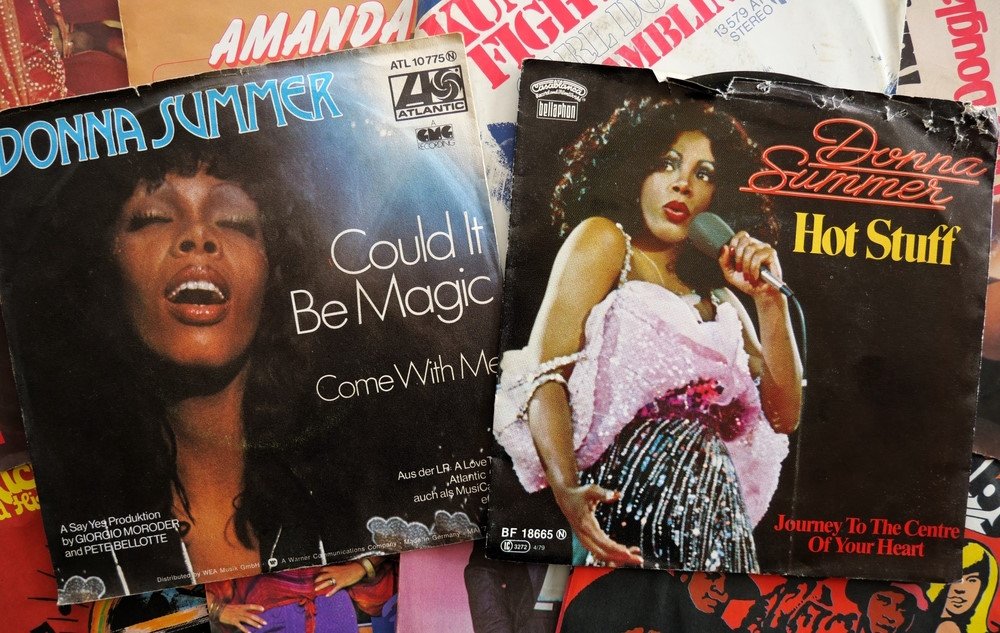
Donna Summer was not just a disco singer; she was the architect of modern pop music. Together with producers Giorgio Moroder and Pete Bellotte, she transformed club culture from an underground phenomenon into a futuristic art form. She possessed the lung capacity of a gospel singer, the sensuality of a movie star, and the daring of a rock artist.
This list dives into the oeuvre of the woman who made the synthesizer human and elevated the dance floor to a place of pure catharsis. These are the ten tracks that made her immortal.
10. No More Tears (Enough Is Enough) (with Barbra Streisand)
On paper, it seemed like an impossible marriage: the ice queen of the sentimental ballad against the steaming diva of disco. In the studio, the tension was palpable—reportedly, Barbra held her breath during Donna’s belts out of fear of being drowned out. The result is not a duet, but a vocal duel to the death.
When the tempo suddenly rockets after the ballad intro, the song turns into a liberation anthem for anyone who was ever stuck in a bad relationship. It is high-level kitsch, performed with a deadly seriousness that you simply don’t hear anymore today.
9. She Works Hard for the Money
After visiting a restaurant where she saw an exhausted waitress (Onetta Johnson) sleeping, Donna wrote this song on a napkin. It marked her transition from ethereal disco to the tight, synthesizer-driven pop of the 80s. The music video, in which Donna herself dances in that waitress outfit, became one of the first major hits by a Black female artist on MTV.
Musically, it is a bulldozer: that saxophone, that demanding beat, and that chorus that hits every worker right in the heart. It is an ode to the working woman, wrapped as an irresistible pop hit.
8. MacArthur Park
A cake left out in the rain and the recipe that is lost. The lyrics of Richard Harris’s original are bizarre, to say the least, yet Summer managed to transform this into a disco symphony of epic proportions. She took a melodramatic piece of 60s pop and injected it with pure adrenaline.
The “Suite” version is a journey in itself, but even in the radio edit, you feel the grandeur. The moment the orchestra swells and the beat kicks in remains one of the most euphoric moments in music history. Only Donna Summer could sing about melting icing and make it sound like a Greek tragedy.
7. On the Radio
There is something cinematic about the way this song begins. A lonely piano, a voice that breaks, and the feeling of a letter that was never sent. Summer perfectly captures that specific feeling of melancholy that sometimes overcomes you in the middle of a crowded dance floor.
When the beat finally drops, it is not an explosion of joy, but of despair. “And now I’m sitting here with the man I sent away.” It is dancing with tears in your eyes, a concept that would later be perfected by artists like Robyn, but was invented here.
6. Dim All the Lights
Many people forget that Donna Summer was also a gifted songwriter. This is the only hit she wrote entirely by herself, and it is perhaps her sexiest track. She originally wrote it for Rod Stewart, but fortunately decided that this velvety soul-disco arrangement was for herself.
Listen to that one note she holds for 16 seconds—not as a technical show-off, but as an expression of pure desire. The song glides and sparks, perfect for the moment the party ends and the lights are finally dimmed.
5. Bad Girls
“Toot toot, hey beep beep.” With those simple whistles, Summer created a soundscape of the street. Inspired by an incident where her assistant was mistaken for a prostitute by the police, she gave a voice to the night owls of Sunset Boulevard.
It is disco with a raw edge, almost punk in its attitude. No strings and glitter here, just a tight groove and lyrics about the hard reality of nightlife. It proved that disco was not just escapism, but could also provide social commentary.
4. Last Dance
The ultimate closer. Paul Jabara locked Donna in a hotel room in Puerto Rico and refused to let her leave until she had recorded this song. Thank goodness. The song plays a game with the listener: it starts slow and dreamy, teases you with an acceleration, slows down again, and then finally breaks loose.
That structure has since become a cliché, but here it still sounds fresh and necessary. It won an Oscar, and rightly so. This is the sound of the last round, the lights coming on, and the desperate hope that the night never has to end.
3. Love to Love You Baby
In 1975, this song changed everything. The BBC refused to play it, Time Magazine called it a “marathon of gasping,” and in clubs all over the world, people went wild. Donna lay on the floor in a dark studio in Munich and simulated an orgasm for 17 minutes over a funky bassline.
It was scandal, art, and commerce all in one. More importantly: the length of the track gave birth to the 12-inch single. Without this sultry masterpiece, modern club culture simply would not have existed.
2. Hot Stuff
By the late 70s, disco was under pressure, so Donna did what any smart artist does: she evolved. She brought in Jeff Baxter of The Doobie Brothers for a ripping guitar solo and created a hybrid monster of rock and dance.
The energy is aggressive and demanding. Donna doesn’t beg for love; she demands action. “I need some hot stuff baby this evening.” The song blasts out of the speakers with an urgency that got even the biggest disco haters onto the dance floor. A blueprint for the pop-rock of the 80s.
1. I Feel Love
In 1977, Brian Eno ran into David Bowie’s studio with a vinyl record in his hand and shouted: “I have heard the sound of the future.” He was right. For “I Feel Love,” the orchestra was shown the door. Everything you hear, except Donna’s voice, is machine. A Moog synthesizer, programmed by Giorgio Moroder.
The result is hypnotic, cold, and yet intensely human due to Donna’s ethereal vocals floating above the sequencers. This is the Big Bang of house, techno, and trance. Every time you hear a beat come out of a computer today, you are listening to the echo of this song.
