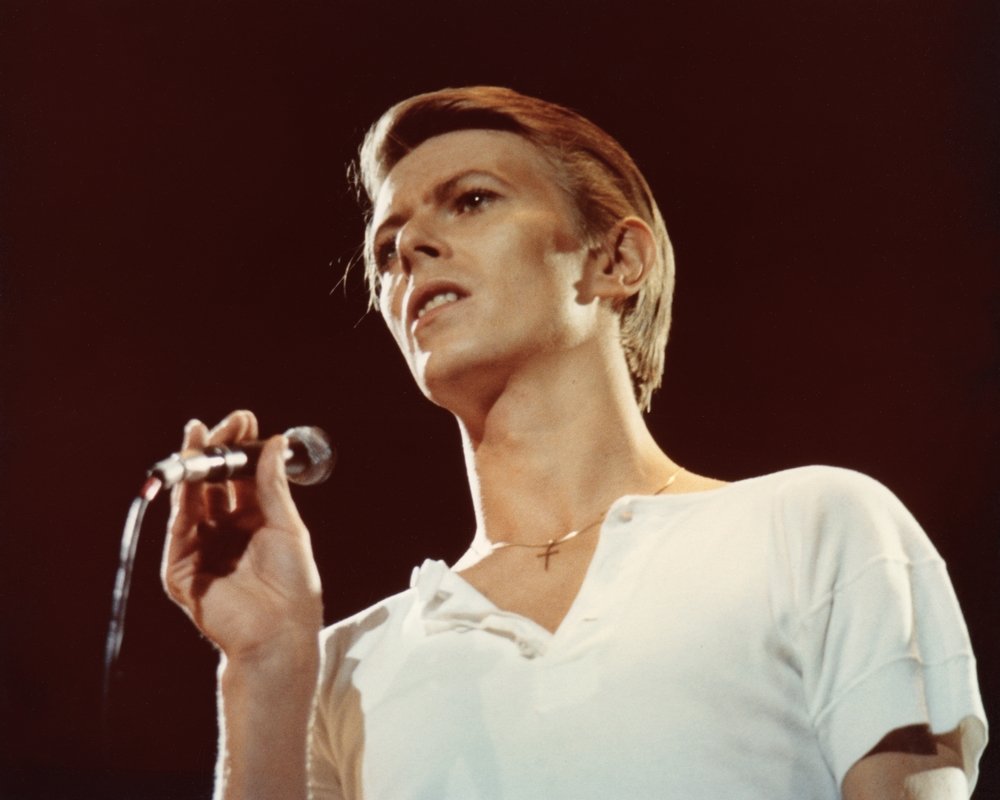
Few artists in the history of recorded music have shaped the artistic landscape as profoundly or as unpredictably as David Bowie.
Born David Robert Jones in Brixton, London, in 1947, Bowie operated not merely as a singer-songwriter, but as a fearless cultural alchemist, continually destroying and reconstructing his public persona across more than five decades.
10. Rebel Rebel
Released in 1974 as the lead single from Diamond Dogs, “Rebel Rebel” served as David Bowie’s euphoric, defiant farewell to the glam-rock movement he had largely spearheaded. Built upon one of the most infectious and immediately recognizable guitar riffs in rock history, played by Bowie himself rather than his longtime six-string virtuoso Mick Ronson, the song immediately commands the listener’s attention with its swaggering, garage-rock energy and propulsive rhythmic drive.
Lyrically, “Rebel Rebel” stands as a pioneering celebration of androgyny, non-conformity, and gender fluidity (“You got your mother in a whirl / She’s not sure if you’re a boy or a girl”).
9. Ashes to Ashes
However, far from a nostalgic reprise, the song offers a haunting, starkly cynical reappraisal of modern isolation, transforming Major Tom from a brave cosmic voyager into an earthbound addict stranded in psychological torment (“We know Major Tom’s a junkie / Strung out in heaven’s high / Hitting an all-time low”). Musically, the composition represents an extraordinary fusion of innovative art-pop and intricate new wave funk.
Producer Tony Visconti layered Chuck Hammer’s groundbreaking guitar synthesizer textures over George Murray’s syncopated slap bass and Roy Bittan’s distinctive, treated acoustic piano riffs, crafting an eerie, nautical groove that feels simultaneously lush and profoundly unsettling.
8. Sound and Vision
Recorded at Château d’Hérouville in France before being completed at Hansa Studio by the Wall in West Berlin with co-producer Tony Visconti and creative collaborator Brian Eno, the track defies conventional pop dynamics by delaying Bowie’s lead vocal entrance until nearly halfway through its runtime. Instead, the first ninety seconds immerse the listener in an intoxicating instrumental bed constructed around Dennis Davis’s revolutionary snare drum sound, processed through the newly invented Eventide H910 Harmonizer to create an iconic pitch-dropping thud, blended with backing vocalist Mary Hopkin’s doo-wop harmonizing and Brian Eno’s shimmering ARP synthesizer arpeggios.
When Bowie finally begins to sing, his lyrics confront severe depression, artistic paralysis, and creative rebirth in a room with “pale blinds drawn all day.”
7. China Girl
Originally co-written with Iggy Pop during their self-imposed creative exile in Berlin and released on Pop’s raw 1977 solo album The Idiot, “China Girl” was radically reinvented by Bowie and producer Nile Rodgers for Bowie’s blockbuster 1983 release Let’s Dance. Where Pop’s original was dark, menacing, and claustrophobic, Bowie’s version was transformed into an exhilarating, gleaming new wave pop anthem engineered for stadium dominance.
Underneath Nile Rodgers’ razor-sharp chic rhythm guitar and Stevie Ray Vaughan’s blistering blues guitar fills lies a composition rich in political metaphor and post-colonial critique.
6. Ziggy Stardust
The conceptual nucleus of 1972’s major The Rise and Fall of Ziggy Stardust and the Spiders from Mars, “Ziggy Stardust” tells the mythic story of rock ‘n’ roll’s ultimate fictional martyr: an alien messiah sent to offer salvation to a dying Earth, only to be consumed by his own messianic ego, sexual excess, and fan adulation (“Making love with his ego, Ziggy sucked into his mind / Like a leper messiah”). Anchored by guitarist Mick Ronson’s thunderous, angular opening power chords and Trevor Bolder’s fluid bass line, the track embodies the peak of English glam rock.
Bowie delivers the vocal narrative with theatrical brilliance, alternating between third-person reportage and intimate rock confessional.
5. Starman
Added to Ziggy Stardust at the eleventh hour after RCA executive Dennis Katz insisted the album needed a definitive commercial single, “Starman” provided the key turning point in David Bowie’s entire career. Musically inspired by Harold Arlen’s “Over the Rainbow” from The Wizard of Oz, with Bowie intentionally mirroring the soaring octave leap on the chorus chorus word “star-man”, the track delivers an infectious message of hope broadcast to Earth’s disaffected youth across the cosmic airwaves.
On July 6, 1972, Bowie performed “Starman” on the BBC’s flagship music program Top of the Pops.
4. Let’s Dance
Entering the 1980s without a recording contract, Bowie recruited Chic co-founder Nile Rodgers to produce an album that would modernize his sound for dance floors worldwide. The title track of the resulting 1983 album, “Let’s Dance,” was an historic commercial hurricane, hitting number one in both the United States and the United Kingdom and establishing Bowie as one of MTV’s primary superstars.
The brilliance of “Let’s Dance” lies in its masterful clash of musical genres.
3. Life on Mars?
Originally conceived as a playful, satirical parody of Frank Sinatra’s “My Way”, after Bowie’s English lyric translation of the French chanson “Comme d’habitude” was rejected in favor of Paul Anka’s version, 1971’s “Life on Mars?” blossomed into one of the most sublime operatic ballads ever written. Featured on the brilliant transitional album Hunky Dory, the track tells the surreal story of a girl with mousy hair escaping her dysfunctional family by fleeing into the cavernous illusion of a cinema screen.
Built upon Rick Wakeman’s sweeping, virtuoso piano chords and arranged with breathless cinematic grandeur by Mick Ronson, whose string orchestrations swell into celestial peaks, the song moves through an astounding progression of non-resolving harmonic shifts.
2. Space Oddity
Released in July 1969 to coincide with Apollo 11’s historic moon landing, “Space Oddity” introduced the world to David Bowie’s genius and established his first immortal alter ego, Major Tom. Inspired by Stanley Kubrick’s 1968 cinematic masterpiece 2001: A Space Odyssey, Bowie crafted a fragile, acoustic-driven cosmic drama that completely rejected the triumphalist political nationalism of the space race.
Produced by Gus Dudgeon and featuring Rick Wakeman playing the quirky, analog Mellotron, the track charts Major Tom’s serene, fatalistic drift into the infinite void after his capsule suffers a mechanical failure (“Here am I floating ’round my tin can / Far above the moon / Planet Earth is blue, and there’s nothing I can do”).
1. “Heroes”
Standing as the undisputed crown jewel of David Bowie’s legendary discography, the title track of 1977’s “Heroes” is a towering hymn to human perseverance, romantic defiance, and triumph against overwhelming geopolitical darkness. Recorded at Hansa Tonstudio in West Berlin, mere yards from the barbed wire and watchtowers of the Berlin Wall, the song was inspired by the sight of producer Tony Visconti secretly embracing his German lover near the heavily guarded border barrier.
The sonic architecture of “Heroes” is an engineering marvel.
Which choice on this list is your personal favorite? Share your thoughts and rankings in the comments below.