A city without people is an unnatural sight: empty streets with weeds growing between the stones, apartment blocks staring at the horizon like empty eye sockets. Yet ghost towns can be found all over the world. Some were emptied by disaster or war, but more often they are the result of human pride or economic miscalculation.
These are ten of the most fascinating ghost towns on Earth, from mining towns frozen in time to cities that never came to life.
10. Kijong-dong (North Korea)
Just north of the border between North and South Korea lies a village that looks perfect at first glance. Kijong-dong was built in the 1950s as a showcase village, meant to show South Koreans how good life was in the North. The buildings are neatly painted and the streets are tidy.
South Korea calls it the “Propaganda Village”. Observations through binoculars suggested the buildings were empty concrete shells, some without glass in the windows, and that the lights went on and off on timers to create the illusion of life. Loudspeakers blasted propaganda across the border for decades.
9. Bodie (United States)
In the dry hills of eastern California lies Bodie, a town straight out of the Gold Rush. At its peak around 1880, it had several thousand residents, dozens of saloons and a reputation for lawlessness and violence. When the gold ran out, the fortune seekers left as quickly as they had come.
Today, Bodie is a state historic park kept in a state of “arrested decay”: buildings are not restored, only kept from collapsing. Goods still stand on shop shelves and desks still sit in the schoolhouse. It is one of the most authentic ghost towns of the Wild West.
8. Centralia (United States)
Centralia in Pennsylvania was once a coal-mining town of more than a thousand people. In 1962, a fire broke out in the coal seams beneath the town, probably started by burning garbage in an old pit. It could not be put out.
Smoke and toxic gases rose from cracks in the ground, and a sinkhole almost swallowed a boy in 1981. In the 1980s, the government bought out most residents and the town was emptied. Only a handful of people remain, and the fire underground is expected to keep burning for many decades, possibly centuries.
7. Kayaköy (Turkey)
Until the early 20th century, Kayaköy, near Fethiye on Turkey’s southwest coast, was a thriving town inhabited mainly by Greek Orthodox Christians. The population exchange between Greece and Turkey in 1923 ended that. The Greek residents had to leave, and the Muslims who arrived from Greece did not settle in the hillside village for long.
The result is an open-air museum: hundreds of roofless stone houses clinging to the slope, and two large churches still standing as silent witnesses. It is a melancholy place that shows how a political decision can wipe out a community overnight.
6. Kolmanskop (Namibia)
In the scorching Namib Desert lies a town that was once one of the richest places on Earth. Kolmanskop was built at high speed after diamonds were found in the sand in 1908, when Namibia was a German colony. It was a little piece of Germany in the desert, complete with a ballroom, a bowling alley, an ice factory and one of the first X-ray machines in the southern hemisphere.
When the diamonds ran out and richer fields were found further south, people left, and by the mid-1950s the town was deserted. Today it is a surreal sight: sand dunes have pushed into the houses and fill the rooms up to the windowsills.
5. Oradour-sur-Glane (France)
On 10 June 1944, soldiers of an SS division massacred 643 people in the French village of Oradour-sur-Glane, in reprisal for resistance activity in the region. The men were shot in barns, and the women and children were killed in the burning church.
After the war, President Charles de Gaulle decided the ruins should be preserved as they were, as a permanent memorial. A new village was built next to it. Walking through the old streets, you still see burnt-out cars, sewing machines and bicycles. It is not a place to visit for the atmosphere, but one that makes you fall silent.
4. Pripyat (Ukraine)
The name Pripyat is forever linked to the worst nuclear disaster in history. Founded in 1970 to house workers at the Chernobyl nuclear power plant, it was a model Soviet city with wide avenues and modern facilities, home to about 49,000 people. Then, on 26 April 1986, reactor 4 exploded.
The next day, the entire population was evacuated, told they would be back in three days. They never returned. Today Pripyat is a radioactive time capsule, and the Ferris wheel in its amusement park, which was due to open just days later, has become a worldwide symbol of the disaster.
3. Varosha (Cyprus)
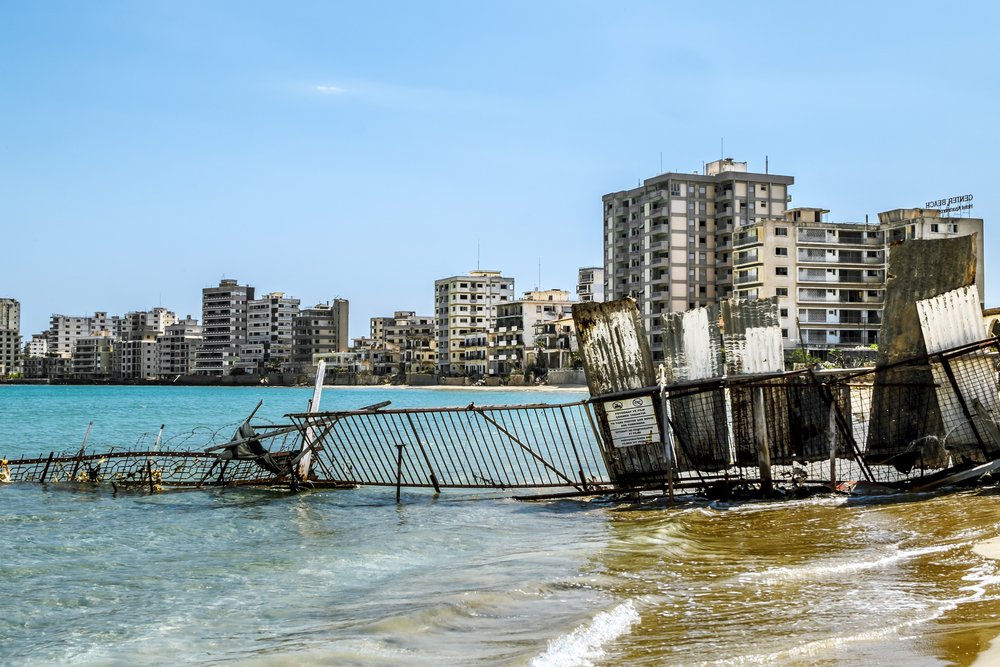
Varosha, part of the city of Famagusta, was once one of the most glamorous beach resorts in the Mediterranean, said to have drawn stars such as Elizabeth Taylor and Brigitte Bardot. Everything changed in 1974, when Turkey invaded Cyprus and the residents fled.
For decades, Varosha was a fenced-off military zone. Curtains flapped in the broken windows of hotels, and nature took over the beaches. Since 2020, parts of the town have reopened to visitors, creating a strange scene of tourists strolling and cycling past the skeletons of once-proud hotels.
2. Hashima Island (Japan)
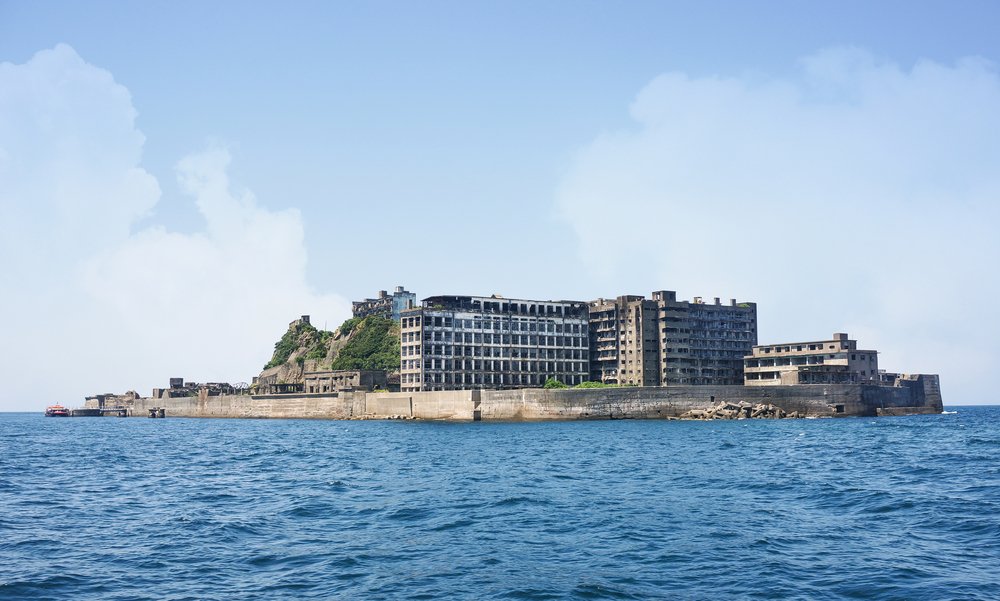
From a distance, Hashima looks like a battleship at sea, which is why it is nicknamed Gunkanjima, “Battleship Island”. This tiny island off Nagasaki was once one of the most densely populated places on Earth. More than 5,000 coal miners and their families lived in huge concrete apartment blocks on an island just 480 meters long. During World War II, Korean and Chinese forced laborers also worked in its mines.
When oil replaced coal, the mine closed and the island was abandoned in 1974. What remains is a concrete jungle slowly being eaten away by the sea. It inspired the villain’s lair in the James Bond film Skyfall.
1. Kangbashi (China)
Kangbashi, a new district of the city of Ordos in Inner Mongolia, is often called the mother of all ghost towns. It was built in the 2000s for hundreds of thousands of residents, with huge squares, futuristic museums and wide boulevards, paid for by the region’s coal boom.
But the people did not come. For years, Kangbashi was a surreal world of empty apartment towers and wide roads with hardly any cars. The government has since moved offices and schools there and the population has grown, but it remains a symbol of China’s real estate bubble, and proof that money can buy buildings but not a living community.