Throughout ancient and modern history, crossing rugged mountain chains meant braving perilous peaks or meandering through winding passes. Modern civil engineering transformed that reality by boring directly through solid bedrock. Underground corridors remain among humankind’s most underestimated feats; while travelers see only concrete portals and illuminated tracks, thousands of meters of immense tectonic pressure rest just above their heads.
This countdown focuses primarily on high-speed railway tunnels, where heavy locomotives require level gradients to reach maximum velocity. However, we also spotlight the world’s premier road tunnel, where specialized psychological lighting transforms a twenty-minute subterranean drive into an extraordinary Scandinavian adventure.
1. Gotthard Base Tunnel (57 km) – Railway Tunnel
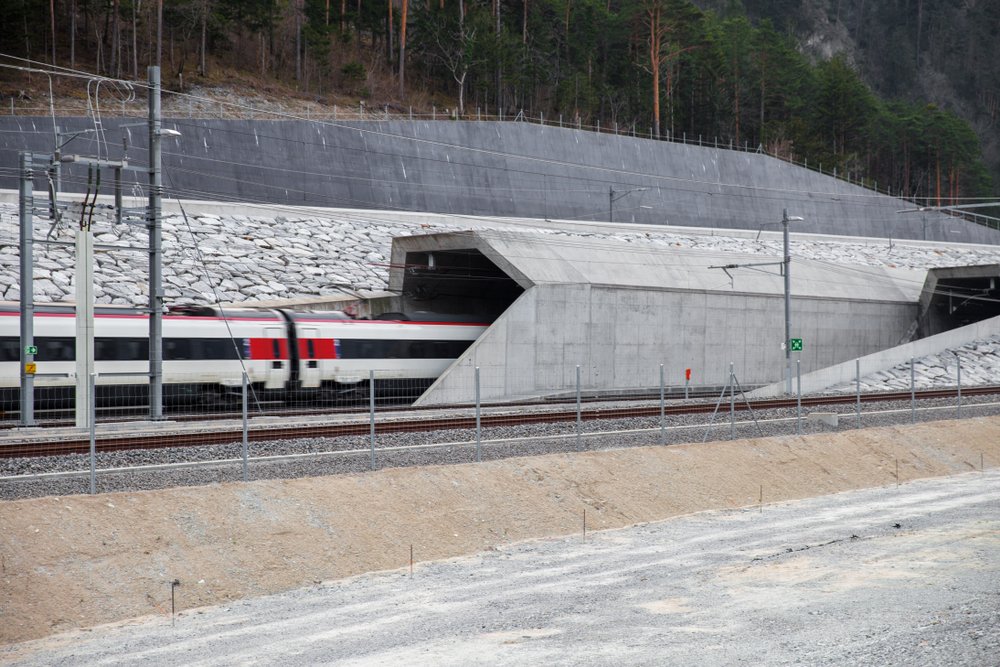
Standing as the crowning jewel of Swiss alpine engineering, the Gotthard Base Tunnel took seventeen years of relentless excavation before opening for scheduled service in 2016. Its primary mission was shifting heavy freight logistics from congested mountain highways directly onto electrified rail, while slashing transit times between Zurich and Milan.
Huge tunnel boring machines chewing from opposite ends met in the middle of the Alps with only a few millimeters of discrepancy.
2. Seikan Tunnel (53.8 km) – Railway Tunnel
Before Switzerland claimed the crown, Japan’s Seikan Tunnel held the world record for decades. Connecting the main island of Honshu with northern Hokkaido, the route plunges deep beneath the turbulent Tsugaru Strait, with twenty-three kilometers running entirely under the seabed.
Because ocean water exerts immense hydrostatic pressure and corrosive salt accelerates wear, maintenance teams constantly monitor structural sensors and run drainage pumps around the clock to ensure high-speed Shinkansen trains operate without disruption.
3. Channel Tunnel (50.4 km) – Railway Tunnel
Commonly referred to as the Chunnel, this iconic conduit links the British coastline at Folkestone with Coquelles in northern France. While slightly shorter than Japan’s Seikan Tunnel in overall distance, it boasts the longest contiguous undersea segment on Earth at nearly thirty-eight kilometers.
The infrastructure comprises three separate tubes: two full-sized running corridors for freight shuttles and Eurostar passenger trains, flanked by a central service tunnel utilized for emergency evacuation, ventilation, and technical maintenance as outlined by Eurotunnel engineering teams.
4. Yulhyeon Tunnel (50.3 km) – Railway Tunnel
Inaugurated in 2016 as a foundation of South Korea’s high-speed rail corridor, the Yulhyeon Tunnel runs along the Suseo high-speed line south of Seoul. Unlike Alpine tunnels driven through remote wilderness, Yulhyeon was excavated directly beneath dense urban development.
Boring deep into the earth allowed engineers to create a continuous track alignment where bullet trains cruise comfortably at speeds reaching 300 km/h without disrupting surface transportation networks or disturbing residential districts.
5. Songshan Lake Tunnel (38.8 km) – Railway Tunnel
China’s rapid infrastructure expansion created some of the most technologically ambitious subterranean networks of the past decade. The Songshan Lake Tunnel forms a vital section of the Dongguan-Huizhou intercity railway within the hyper-developed Pearl River Delta.
Commuters travel smoothly through nearly forty kilometers of subterranean passageways beneath industrial parks, lakes, and urban centers, reflecting the massive scale of modern Chinese transport planning.
6. Lötschberg Base Tunnel (34.6 km) – Railway Tunnel
Switzerland earns a second entry on the podium with the Lötschberg Base Tunnel, which cuts through the Bernese Alps to connect Frutigen and Raron. Serving as a crucial precursor to the larger Gotthard project, it proved modern base-tunnel concepts were viable at scale.
Today, regional operator BLS utilizes the route to divert hundreds of thousands of freight containers off steep alpine roads every year, helping preserve delicate mountain ecosystems.
7. New Guanjiao Tunnel (32.6 km) – Railway Tunnel
Perched high upon the Qinghai-Tibet Plateau at an elevation exceeding 3,300 meters above sea level, the New Guanjiao Tunnel represents one of the harshest excavation environments ever tackled by construction crews. Workers battled thin air, freezing temperatures, and unpredictable geological faults.
Before its dual-bore opening, trains crept across treacherous, winding mountain passes that were frequently paralyzed by winter storms. The modern tunnel slashed transit times across the plateau from several hours down to twenty minutes.
8. Guadarrama Tunnel (28.4 km) – Railway Tunnel
Spain’s premier engineering achievement runs beneath the Sierra de Guadarrama mountain range, linking Madrid with Segovia and Valladolid on the AVE high-speed network. The route consists of two independent parallel tubes spaced thirty meters apart.
Cross-passages connect the bores every few hundred meters to facilitate emergency evacuation, providing a secure, level corridor through granite mountains that once presented a formidable barrier between central Spain and the northern provinces.
9. West Qinling Tunnel (28.2 km) – Railway Tunnel
Piercing the Qinling Mountains of northwestern China, this dual-bore railway tunnel provides an essential transportation artery between Lanzhou and Chongqing. The mountainous terrain is notorious for loose tectonic fault zones that complicated excavation.
Engineers utilized specialized shields and reinforced shotcrete to stabilize the bores, allowing freight and passenger trains to pass safely through geological formations that once severed trade between northern and southwestern provinces.
10. Lærdal Tunnel (24.5 km) – Road Tunnel
Standing apart from the railway giants, Norway’s Lærdal Tunnel is officially the longest road tunnel on Earth. Traversing nearly twenty-five kilometers through mountain rock between Aurland and Lærdal, it eliminates the need for ferry crossings and hazardous winter passes.
To combat driver fatigue and claustrophobia during the twenty-minute transit, Norwegian psychologists and lighting engineers created three spacious caverns illuminated in luminous blue and sunrise-gold tones.
Which choice on this list is your personal favorite? Share your thoughts and rankings in the comments below.