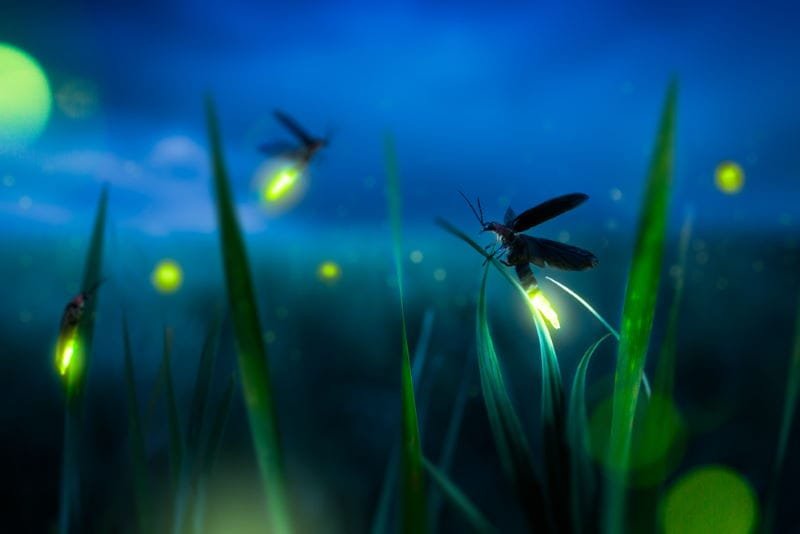
Did you know that some animals can produce light in the dark, without any electricity? This is called bioluminescence: a chemical reaction in the body, usually involving a substance called luciferin, that releases energy as light. It occurs all over the animal kingdom, but especially in the sea, where the great majority of deep-sea animals are thought to produce light. These are ten animals that glow in the dark.
1. Fireflies
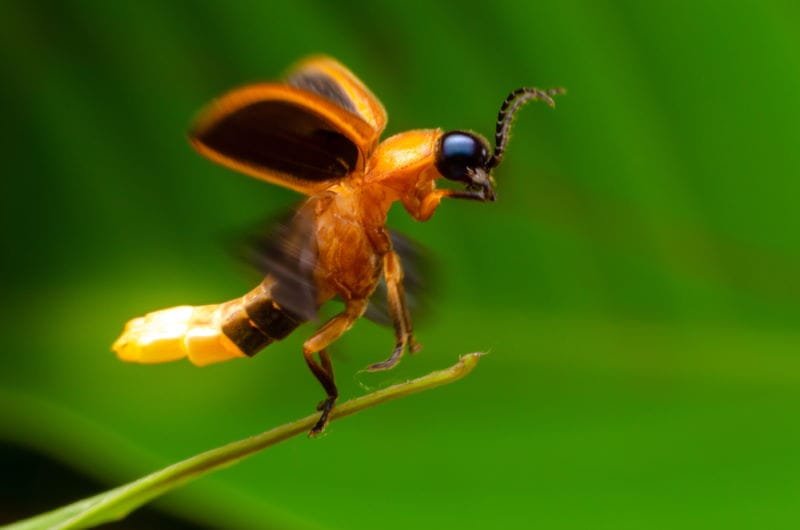
These are probably the best-known glowing animals in the world. Fireflies, which are actually beetles, use their light mainly to find a mate: each species has its own pattern of flashes, a kind of Morse code. There are more than 2,000 species, most of them in the tropics, but you can also find them in Europe and North America. Depending on the species, the light is yellow, green or orange. Their light is incredibly efficient: almost all of the energy becomes light, and hardly any is lost as heat.
2. Jellyfish
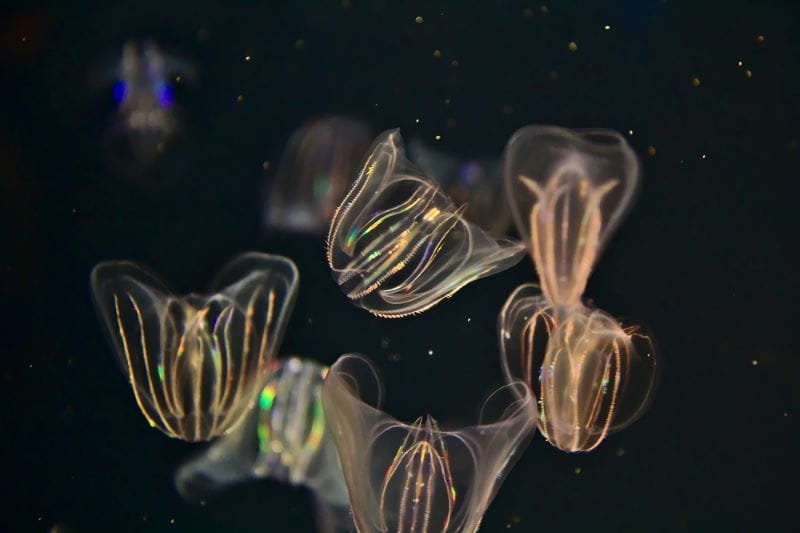
The deep ocean can sometimes look like a starry sky, thanks to the many jellyfish and other gelatinous animals that produce light. They use it to startle predators or, in some cases, to attract prey. One glowing jellyfish even changed science: from the crystal jelly (Aequorea victoria), researchers isolated green fluorescent protein, or GFP. It is now used in laboratories worldwide to make cells and genes visible, and its discovery was awarded the Nobel Prize in Chemistry in 2008.
3. Glowing sea snail (Hinea brasiliana)
Hinea brasiliana is a small sea snail found along the coasts of eastern Australia. It lives in groups in rocky crevices and feeds on algae. When it feels threatened, it lights up with a green glow. Remarkably, its shell does not block that light, but spreads it, so that the entire shell lights up. Scientists think the sudden glow makes the snail look much bigger to a predator, or scares it away.
4. Bobtail squid and its glowing bacteria
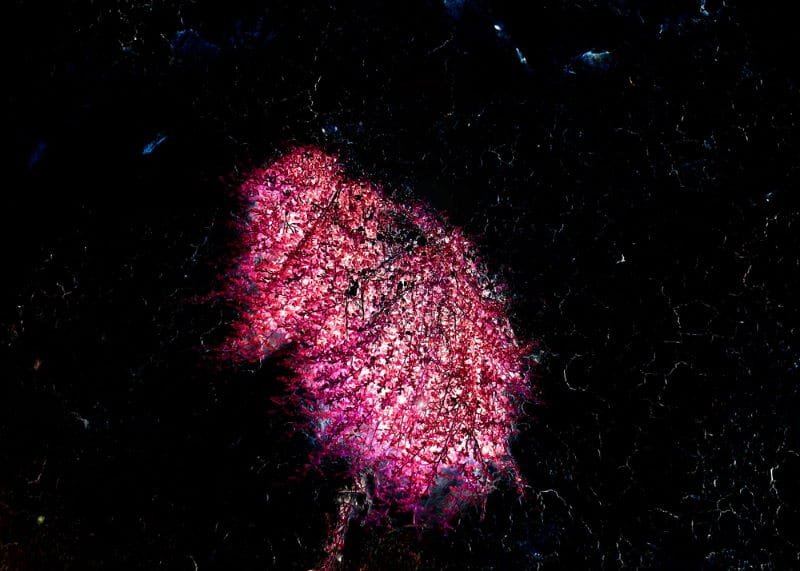
Many glowing animals do not make the light themselves, but host bioluminescent bacteria. A famous example is the Hawaiian bobtail squid. It keeps glowing bacteria in a special light organ on its underside. At night, the light matches the moonlight coming from above, so the squid casts no shadow and becomes almost invisible to predators below. Every morning, the squid expels most of the bacteria, and they grow back by evening.
5. Firefly squid
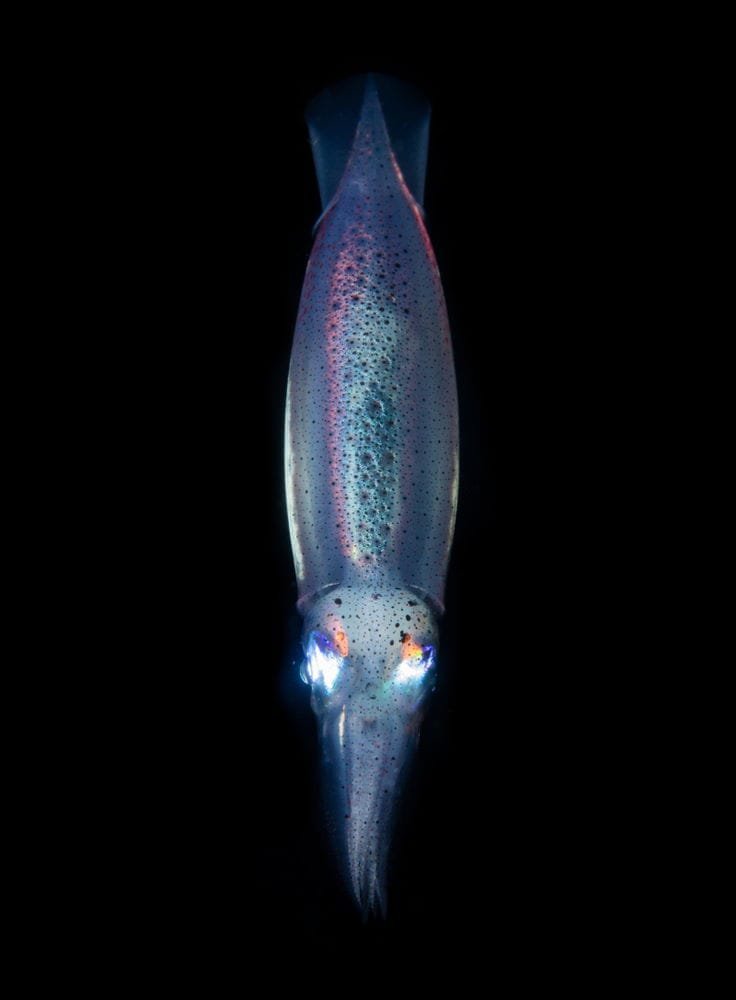
If you are ever on the coast of Toyama Bay in Japan in spring, it is worth looking at the sea after dark. Especially from March to May, you may see a spectacular blue glow. It is caused by countless firefly squid (Watasenia scintillans), small squid of around 7 centimeters that come up from the deep to spawn. Their bodies are covered with tiny light organs, and they can create complex patterns of light.
6. Sea sparkle
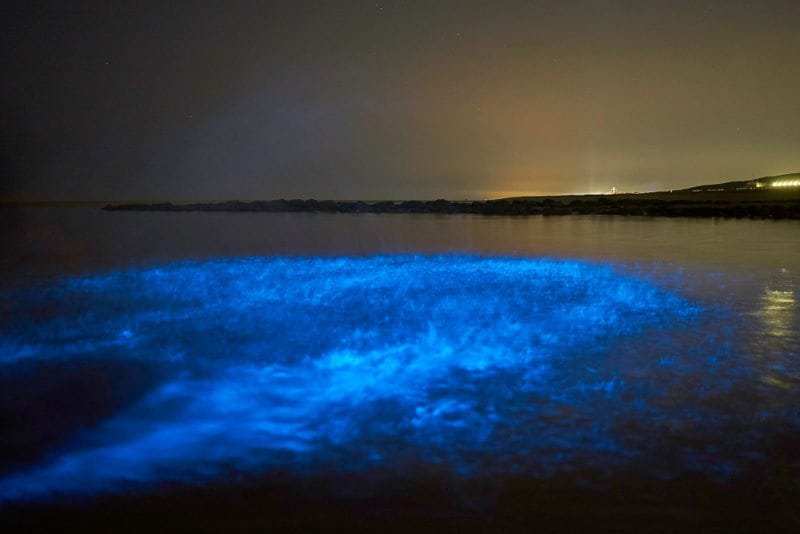
Sea sparkle (Noctiluca scintillans) is not really an animal, but a relatively large single-celled organism. It looks like a tiny transparent balloon with a tail. When the water is disturbed, by waves, a boat or a swimmer, it produces flashes of blue light.
During large blooms, entire beaches seem to glow at night, with light in the breaking waves and even in the footprints of people walking on the wet sand. You can see this phenomenon on coasts around the world, including in Europe, especially in warm, calm weather.
7. Deep-sea anglerfish
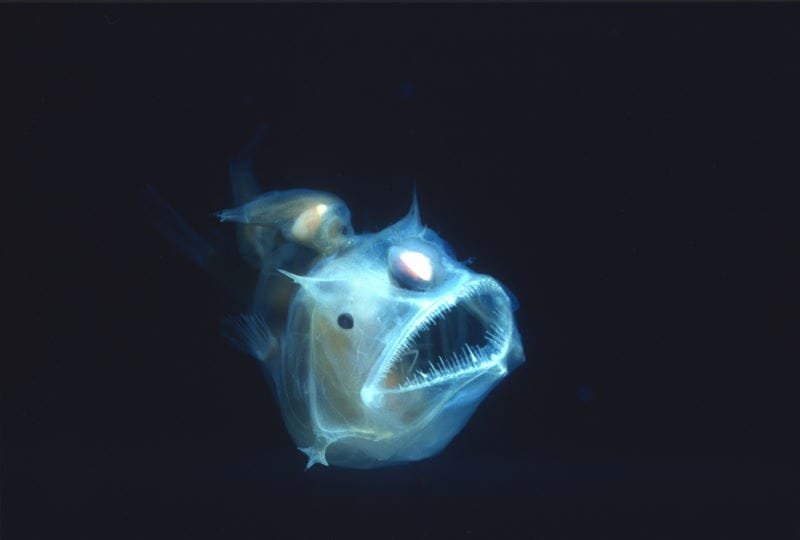
The deep-sea anglerfish lives at depths of hundreds to thousands of meters, where no sunlight reaches. Females have a striking “fishing rod” on their head with a glowing lure at the tip. The light is produced by bioluminescent bacteria living inside it. It attracts curious prey, and as soon as a fish comes close enough, the anglerfish opens its huge mouth and sucks it in.
8. New Zealand glowworms
In caves in New Zealand, such as the famous Waitomo Caves, the ceiling sometimes looks like a starry night sky. The light comes from glowworms: the larvae of a fungus gnat (Arachnocampa luminosa). Each larva hangs down dozens of sticky silk threads and lights up its tail with a blue-green glow. Insects that fly toward the light get stuck in the threads and are eaten.
9. Lanternfish
Lanternfish are small deep-sea fish with rows of light organs along their bodies. You have probably never heard of them, yet they are among the most numerous vertebrates on Earth. Every night, billions of them rise from the depths to feed near the surface, and return before dawn, one of the largest daily migrations on the planet. Each species has its own pattern of lights, which probably helps them recognize each other in the dark.
10. Ostracods, the sea fireflies
Ostracods are tiny crustaceans, only a few millimeters long. Some species are called sea fireflies, because they produce bright blue light. In the Caribbean, males perform courtship displays in which they leave trails of glowing dots in the water, like a light show. In Japan, dried sea fireflies were reportedly used during the Second World War as a dim light source that could be reactivated with water.
Bonus: three animals that seem to glow, but do not
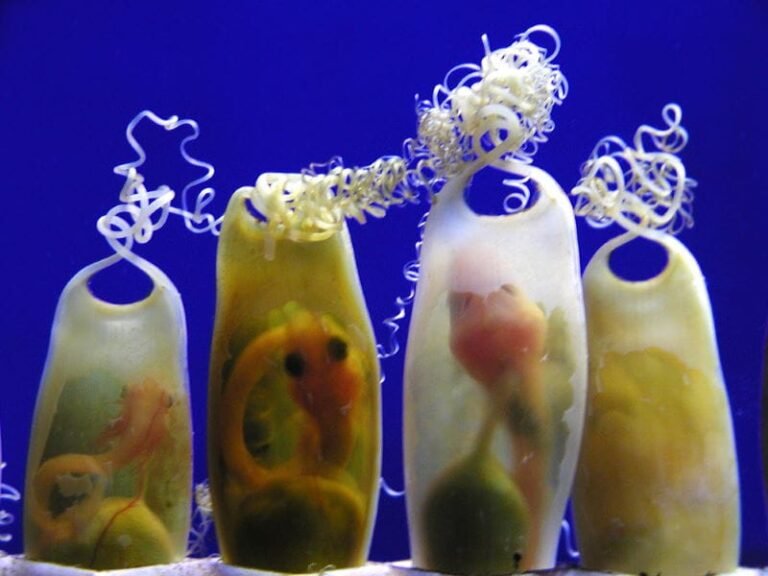
Not every animal that seems to glow produces its own light. Some are fluorescent: they absorb light of one color and give it off in another. The swell shark, for example, glows bright green to other sharks, which can see that light, but not to us without special filters. Scorpions light up blue-green under ultraviolet light, a trick that scientists still cannot fully explain. And tiny copepods called sea sapphires (Sapphirina) shimmer in brilliant blue and purple, not through bioluminescence but because of microscopic crystal structures in their skin that reflect light, like a soap bubble.