


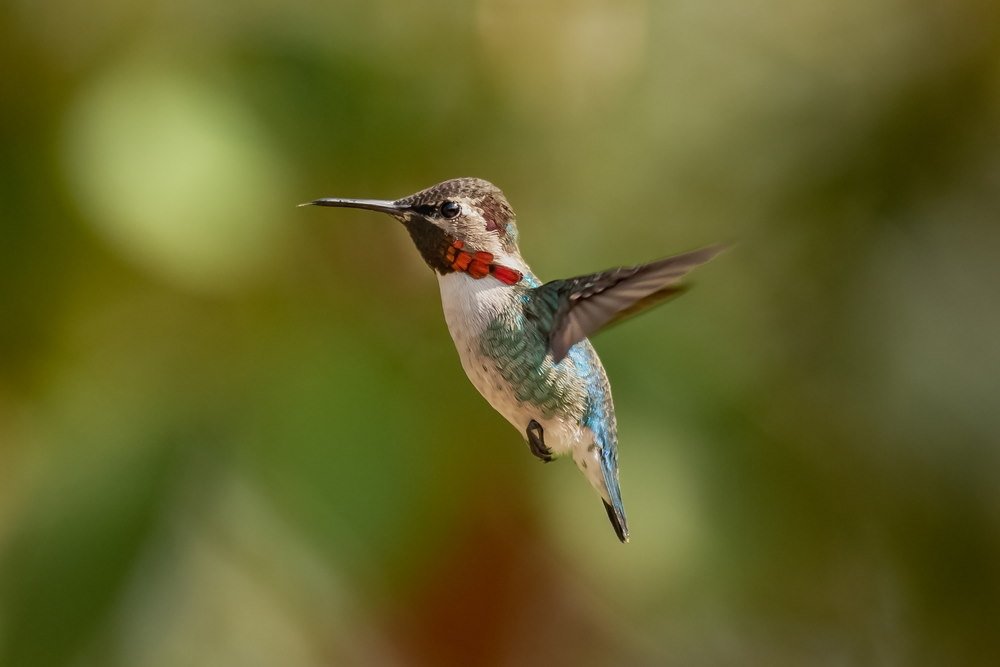
The smallest bird in the world is the Bee Hummingbird. This flying jewel grows to only 5 or 6 centimeters and weighs less than 2 grams. That is lighter than an average tea bag. They are so small that they often fight with bumblebees over the same flowers.
Most birds in this list are hummingbirds, as this family has evolutionarily specialized in being extremely small nectar drinkers. However, we also look at the smallest birds from other continents, such as Europe and Australia, to provide a complete picture.
Here are the 10 absolute minis of the animal kingdom.
1. Bee Hummingbird (Mellisuga helenae)
The undisputed number one. This little bird is found only in Cuba. The male is even slightly smaller than the female and has a dazzling red head and throat during the breeding season. Because they are so small, they must eat at an incredibly fast pace to maintain their body temperature; they visit up to 1,500 flowers a day. Their heart rate can reach up to 1,260 beats per minute.
2. Vervain Hummingbird (Mellisuga minima)
The cousin of the number one. This hummingbird lives in Jamaica and Haiti. Although its body length is just slightly larger than the Bee Hummingbird, it holds another record: the Vervain Hummingbird lays the smallest bird eggs in the world (about the size of a pea). Locally, it is often found in open gardens and scrublands.
3. Esmeraldas Woodstar (Chaetocercus berlepschi)
This rare bird lives exclusively in the forests of Ecuador. With a length of about 6.4 centimeters, it is the second-smallest bird in South America. The species was long considered lost until it was rediscovered. The male has a beautiful purple throat, but due to deforestation, this “forest elf” is unfortunately critically endangered.
4. Bumblebee Hummingbird (Atthis heloisa)
The name says it all: this bird is barely larger than a substantial bumblebee. It is found in the mountains of Mexico. With a weight of about 2.2 grams, it is extremely light. They fly differently than other birds; their wings make a buzzing sound that sounds suspiciously like an insect, which often causes predators to ignore them.
5. Calliope Hummingbird (Selasphorus calliope)
This is the smallest bird found in the United States and Canada. Despite its minuscule size (approx. 7 cm), it is a tough traveler. Each year, they migrate thousands of miles from the cold Canadian mountains to Mexico. No other bird of this size covers such a vast distance.
6. Costa’s Hummingbird (Calypte costae)
An inhabitant of the hot deserts in the Southwestern US. What makes this small bird (approx. 7.6 cm) unique is its bright purple “mustache.” The feathers on its head form a gorget that it can flare out to impress females, making it look like a sort of purple octopus. They enter a state of torpor (deep sleep) to survive the cold desert nights.
7. Weebill (Smicrornis brevirostris)
We leave the hummingbirds for a moment for Australia’s smallest bird. The Weebill is about 8 centimeters long. It is a yellowish songbird that spends almost its entire life in the canopy of eucalyptus trees. They have a short, blunt beak used to pluck tiny insects from the leaves.
8. Goldcrest (Regulus regulus)
This is the smallest bird in Europe. They often weigh only 5 to 6 grams. You recognize them immediately by the bright yellow or orange stripe on their head. They are incredibly active and can hardly sit still. According to Bird Protection organizations, they must eat almost continuously in winter to avoid freezing, as such a small body loses heat very quickly.
9. Pale-billed Flowerpecker (Dicaeum erythrorhynchos)
One of the smallest birds of India and Sri Lanka (approx. 8 cm). They are often overlooked because they are small, brown, and fast. They love the berries of parasitic plants (like mistletoe) and play a crucial role in dispersing seeds in the forest. They have a characteristic, curved pale beak.
10. Spotted Pardalote (Pardalotus punctatus)
Another Australian mini (8 to 10 cm). While many small birds are dull-colored (brown/grey), the Spotted Pardalote is an explosion of color with white spots on a black background and bright yellow accents. They often build their nests—quite unusually for birds—in tunnels they dig themselves into earth banks.
