


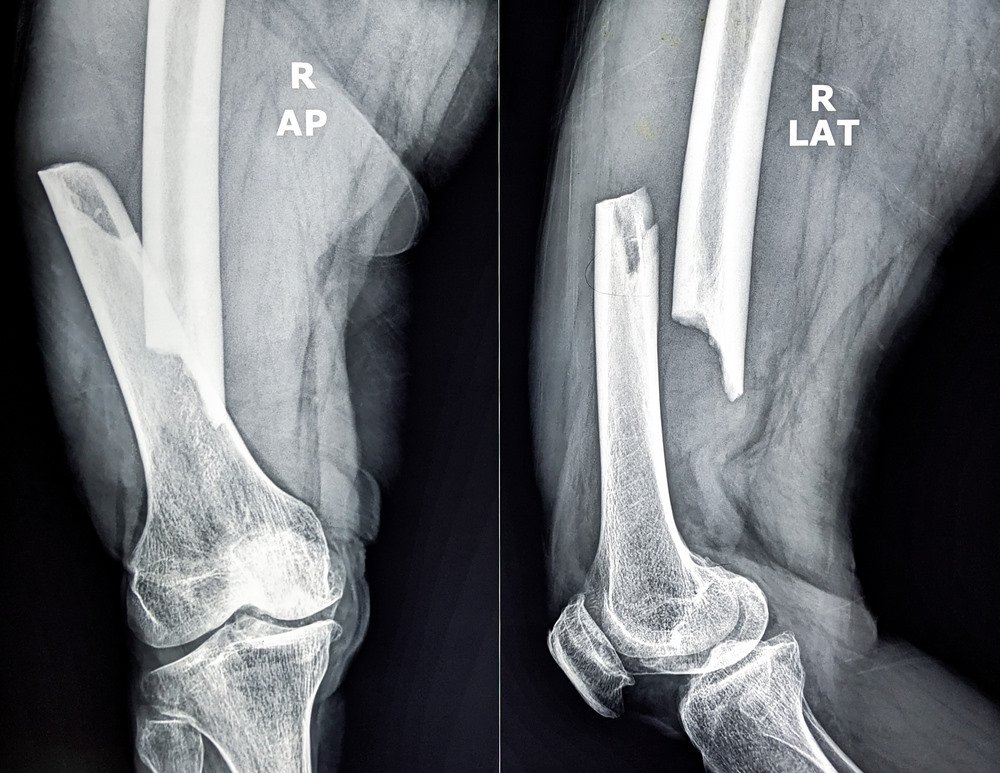
According to many, the most painful bone fracture is the femur (thigh bone). The femur is the strongest and longest bone in our body. Breaking it requires a massive amount of force, such as a car accident. The pain is unbearable because the large leg muscles go into spasm after the break, pulling the loose bone fragments over one another.
In this list, we aren’t necessarily looking at the most dangerous fractures, but purely at the pain experience during the acute phase and recovery.
Here are the 10 bones you would rather keep intact.
1. Thigh Bone (Femur)
Breaking your femur is often described as the maximum pain a human can experience without fainting. Because this bone is so strong, a fracture is often accompanied by extensive damage to surrounding muscles, blood vessels, and nerves. The most notorious aspect is the muscle spasm: your upper leg muscles are so powerful that they pull the broken bone pieces past each other, leading to a grinding, nauseating pain until the leg is placed in traction.
2. Ribs
A broken rib is a psychological torture. With most other fractures, you get a cast and can keep the body part still. With ribs, that is impossible: you have to keep breathing. Every breath is a jolt of pain. Having to cough, sneeze, or laugh with broken ribs is described by patients as the feeling of a knife being thrust into your chest.
3. Tailbone (Coccyx)
A small bone with a big impact. A broken tailbone often occurs from a fall straight onto the buttocks. The pain is gnawing, sharp, and constant. The problem is that you can hardly sit or lie down without putting pressure on the area. Even going to the toilet becomes a painful task. Since it cannot be put in a cast, the pain often lasts for months.
4. Heel Bone (Calcaneus)
This is also known as the Don Juan fracture (because people often suffer this when jumping from a balcony). The heel bone is like a sponge made of bone. When it breaks, it often shatters, and the foot swells enormously. The skin becomes so tight it feels as if your foot is bursting apart. Because your entire body weight rests on your heel, rehabilitation is a long and painful process.
5. Pelvis
A pelvic fracture is often life-threatening due to internal bleeding, but also extremely painful. The pelvis is the ring that connects your upper and lower body. Every tiny movement of your torso or legs translates directly into pain in the pelvis. Patients often have to lie flat for weeks and cannot move an inch without agony.
6. Collarbone (Clavicle)
A classic for cyclists and judokas. The collarbone breaks easily, and the fracture pieces often shift relative to each other, creating a visible lump. Because your arm hangs from your shoulder, the weight of your arm constantly pulls at the break. Even in a sling, every step you take echoes in your shoulder.
7. Shin Bone (Tibia)
The compound or open leg fracture is particularly notorious. The shin bone lies right under the skin. With a hard impact, such as a sliding tackle in football, the bone can pierce through the skin. Besides the fracture pain, the wound pain and fear factor here are enormous. The periosteum (bone lining) around the shin is extremely sensitive—multiply that sensation of hitting your shin against a table by a hundred.
8. Spine (Compression Fracture)
With osteoporosis or a fall, vertebrae can collapse. This causes a band-like pain that radiates around your entire torso. Because the spinal cord nerves are nearby, the pain can radiate to your legs or arms. It often feels to patients as if their back is literally unstable, causing deep, frightening pain with every movement.
9. Elbow
We all know the feeling of hitting your funny bone. A fracture in the elbow is that feeling, but continuous and much more intense. The elbow is a complex hinge where three bones meet. The swelling quickly puts pressure on the nerves running to your hand, causing a burning, tingling nerve pain that is often worse than the bone pain itself.
10. Fingertips
Perhaps a surprise in this list of large bones, but your fingertips are more densely packed with nerve endings than almost any other part of the body. If you crush the tip of your finger (for example, in a car door), the pain is nauseating and throbbing. As pressure builds up in the fingertip due to blood accumulation under the nail, it feels like your finger is about to explode.
