


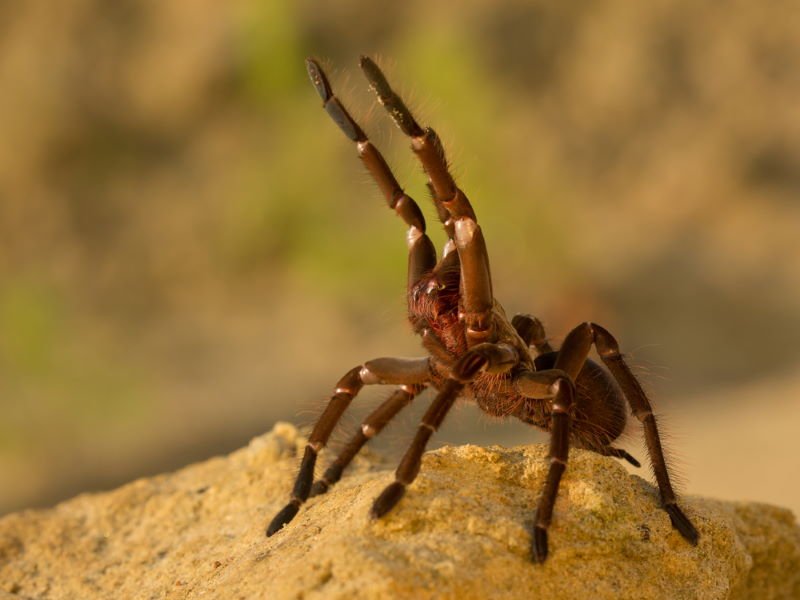
The largest spider in the world in terms of body mass is the Goliath Birdeater. This heavyweight can weigh up to 170 grams and is as large as a dinner plate. However, if we look purely at leg span, the Giant Huntsman wins; its legs can reach a width of 30 centimeters, making it as wide as a ruler.
In the world of spiders, there are two ways to measure: how heavy they are (mass) and how wide they can stretch (span). Most giants in this list are tarantulas, which often look even larger and more cuddly than they are due to their hairiness.
Here are the 10 absolute giants of the spider world.
1. Goliath Birdeater (Theraphosa blondi)
The undisputed king of the jungle. This spider lives in the rainforests of South America (mainly Suriname and Brazil). Although its name suggests it eats birds, it rarely does; it prefers worms, frogs, and large insects. It has enormous fangs up to 2.5 centimeters long that can pierce through a human nail.
2. Giant Huntsman (Heteropoda maxima)
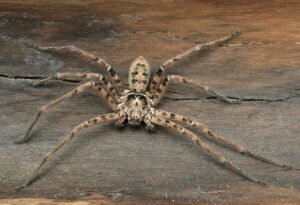
This spider was only discovered in 2001 in a cave in Laos. Where the Goliath is a thick tank, the Huntsman is a fast sports car. It has extremely long, thin legs and moves sideways like a crab. Because it lives in caves, it is quite pale in color. It does not hunt with a web but physically runs down its prey.
3. Brazilian Salmon Pink Birdeater (Lasiodora parahybana)
This spider is popular among hobbyists because it is easy to keep, but it grows to be gigantic. It comes from eastern Brazil. It is not known for its bite, but rather for its urticating hairs. If it feels threatened, it rubs its back legs over its abdomen to release a cloud of irritating hairs that can severely pain your skin and eyes.
4. Grammostola anthracina
This tarantula occurs in Uruguay, Paraguay, Brazil, and Argentina. It is an imposing, shiny spider known for being quite calm. In terms of leg span, it is hardly inferior to numbers 1 and 3.
5. Poecilotheria rajaei
This spider was discovered around 2013 in Sri Lanka and immediately made world news as the face-sized tarantula. It has a beautiful pattern with yellow and gray markings. Unfortunately, its habitat is threatened by deforestation, which is why they are increasingly found in abandoned buildings and hospitals.
6. King Baboon (Pelinobius muticus)
An aggressive burrower from East Africa (mainly Kenya and Tanzania). This spider is notorious for its bad temper. It digs deep burrows and if you disturb it, it makes a hissing sound by rubbing its legs together (stridulation). It has thick back legs that resemble a baboon’s fingers, hence the name.
7. Colombian Giant Redleg (Megaphobema robustum)
This spider is known for its defense mechanism. It has sharp spikes on its back legs. If a predator (or a curious human) gets too close, it turns around and kicks with its spiky back legs to prick the attacker. It is deep black with bright orange details.
8. Brazilian Wandering Spider (Phoneutria)
Perhaps not the very largest in body size, but certainly in reputation and leg span (up to 15 cm). This is one of the most venomous spiders in the world. It does not make a web but wanders the jungle floor at night (and sometimes in banana boxes) in search of prey. Its scientific name means murderess in Greek.
9. Chaco Golden Knee (Grammostola pulchripes)
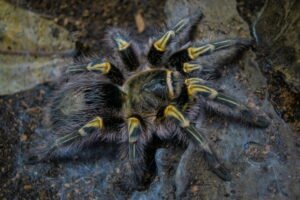
A beautiful, large spider from Paraguay and Argentina. It can be recognized by the golden stripes on its knees. Despite its size (it can reach a 20 to 22 cm leg span), this is one of the most docile spiders in the world, which is why it is often used as an entry-level model for people who want a giant spider as a pet.
10. Cerbalus aravaensis
The largest spider in the Middle East, living in the sand dunes of Israel and Jordan. This spider is a master of camouflage and digs burrows in the sand that it closes with a door made of sand and glue. It was only officially described in 2010, which shows that we are still discovering new giants even in heavily visited areas.
