


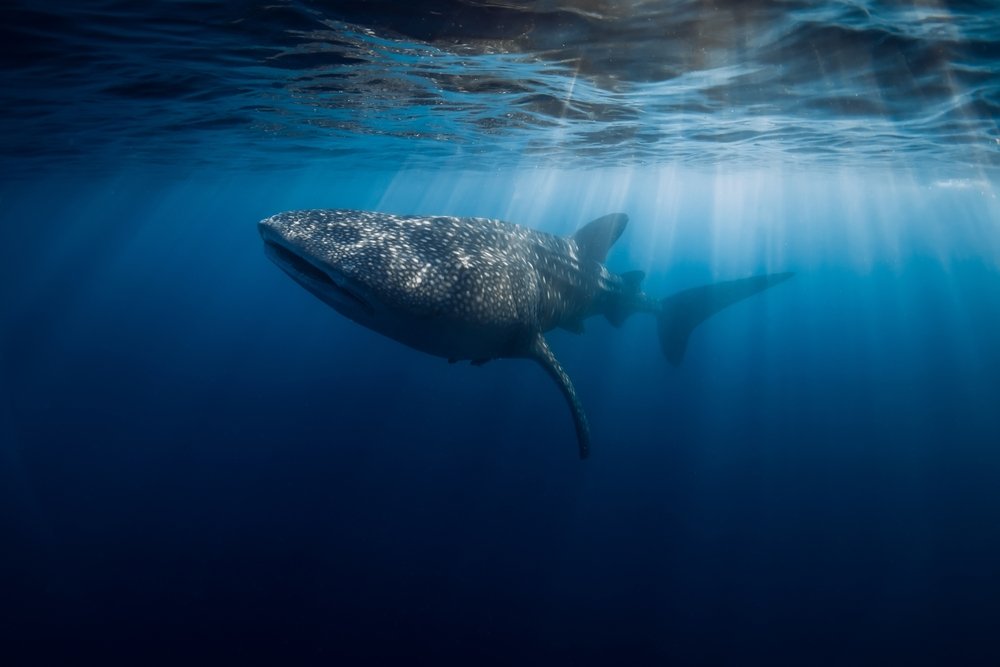
The largest shark (and also the largest fish) in the world is the Whale Shark. This gentle giant can grow up to 18.8 meters long. That is roughly as long as an articulated city bus. Despite its enormous mouth, it is completely harmless to humans; it calmly filters small crustaceans from the water.
Sharks have existed for more than 400 million years, long before dinosaurs roamed the earth. The species in this list range from deep-sea monsters we rarely see to the well-known hunters near the surface.
Here are the 10 longest and heaviest sharks swimming in our oceans today.
1. Whale Shark (max. 18.8 meters)
The Whale Shark is not a whale, but a fish (it has gills). You recognize it by its broad, flat head and the pattern of white spots on its dark skin, which is as unique as a fingerprint. They often swim with their mouths wide open just below the water surface to gulp down plankton and krill.
2. Basking Shark (max. 12 meters)
The runner-up is also a filter feeder. The Basking Shark looks terrifying when it opens its mouth: it appears gigantically large. Shark Trust describes that this shark filters thousands of liters of water per hour. They swim extremely slowly and are often spotted around the British Isles and in the North Sea.
3. Great White Shark (max. 6 – 7 meters)
The largest predatory shark in the world. The Great White became world-famous through the movie Jaws. Females are considerably larger than males. Although they have a bad reputation, they often make a mistake when biting a human; they are looking for seals with high fat content and actually find humans too bony. They can raise their body temperature to hunt in colder waters.
4. Greenland Shark (max. 6.4 – 7.3 meters)
This shark is a mysterious creature from the icy depths of the Arctic Ocean. They grow extremely slowly (only 1 cm per year) and can therefore become incredibly old. Scientists estimate that some specimens are more than 400 years old, making them the longest-living vertebrates on Earth. They are often blind due to parasites hanging from their eyes.
5. Tiger Shark (max. 5.5 meters)
The Tiger Shark is known as the “garbage can of the sea.” All sorts of things have been found in their stomachs: from license plates and car tires to medieval suits of armor. They owe their name to the dark stripes on their body (which fade as they age). It is one of the few sharks that is not picky about food and can therefore be dangerous to swimmers.
6. Great Hammerhead Shark (max. 6.1 meters)
The largest of the hammerhead family. Their unique T-shaped head (the cephalofoil) serves as a kind of metal detector; sensors are spread across the entire width, allowing them to flawlessly find prey hidden under the sand (such as rays). They are more agile than most other large sharks.
7. Bluntnose Sixgill Shark (max. 5.5 meters)
The Bluntnose Sixgill Shark is a living fossil. While most modern sharks have five gill slits, this ancient shark has six. They live in the deep, dark parts of the ocean and rarely come to the surface. They look bulky and slow but can accelerate explosively when they spot prey.
8. Megamouth Shark (max. 5.5 meters)
The Megamouth is one of the rarest sharks in the world. It was only discovered in 1976 when one accidentally became entangled in the anchor of a naval ship. Like numbers 1 and 2, it eats plankton. It has an enormous, soft mouth with rubbery lips. Some researchers believe the inside of its mouth glows in the dark to lure plankton.
9. Thresher Shark (max. 6 meters)
This shark cheats a bit with its length: almost half of its body consists of its tail fin. The Thresher Shark uses that tail like a whip. It swims into a school of fish and then strikes hard with its tail to knock the fish unconscious, after which it can eat them at its leisure.
10. Pacific Sleeper Shark (max. 4.4 – 7 meters)
A close relative of the Greenland Shark. They live in the deep waters of the Pacific Ocean. Because they live so deep and are rarely caught, their exact maximum length is difficult to determine, but gigantic specimens have been captured on camera. They are scavengers that clean up everything that sinks to the bottom, including giant squids.
