
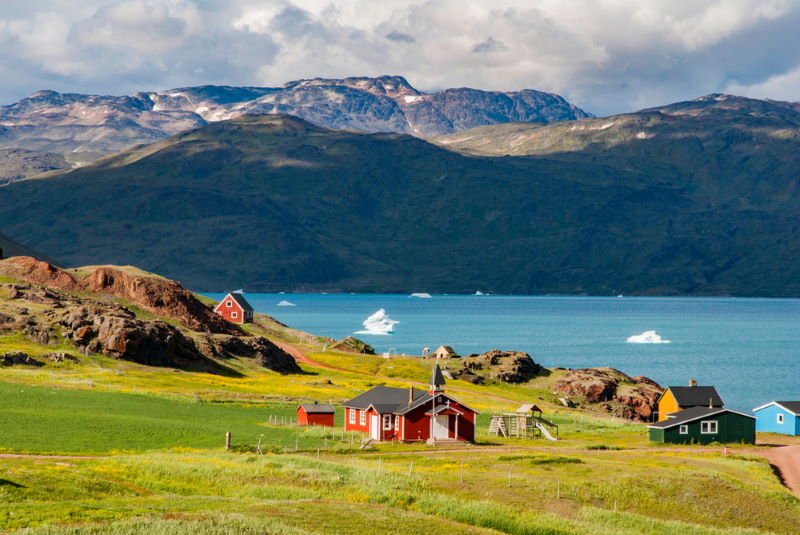
The largest island in the world is Greenland. With an area of more than 2.1 million square kilometers, it is three times the size of France. People often think Australia is the largest island, but geographers officially regard Australia as a continent, not an island. So Greenland takes the title.
When is something an island and when is it a continent? The line is sometimes blurry, but the rule is usually simple: Australia is too big and has its own tectonic plate, so it doesn't count.
What remains is a list full of extremes. From impenetrable jungles in Asia where we are still discovering new species, to frozen plains in the far north where hardly anyone can survive.
Cast your vote - the ranking shifts live based on the votes.
Greenland (2,130,800 km²)
Although geographically part of North America, Greenland is politically linked to Denmark. It is a land of huge contrasts: it is gigantic, yet fewer people live there than in an average provincial town (about 56,000). That is because 80% of the land is covered by an ice sheet that can be kilometers thick. If all that ice melted, global sea levels would rise by 7 meters.
New Guinea (785,753 km²)
This island just north of Australia is a paradise for biologists. It is politically divided: the western half belongs to Indonesia (Papua) and the eastern half is the independent country of Papua New Guinea. Because the landscape is so rugged and mountainous, hundreds of tribes live here in relative isolation from one another. The island is known for its enormous biodiversity; scientists still regularly find animals and plants that exist nowhere else, from tree kangaroos to birds of paradise.
Log in to post a comment.
Borneo (748,168 km²)
Borneo is unique because it is the only island in the world shared by three countries: Indonesia (the largest part), Malaysia and tiny, super-rich Brunei. The island is home to one of the oldest rainforests on Earth – it is even older than the Amazon. It is also the only place in the wild where you can encounter the orangutan. Sadly, this green paradise is seriously threatened by logging and palm oil plantations.
Log in to post a comment.
Madagascar (587,041 km²)
Madagascar broke away from Africa and India millions of years ago and then drifted in isolation. As a result, nature went its own way. About 90% of the animals on Madagascar are found nowhere else. The best-known residents are of course the lemurs. According to UNESCO, the rainforests here are of immeasurable value to the global history of evolution.
Log in to post a comment.
Baffin Island (507,451 km²)
Back to the cold. Baffin Island is Canada's largest island, located between Greenland and the Canadian mainland. It is a rugged landscape of fjords, glaciers and mountains. The name comes from the British explorer William Baffin. Despite its huge area (bigger than Spain), only 11,000 people live there, mostly Inuit, who live from hunting and fishing.
Log in to post a comment.
Sumatra (473,481 km²)
Sumatra is the largest island that belongs entirely to Indonesia (since it has to share Borneo and New Guinea). It lies on the 'Ring of Fire', meaning the island was shaped by volcanoes and earthquakes. It is one of the few places on Earth where tigers, rhinos, elephants and orangutans live in the same area.
Log in to post a comment.
Honshu (227,960 km²)
This is the island we know as the “mainland” of Japan. This is where you'll find the big cities like Tokyo, Kyoto and Osaka. While the other islands on this list are often sparsely populated, Honshu is extremely busy. Travel guides often describe Honshu as the cultural and economic heart of Japan, where ultra-modern cities and centuries-old temples exist side by side. Despite the crowds, the interior still consists of wild mountains and volcanoes.
Log in to post a comment.
Victoria Island (217,291 km²)
Another Canadian island on the list. Victoria Island lies in the Arctic Ocean and is slightly larger than Great Britain, yet fewer than 2,000 people live there. A bizarre fact for your next party: this island has a lake, containing an island, containing another lake, containing yet another island. Inception in nature.
Log in to post a comment.
Great Britain (209,331 km²)
This is the island that England, Scotland and Wales sit on. It is the largest island in Europe. Historically, this small piece of land has been one of the most influential places on Earth; the British Empire was once the largest empire in the world. Geologically, the island is quite young: Encyclopædia Britannica explains that it only separated from the European mainland after the last ice age due to rising water.
Log in to post a comment.
Ellesmere Island (196,235 km²)
We close with the third Canadian island in the top 10. Ellesmere lies in the far north, close to the North Pole. The landscape consists of ice fields and bare rock. Because it is so far north, it is dark for months in winter and the sun doesn't set for months in summer. Scientists regularly find fossils of tropical animals and plants here, proving that this icebox of an island was a warm jungle millions of years ago.
Log in to post a comment.
Missing an item in this list?
Log in or create a free account to add an item yourself.
Log in / create account
Log in to post a comment.