 katatonia82 / Shutterstock.com
Thanks to the organization of major tournaments such as the 1998 World Cup, the 2016 European Championships and the 2024 Olympic Games, France has one of the most modern stadium landscapes in Europe. Where English stadiums are often tightly packed between working-class terraced houses, the French often opted for futuristic arenas with daring architecture and multifunctional roofs. From intimidating southern French cauldrons to ultra-modern sports palaces: these are the 10 largest football stadiums in France, ranked by official spectator capacity.
Which one of these deserves the top spot? Cast your votes below and let us know your personal ranking in the comments!
Cast your vote - the ranking shifts live based on the votes.
Stade de France (Saint-Denis: 81,338 seats)
The absolute crown of the French sports world is in the northern Parisian suburb of Saint-Denis. The Stade de France was built for the 1998 World Cup and immediately became a national heritage when Zinédine Zidane decided the final against Brazil (3-0) with two accurate headers, meaning France won the World Cup for the first time in history. With a capacity of 81,338 spectators, this is by far the largest stadium in the country. The gigantic elliptical disk that floats above the stands like a halo weighs thirteen thousand tons and protects the audience without blocking the natural daylight on the turf. Thanks to retractable lower bleacher decks, the complex can be quickly converted from a football and rugby arena to an international athletics stadium, as was brilliantly demonstrated during the 2024 Olympic Games.
Orange Vélodrome (Marseille: 67,394 places)
The Stade Vélodrome on Boulevard Michelet is the most thrilling cauldron in France. The stadium opened in 1937 and owes its name to the cycling track that surrounded the field at the time. For the 2016 European Championships, the complex received a colossal metamorphosis: a wavy white roof of 65,000 square meters was built that shielded the open, windy stands from the infamous mistral wind. The canopy turned the stadium into a gigantic sound box. With 67,394 seats, the Vélodrome boils over every week as the fanatical supporters of the *Virage Nord* and *Virage Sud* drown each other out with chants and gigantic fireworks shows. When arch-rival PSG visits Le Classique, the whole of Marseille shakes to its core.
Log in to post a comment.
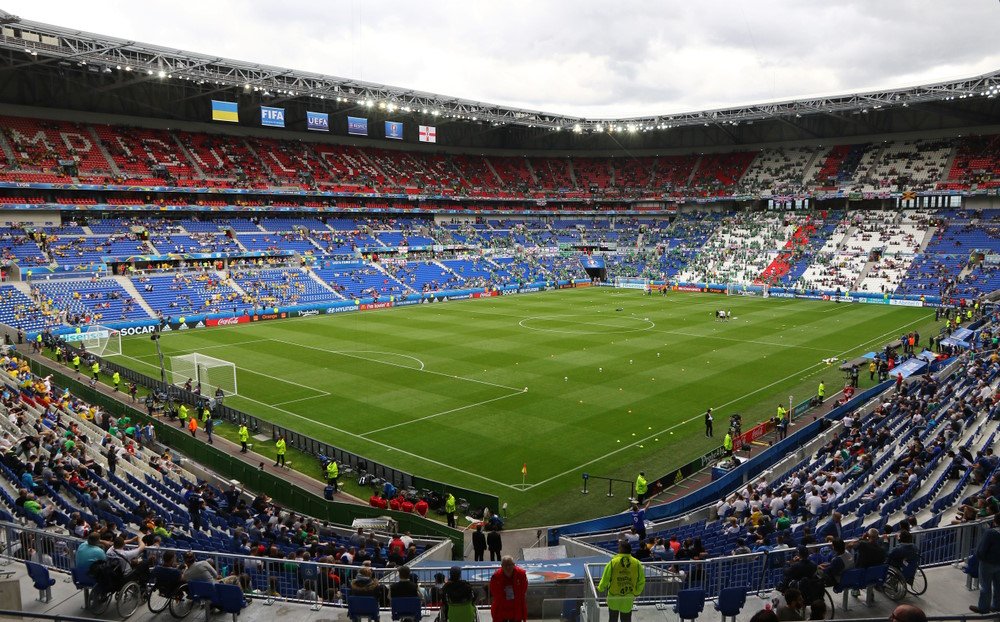
Groupama Stadium / Parc OL (Lyon: 59,186 places)
Almost all major French stadiums are owned by the local municipality, but Olympique Lyonnais chose a radically different path. Under the inspiring leadership of chairman Jean-Michel Aulas, the club built and financed its own mega-stadium in the eastern suburb of Décines-Charpieu, which opened its doors in early 2016. With a capacity of 59,186 places and a gigantic canopy system that extends far beyond the facade like a turtle shell, Lyon set the standard for commercial stadium operation in France. In addition to football, the arena houses a complete leisure complex with hotels, office buildings, medical centers and an events hall.
Log in to post a comment.
Decathlon Arena – Stade Pierre-Mauroy (Lille: 50,186 seats)
In the suburb of Villeneuve-d'Ascq there is a technological prodigy. The Lille OSC facility, which opened in 2012, not only has a roof that closes completely within thirty minutes, but also houses a unique trick under the grass: the northern half of the playing field can be lifted up via hydraulic lifts and slide over the southern half. This creates a covered hall for thirty thousand spectators in the vacated space, the so-called Boîte à Spectacles. The complex was used for the Davis Cup finals in tennis, European basketball championships and the basketball matches during the 2024 Olympic Games.
Log in to post a comment.
Parc des Princes (Paris: 47,929 places)
The chic 16th arrondissement of Paris is home to one of France's most characteristic brutalist buildings. Architect Roger Taillibert designed the Parc des Princes in 1972 with fifty gigantic concrete ribs that curve over the stands like an enormous chest. The lack of supporting pillars ensures unobstructed sightlines and overwhelming acoustics. Since 1974, the stadium has been the proud bastion of Paris Saint-Germain. The arena is the center of a fierce political trench war: the wealthy club owners from Qatar want to buy the stadium to expand it significantly, but mayor Anne Hidalgo refuses to sell the municipal heritage. PSG has therefore been threatening for some time with the construction of a completely new mega stadium outside the ring road.
Log in to post a comment.
Matmut Atlantique (Bordeaux: 42,115 places)
Architecturally, Bordeaux's stadium is a breathtaking work of art. Top Swiss agency Herzog & de Meuron designed a white, floating bowl that rests on a forest of more than nine hundred slender steel columns. The complex was completed in 2015 for the 2016 European Championship and replaced the outdated Stade Chaban-Delmas. However, today the stadium is the symbol of a dramatic sporting decline. Six-time national champion Girondins de Bordeaux succumbed to a sky-high debt burden in the summer of 2024, lost her professional status and was demoted to the fourth division (National 2). As a result, this ultra-modern arena of 42,000 seats forms the bizarre backdrop for amateur matches for only a few thousand spectators.
Log in to post a comment.
Stade Geoffroy-Guichard (Saint-Étienne: 41,965 seats)
Throughout France, this arena is known by the terrifying nickname Le Chaudron (The Witch's Cauldron). The stadium was built in 1931 on a site owned by supermarket magnate Geoffroy Guichard, the founder of the Casino chain, and grew into the temple of the most successful club of the twentieth century in France. With its closed corners and stands that connect directly to the playing field, Saint-Étienne is home to one of the most fanatical supporters in the country. Both the *Kop Nord* and the *Kop Sud* guarantee a wall of sound, green smoke and massive waves of flags for ninety minutes.
Log in to post a comment.
Stade Bollaert-Delelis (Lens: 38,223 places)
In the northern mining town of Lens, one of the sports world's most bizarre demographic phenomena is occurring. The Stade Bollaert-Delelis can accommodate 38,223 spectators, while the entire municipality of Lens has barely 31,500 inhabitants. When the stadium fills up on Saturday evening, there are literally more people in the stands than live in the entire city. The arena breathes heavy industry: it is named after mine director Félix Bollaert and former mayor André Delelis. Before every RC Lens match, tens of thousands of supporters sing the miners' song *Les Corons* by Pierre Bachelet with their heads bare. The four steep, detached stands give the complex an authentic English character that is rare in France.
Log in to post a comment.
Stade de la Beaujoire (Nantes: 35,322 seats)
The Stade de la Beaujoire was opened for the 1984 European Championship and immediately experienced a legendary baptism of fire when Michel Platini scored a hat-trick on behalf of France against Belgium (5-0). The stadium, designed with elegant undulating roofs, exudes the pure football philosophy of the Loire region. In this arena, trainers José Arribas and Jean-Claude Suaudeau perfected the famous Jeu à la nantaise: an elegant, flashy combination game in which ball circulation and intuition were central. The yellow-green supporters on the *Tribune Loire* create one of the most loyal and visually impressive atmospheres in western France at home games of FC Nantes.
Log in to post a comment.
Stade de la Mosson (Montpellier: 32,900 seats)
On the western edge of the southern French university city lies a stadium that is in a permanent battle against the elements. The Stade de la Mosson dates from 1972 and is located directly on the banks of the river of the same name. In the autumn of 2014, the river overflowed its outer banks after heavy weather, causing the field, dressing rooms and catacombs to disappear under more than three meters of muddy water. With a capacity of 32,900, the stadium was the setting for the fairytale of 2012, when Montpellier HSC, led by the striking, chain-smoking chairman Louis Nicollin, sensationally won the French title in front of the wealthy Paris Saint-Germain. Due to the constant flood risks, plans have been in place for years for a move to a safer site elsewhere in the city.
Log in to post a comment.
Missing an item in this list?
Log in or create a free account to add an item yourself.
Log in / create account
Log in to post a comment.