


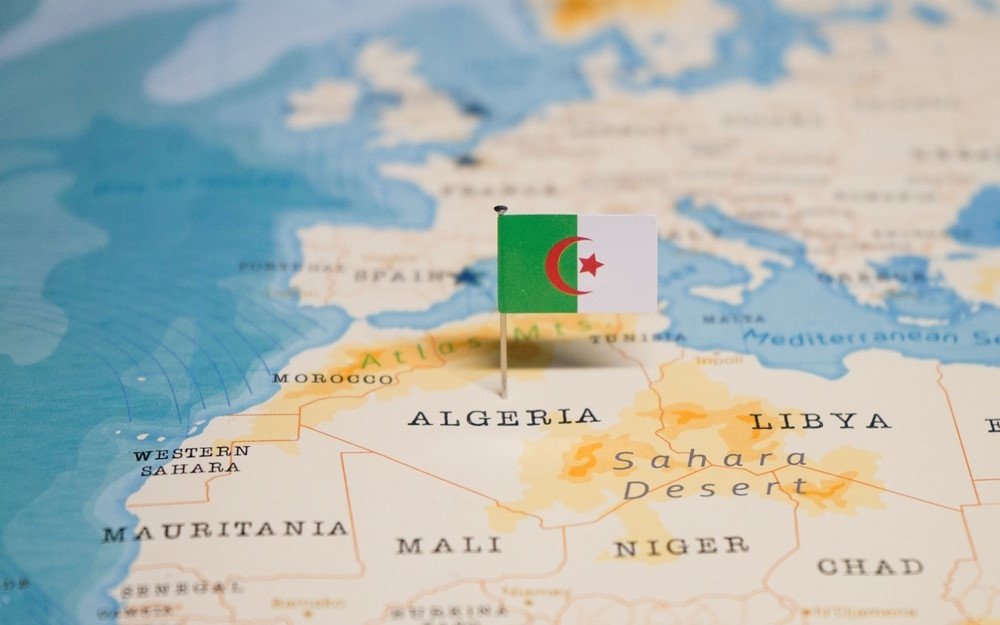
The largest country in Africa is Algeria. With an area of nearly 2.4 million square kilometers, this country in the north of the continent is over 50 times the size of the Netherlands. Since the split of Sudan in 2011, Algeria has been the undisputed number one, although nearly 90% of the country consists of desert.
Africa is a gigantic continent; it is three times the size of Europe. The countries on this list are therefore massive. For comparison: the smallest country in this top 10 is still twice the size of France.
The list is dominated by countries located in the Sahara (the north), but we also find green giants in the heart of the continent.
1. Algeria (2,381,741 km²)
The winner lies on the Mediterranean Sea, but the largest part of the interior consists of the endless sandy plains of the Sahara. It is not just sand and dunes: the UNESCO World Heritage List praises ancient Roman ruins such as Timgad, which have been perfectly preserved here in the dry climate. Algeria is also immensely rich in oil and gas, which forms the basis of its economy.
2. Democratic Republic of the Congo (2,344,858 km²)
It is a close call with number one, but the DRC (often simply called Congo) finishes in second place. This country is the opposite of Algeria: green, humid, and densely forested. The country is dominated by the Congo Basin, which according to the World Wildlife Fund houses the second-largest rainforest on Earth after the Amazon.
3. Sudan (1,861,484 km²)
For years, this was the largest country in Africa, until the south declared independence in 2011. Despite that loss, Sudan remains a giant. The Nile flows through the desert like a lifeline. Many people do not know that you can find more pyramids here than in neighboring Egypt, although they are a bit smaller and steeper than those in Giza.
4. Libya (1,759,540 km²)
Libya consists of an even larger percentage of desert than Algeria. Almost the entire population lives in a narrow strip along the coast. The country has the longest coastline on the Mediterranean of all African nations. Deep in the desert lie enormous underground water reserves (aquifers) that are pumped to coastal cities via gigantic pipelines.
5. Chad (1,284,000 km²)
Chad is located in the heart of North Africa and is landlocked. The landscape varies from the arid Sahara in the north to fertile savannas in the south. The country is named after Lake Chad, which unfortunately has shrunk dramatically in recent decades due to climate change, leaving only a fraction of its original size.
6. Niger (1,267,000 km²)
Not to be confused with Nigeria (which is much smaller). Niger is named after the Niger River that flows through the southwest. The country is known for its vast uranium reserves. The landscape is rugged and extremely hot; the Tenere region in Niger is often described as one of the most beautiful yet inhospitable desert landscapes in the world.
7. Angola (1,246,700 km²)
On the west coast of southern Africa lies Angola. It is a country rich in raw materials such as oil and diamonds, leading to a rapidly growing economy in the capital, Luanda. After a long civil war, the country is now developing into a tourist destination, with beautiful waterfalls and wildlife parks that are slowly recovering.
8. Mali (1,240,192 km²)
Mali has an incredible history. In the Middle Ages, the Mali Empire was one of the wealthiest in the world thanks to the gold trade. The legendary city of Timbuktu was once a world center of knowledge, where ancient manuscripts and libraries still testify to this rich past. Today, the north consists mainly of the Sahara and the Sahel.
9. South Africa (1,221,037 km²)
South Africa is likely the most diverse in terms of landscape on this list. From the dry Kalahari Desert to the green winelands and the rugged coastline where two oceans meet. It is the economic engine of the continent. Kruger National Park is one of the most famous places in the world to see the “Big Five” in the wild.
10. Ethiopia (1,104,300 km²)
We close the top 10 in the Horn of Africa. Ethiopia is unique because (apart from a short occupation) it was never colonized by European powers. The country is often called the cradle of humanity because the famous fossil ‘Lucy’ was found here, which changed our view of human evolution forever.
